A Complete Guide to Implementing Domain-Specific RAG
A Complete Guide to Implementing Domain-Specific RAG
While general-purpose RAG systems can answer a wide range of questions, certain industries and domains have unique requirements… -
A Complete Guide to Implementing Domain-Specific RAG
While general-purpose RAG systems can answer a wide range of questions, certain industries and domains have unique requirements: specialized vocabularies, stringent compliance rules, and complex domain knowledge. Domain-Specific Retrieval-Augmented Generation (Domain-Specific RAG) tailors every stage of the RAG pipeline — from retrieval strategies to reasoning and generation modules — to meet these specialized needs.
This guide outlines architectural patterns, domain modeling techniques, performance optimization strategies, and best practices for implementing Domain-Specific RAG. It aims to help architects, engineering leads, and senior engineers deliver AI solutions that excel in specialized fields, leveraging domain expertise for more accurate, reliable, and contextually relevant outcomes.
Core Concepts of Domain-Specific RAG
Domain-Specific RAG modifies the standard RAG architecture in ways that reflect the particularities of a given field: - Customized Embeddings & Indexes: Use domain-tuned embeddings and specialized indexing strategies to capture domain-specific terminologies, acronyms, and concepts. - Domain-Aware Reasoning: Incorporate logic, heuristics, and domain constraints that ensure answers align with industry standards or regulations. - Contextual Generation: Configure generation modules to produce responses in formats, styles, and levels of technical depth that domain experts expect.
For example, a legal RAG system might prioritize authoritative case law and statutes, apply legal reasoning frameworks, and output answers in a format that legal professionals find standard and acceptable.
Architectural Patterns & Data Flow
Reference Architecture:
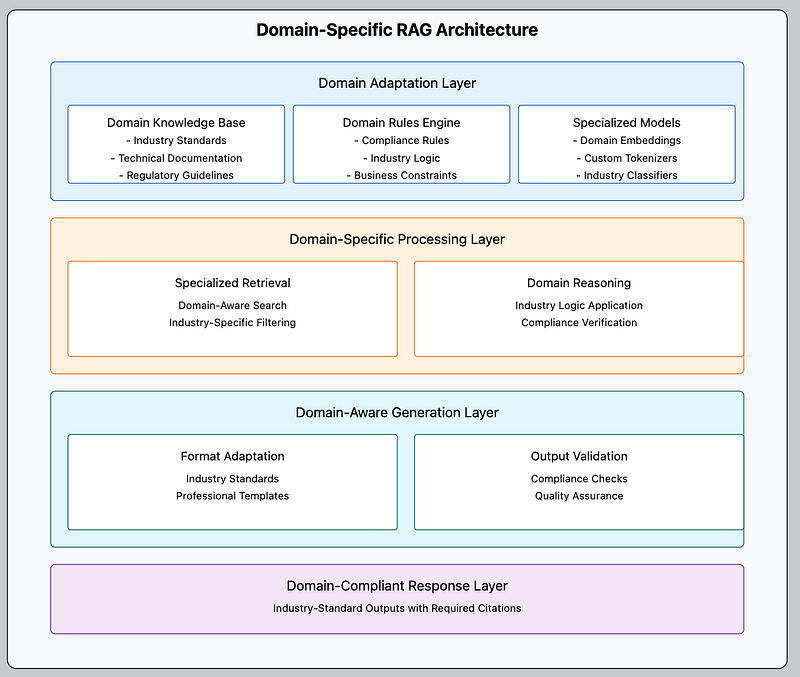
Domain Specific RAG
Data Flow:
1. Domain-Specific Query: The user poses a question requiring industry-specific knowledge (e.g., “What are the implications of the latest tax law?”). 2. Domain-Tuned Retrieval: The retrieval module uses specialized embeddings, curated corpora, and domain filters to find the most relevant documents. 3. Domain-Aware Reasoning: The reasoning module applies industry rules, logic frameworks, or best practices to synthesize retrieved information into a coherent, domain-consistent understanding. 4. Custom Generation: The generation module crafts a response that meets the domain’s stylistic and format standards. 5. Response Delivery: The final, domain-specific answer is returned to the user.
Tailoring Retrieval to the Domain
Domain-Specific Corpora: - Curate specialized documents: internal manuals, regulatory texts, technical specifications. - Maintain updated libraries of domain-relevant research papers, guidelines, or market analyses.
Specialized Embeddings & Indexing: - Use domain-adapted embeddings (e.g., fine-tune BERT or other models on domain corpora). - Implement custom tokenization that recognizes industry acronyms, formulas, or jargon. - Employ filters and metadata tags that reflect domain structures (e.g., labeling documents by regulatory category, device type, or product line).
`
class DomainSpecificRetrievalModule:
def \_\_init\_\_(self, domain\_vector\_store, domain\_filters):
self.vector\_store = domain\_vector\_store
self.domain\_filters = domain\_filters
async def retrieve(self, query: str, top\_k: int = 10) -> List\[Dict\]:
embeddings = self.\_embed\_domain\_query(query)
candidates = await self.vector\_store.similarity\_search(embeddings, top\_k=50)
filtered\_candidates = self.\_apply\_domain\_filters(candidates)
return self.\_rank\_by\_domain\_relevance(filtered\_candidates, top\_k=top\_k)
`
Domain-Aware Reasoning
Logic & Heuristics: - Integrate domain logic: financial ratios, clinical guidelines, legal reasoning templates. - Incorporate rule-based reasoning or symbolic logic to verify claims or cross-check data.
Domain Constraints & Compliance: - For heavily regulated industries, ensure reasoning respects legal constraints, safety rules, or compliance standards. - If certain information is off-limits or restricted, incorporate domain rules to filter it out.
`
class DomainAwareReasoningModule:
async def process\_context(self, docs: List\[Dict\]) -> Dict:
structured\_facts = self.\_extract\_domain\_facts(docs)
validated\_facts = self.\_apply\_domain\_logic(structured\_facts)
return {"insights": validated\_facts}
`
Specialized Generation
Domain-Specific Style: - Adapt the tone, formality, and format of responses to match industry norms (e.g., concise bullet points for engineering specs, detailed case references for legal advice). - Insert mandatory disclaimers or qualifiers that domain experts expect.
Compliance & Format: - Ensure the answer includes references to underlying regulations or standards when necessary. - Validate that the generated text matches domain formatting guidelines (e.g., standard invoice formats, ISO-compliant documents).
`
class DomainSpecificGenerationModule:
async def generate(self, reasoning\_output: Dict) -> str:
prompt = self.\_build\_domain\_prompt(reasoning\_output\["insights"\])
raw\_answer = await self.llm.generate(prompt, parameters={"max\_length": 1024})
final\_answer = self.\_ensure\_domain\_compliance(raw\_answer, reasoning\_output\["insights"\])
return final\_answer
`
Monitoring, Observability, and Maintenance
Metrics: - Domain Accuracy: Evaluate how often responses align with domain standards, regulations, or expert judgments. - Adoption Metrics: Track user satisfaction in professional settings (e.g., fewer escalations to experts, faster approval times). - Coverage of Specialized Concepts: Monitor how well the system handles the breadth of domain topics.
Logging & Tracing: - Record which domain filters or logic rules were applied per query. - Trace queries across embedding, retrieval, and reasoning steps to find where domain adaptations add value or cause latency.
Automated Maintenance: - Regularly update domain models (embeddings, rules) as industry standards change. - Retrain and refine domain embeddings or logic when new products, regulations, or terminologies appear.
Common Challenges and Solutions
Constantly Evolving Domain Knowledge: Challenge: Rapid changes in regulations or technology. Solution: Establish continuous integration pipelines that regularly update domain corpora, embeddings, and logic rules.
Ambiguous Domain Terminology: Challenge: Terms with multiple meanings in different contexts. Solution: Define controlled vocabularies, use domain ontologies, and apply disambiguation rules.
Over-Specialization: Challenge: The system might struggle with general queries outside the domain. Solution: Maintain fallback strategies that revert to generic RAG pipelines when domain signals are weak.
Lifecycle Management & MLOps Integration
- Model Versioning & Registries: Track and roll back changes to domain embeddings, filters, and reasoning heuristics as the industry landscape shifts. - CI/CD Pipelines: Run regression tests and domain-specific evaluation suites whenever domain rules or embeddings are updated. - Continuous Data & Pipeline Management: Monitor domain data ingestion, ensuring that newly published documents, standards, or guidelines are quickly integrated.Example Use Cases
Legal Research Assistants: - Retrieve and reason over legal cases, statutes, and regulatory texts. - Generate legally sound summaries or opinions aligned with jurisdictional requirements.
Healthcare Decision Support Systems: - Integrate medical guidelines, drug databases, and patient records. - Produce clinically relevant, evidence-based advice that respects privacy and compliance standards.
Manufacturing & Engineering Advisors: - Leverage technical manuals, safety regulations, and quality control procedures. - Deliver reliable engineering recommendations that improve safety and efficiency.
Conclusion
Domain-Specific RAG enhances the generic RAG framework by tailoring retrieval, reasoning, and generation to industry-specific contexts. By integrating domain-tuned embeddings, logic frameworks, and compliance rules, engineering teams can build AI solutions that deliver highly accurate, contextually rich, and trustworthy answers.
> For additional details on other type of RAGs, navigate to — [A Complete Guide to Retrieval-Augmented Generation (RAG): 16 Different Types, Their Implementation, and Use Cases](https://medium.com/aingineer/a-complete-guide-to-retrieval-augmented-generation-rag-16-different-types-their-implementation-10d48248517b)
— Gaurav
Responses