A Complete Guide to Implementing Federated RAG
A Complete Guide to Implementing Federated RAG
As organizations increasingly distribute their data and processing across multiple locations, regions, or siloed departments, the need for… -
A Complete Guide to Implementing Federated RAG
As organizations increasingly distribute their data and processing across multiple locations, regions, or siloed departments, the need for AI systems that can operate effectively in such environments becomes essential. Federated Retrieval-Augmented Generation (Federated RAG) extends the traditional RAG architecture to support distributed, secure, and policy-compliant retrieval and reasoning over data sources that may reside in separate trust domains.
This guide provides architectural patterns, design considerations, and implementation details for deploying Federated RAG systems. It aims to help architects, engineering leads, and senior engineers build scalable, resilient, and compliant solutions that leverage data across distributed infrastructures.
Core Concepts of Federated RAG
Federated RAG integrates the standard RAG modules — Retrieval, Reasoning, and Generation — within a federated framework. Instead of assuming all data is centrally located, it enables: - Federated Retrieval: Querying multiple remote or siloed data sources without aggregating them into a single location. - Localized Reasoning: Applying reasoning steps close to data sources or after securely fetching relevant subsets of data. - Policy-Aware Generation: Producing outputs that respect each data source’s privacy, access control, and compliance rules.
By operating in a federated manner, the system can leverage local compute and data storage while maintaining data governance and reducing compliance risks. For example, a global enterprise might use Federated RAG to provide unified answers to corporate users, pulling from regional document stores and adhering to each region’s data residency laws.
Architectural Patterns & Data Flow
Reference Architecture:
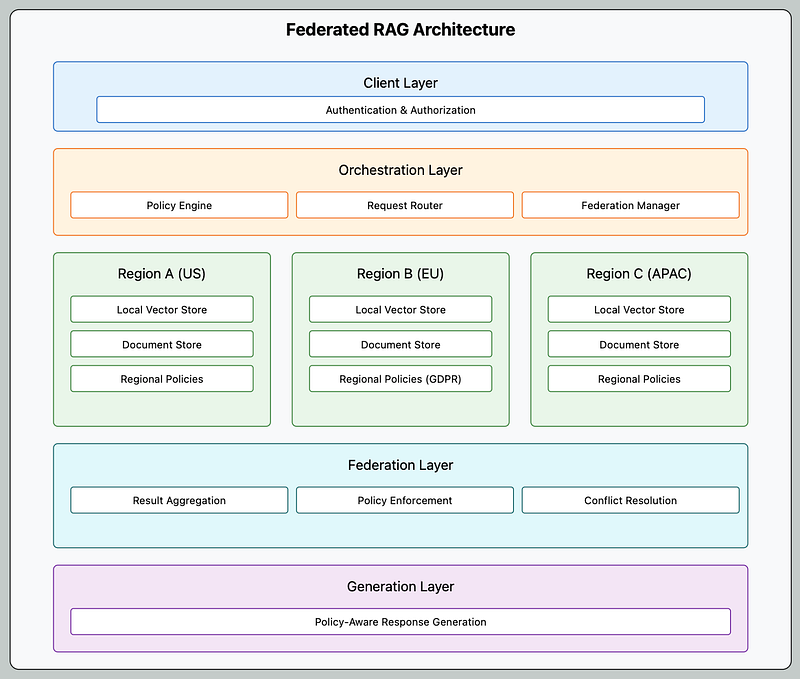
Federated RAG Architecture
#### Data Flow:
1. Incoming Query: The user queries for information that may be distributed across multiple regions or departments. 2. Federated Retrieval: The system dispatches retrieval requests to multiple nodes or gateways, each associated with a local data store. 3. Data Federation Layer: Aggregates partial results, ensuring that policies are enforced, data is properly filtered, and no unauthorized data crosses boundaries. 4. Contextual Reasoning: The Reasoning Module processes the unified, federated context to produce a coherent, policy-compliant understanding. 5. Policy-Aware Generation: The Generation Module creates an output that respects local rules and privacy constraints. 6. Response Delivery: The final answer, enriched by distributed data but compliant with all policies, is returned to the user.
Federated Retrieval: Technical Considerations
Distributed Data Sources: - Different departments, regions, or partners maintain separate document stores or vector databases. - Each data silo may have unique indexing, schemas, and performance characteristics.
Federated Retrieval Patterns: - Federated Search: Route queries to multiple endpoints and merge results. - Hierarchical Retrieval: Query a global index to identify relevant sources, then query those sources directly. - Policy-Based Routing: Apply routing rules based on data classification, user roles, or data residency laws.
Example Implementation:
`
class FederatedRetrievalGateway:
def \_\_init\_\_(self, endpoints: Dict):
# endpoints: {"us-east": {...}, "eu-central": {...}}
self.endpoints = endpoints
async def federated\_search(self, query: str, user\_roles: List\[str\]) \-> Dict:
results = {}
for region, config in self.endpoints.items():
if self.\_allowed\_to\_query(region, user\_roles):
region\_results = await self.\_query\_region(query, config)
results\[region\] = region\_results
return results
`
Data Federation Layer
The Data Federation Layer merges results from multiple retrieval nodes: - Normalization: Convert results into a common format. - Policy Enforcement: Apply filtering rules (e.g., masking PII, removing restricted documents) based on compliance requirements. - Aggregation & Ranking: Combine results, re-rank them globally, or select the most relevant subsets.
`
class DataFederationLayer:
def \_\_init\_\_(self, policies: Dict):
self.policies = policies
def aggregate\_and\_filter(self, federated\_results: Dict, user\_context: Dict) -> Dict: \# Normalize and merge results unified\_results = self.\_normalize\_results(federated\_results)
\# Apply compliance policies filtered\_results = self.\_apply\_policies(unified\_results, user\_context)
\# Rank or select top-K results ranked\_results = self.\_rank\_results(filtered\_results)
return ranked\_results
`
Reasoning with Federated Context
Once the data is aggregated and policy-checked, the Reasoning Module can: - Interpret context drawn from multiple jurisdictions or domains. - Handle conflicting information or variable data quality. - Incorporate metadata indicating data source trust levels or regulatory constraints.
Example:
`
class FederatedReasoningModule:
async def process\_context(self, unified\_context: Dict) -> Dict:
\# Extract high-level insights while considering data provenance
insights = self.\_derive\_insights(unified\_context\["documents"\])
\# If conflicting data, apply rules (e.g., prefer more recent or higher-trust sources) resolved\_insights = self.\_resolve\_conflicts(insights)
return {"insights": resolved\_insights}
`
Generation Module: Policy-Aware Outputs
The Generation Module must respect all policies and constraints:
Prompt Templates:
`
You have the following documents from multiple regions, each with specific privacy and compliance rules.
Considering only the allowed information, provide an answer to the user’s query.
`
Post-Processing: Ensure no sensitive data is leaked. If needed, redact certain passages or replace them with generic placeholders.
`
class FederatedGenerationModule:
async def generate(self, reasoning\_output: Dict) -> str:
prompt = self.\_build\_prompt(reasoning\_output\["insights"\])
raw\_response = await self.llm.generate(prompt, parameters={"max\_length":1000})
\# Post-process to ensure no policy violations
validated\_response = self.\_apply\_generation\_policies(raw\_response)
return validated\_response
`
Performance and Scalability
Caching: - Cache partial results from each region to reduce latency on repeated queries. - Store query-level metadata (e.g., last query time) to optimize federated requests.
Load Balancing: - Distribute retrieval requests across multiple federated gateways. - Employ traffic shaping to respect regional bandwidth or latency constraints.
Latency Considerations: - Use asynchronous I/O to query multiple endpoints in parallel. - Consider a timeout or fallback strategy if certain regions are slow or unavailable.
Monitoring, Observability, and Maintenance
Metrics: - Regional Latency: Track response times per region or endpoint. - Policy Violations: Count how often policy checks reject or mask data. - Data Coverage: Measure which portions of the federation are frequently queried.
Logging & Tracing: - Log which federated endpoints were queried, what data was returned, and which policies were applied. - Use distributed tracing (OpenTelemetry) to visualize cross-region request flows.
Automated Maintenance: - Periodically update policies as regulations change. - Refresh endpoints and indices if data sources are added or removed.
Security and Compliance
Access Controls: - Enforce RBAC/ABAC on a per-endpoint basis; certain user roles may only access data from certain regions. - Implement mutual TLS or OAuth 2.0 between federated services.
Encryption: - Encrypt data in transit (TLS) and at rest according to local regulations. - Use KMS (Key Management Service) to handle encryption keys, allowing region-specific key rotation.
Compliance: - Support data residency requirements by ensuring data doesn’t leave its allowed region. - Implement audit logs to prove compliance with standards like GDPR, CCPA, or HIPAA.
Common Challenges and Solutions
Policy Conflicts: Challenge: Conflicting compliance requirements across regions. Solution: Implement a policy hierarchy. For each conflict, apply the strictest policy or default to no disclosure.
Partial Responses: Challenge: Some queries can’t be fully answered due to restricted data. Solution: Provide a partial response, indicating which parts of the question can’t be addressed due to policy constraints.
Network Reliability: Challenge: Intermittent connectivity to certain endpoints. Solution: Implement retry strategies, cached fallbacks, or asynchronous queries with timeouts.
Lifecycle Management & MLOps Integration
- Model Versioning & Registries: Keep track of separate reasoning or generation models if certain regions require different tuning. - CI/CD Pipelines: Automate deployment of updated policies, retrieval endpoints, and embedding models as data federations evolve. - Continuous Data & Pipeline Management: Regularly validate the freshness and accuracy of each region’s data. Integrate with DataOps practices to maintain consistent quality as federated data sources grow.Example Use Cases
Global Corporate Knowledge Assistant: - Query documents from North American and European data centers. - Enforce GDPR compliance in EU responses while using less restricted data from the US.
Healthcare Research Portal: - Federate patient data from multiple hospitals with different compliance rules (HIPAA in the US, GDPR in the EU). - Produce research summaries without violating patient privacy regulations.
Cross-Company Collaborations: - Partner organizations share limited documents without centralizing all data. - Federated RAG ensures each partner retains control over its data and policies.
Conclusion
Federated RAG enhances RAG architectures by enabling distributed, policy-compliant data retrieval and reasoning across multiple domains. By following the architectural patterns, policy enforcement strategies, and performance optimizations detailed in this guide, engineering teams can create systems that leverage global knowledge while respecting local constraints. Federated RAG thus paves the way for broader collaboration, compliance, and scalability in enterprise AI systems.
> For additional details on other type of RAGs, navigate to — [A Complete Guide to Retrieval-Augmented Generation (RAG): 16 Different Types, Their Implementation, and Use Cases](https://medium.com/aingineer/a-complete-guide-to-retrieval-augmented-generation-rag-16-different-types-their-implementation-10d48248517b)
— Gaurav
Responses