A Complete Guide to Implementing Hybrid RAG
A Complete Guide to Implementing Hybrid RAG
RAG architectures are diverse, ranging from pure vector-based semantic search to rule-driven keyword queries or structured database… -
A Complete Guide to Implementing Hybrid RAG
RAG architectures are diverse, ranging from pure vector-based semantic search to rule-driven keyword queries or structured database lookups. Hybrid Retrieval-Augmented Generation (Hybrid RAG) blends multiple retrieval approaches, indexing schemes, or data modalities within the same pipeline. By doing so, it capitalizes on the strengths of each approach — semantic understanding, exact keyword matching, domain knowledge, structured data integration — to deliver more accurate and resilient results.
This guide outlines architectural patterns, integration strategies, performance considerations, and best practices for implementing Hybrid RAG. It aims to help architects, engineering leads, and senior engineers design solutions that adapt to a variety of content types, user needs, and query complexities.
Core Concepts of Hybrid RAG
Hybrid RAG integrates multiple retrieval methods into one pipeline: - Mix of Retrieval Paradigms: Combine vector-based semantic search with keyword-based retrieval, knowledge-graph lookups, or rule-based filters. - Adaptive Query Routing: Dynamically decide which retrieval strategies to apply based on query complexity, domain signals, or user preferences. - Multi-Source Evidence Fusion: Merge results from different retrieval methods (e.g., text documents from semantic search and structured facts from a database) to form a richer context for reasoning and generation.
For example, a Hybrid RAG system might use semantic search to understand complex user intent while also running keyword queries to ensure it doesn’t miss critical exact-match terms, then combine these results into a single cohesive answer.
Architectural Patterns & Data Flow
Reference Architecture:
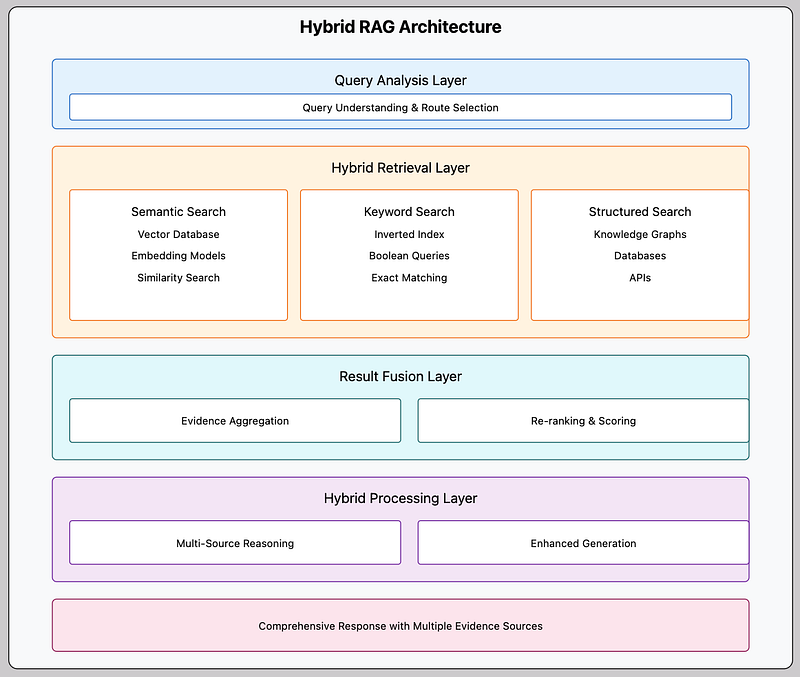
Hybrid RAG
Data Flow:
1. Incoming Query: The user submits a query that may benefit from multiple retrieval methods. 2. Hybrid Retrieval: The system runs parallel or sequential retrieval strategies (e.g., vector search and keyword search) to gather diverse candidate documents. 3. Fusion & Ranking: Merge and re-rank results, selecting the best combination of semantic matches, exact keywords, structured facts, or domain-specific data. 4. Reasoning & Generation: The reasoning module interprets the hybrid context to produce a coherent understanding, and the generation module crafts a final answer. 5. Response Delivery: The user receives an enriched, comprehensive answer.
Combining Multiple Retrieval Approaches
Retrieval Methods: - Vector-Based Semantic Search: Uses embeddings and similarity metrics to capture conceptual meaning. - Keyword/Boolean Search: Ensures exact matches, complements semantic results with precision in terminology. - Structured Queries: Leverage databases, knowledge graphs, or APIs for authoritative facts and structured data.
Integration Strategies: - Parallel Retrieval: Simultaneously query multiple indexes; merge results after retrieval. - Cascading Retrieval: Start with a broad semantic search, then refine with keyword filters or structured lookups. - Weighted Scoring: Assign different weights or confidence scores to results from each retrieval source.
Retrieval Modules in a Hybrid Setup
Each retrieval module is specialized, but they coordinate to provide a unified context:
`
class HybridRetrievalOrchestrator:
def \_\_init\_\_(self, vector\_store, keyword\_index, structured\_client):
self.vector\_store = vector\_store
self.keyword\_index = keyword\_index
self.structured\_client = structured\_client
async def retrieve(self, query: str, top\_k: int = 10) -> List\[Dict\]: vector\_results = await self.\_semantic\_search(query, top\_k=top\_k) keyword\_results = await self.\_keyword\_search(query, top\_k=top\_k) structured\_data = await self.\_structured\_lookup(query)
combined = self.\_combine\_and\_rank(vector\_results, keyword\_results, structured\_data)
return combined\[:top\_k\]
`
Reasoning & Generation with Hybrid Context
Once results from multiple retrieval methods are fused: - Evidence Alignment: Check if semantic and keyword results overlap on key points. Reinforce conclusions supported by both methods. - Conflict Resolution: If semantic and keyword searches disagree, apply logic to prioritize more authoritative sources. - Contextual Templates: Include signals in prompts that reflect which retrieval methods contributed to the final answer, improving interpretability.
`
class HybridReasoningModule:
async def process\_context(self, combined\_docs: List\[Dict\]) -> Dict:
\# Analyze commonalities between semantic and keyword hits
aligned\_facts = self.\_align\_sources(combined\_docs)
\# If structured data present, verify textual claims against it verified\_insights = self.\_verify\_with\_structured\_data(aligned\_facts)
return {"insights": verified\_insights}
`
Performance and Scalability
Efficiency Tips: - Cache frequent queries’ embeddings and keyword results. - Use partial indexing: semantic indexing for broad coverage, keyword indexes for critical terms.
Load Balancing: - Distribute vector searches across multiple nodes for parallel embedding similarity computations. - Shard keyword indexes or use inverted indexes that scale horizontally.
Throughput Management: - Implement adaptive timeouts: if vector search is slow, fallback to keyword or partial results. - Adjust top\_k dynamically based on complexity (fewer results if many retrieval methods are slow).
Monitoring, Observability, and Maintenance
Metrics: - Coverage: Measure how often multiple retrieval methods contribute to final answers. - Quality Improvements: Compare hybrid results against single-method baselines for accuracy and relevance. - Latency Impact: Track how adding multiple retrieval steps affects response times.
Logging & Tracing: - Log which retrieval methods contributed to each final answer. - Trace requests through vector, keyword, and structured lookups to identify performance bottlenecks.
Automated Maintenance: - Periodically re-train embeddings and update keyword indexes. - Revise weighting schemes as data distributions or user preferences change. -
Security and Compliance
Access Controls: - Ensure that each retrieval method respects user permissions (e.g., restricted documents not returned from keyword search). - Apply uniform policy enforcement after merging results, filtering out unauthorized content.
Encryption & Compliance: - Secure all retrieval endpoints (TLS). - For sensitive data, ensure each retrieval source adheres to compliance rules, such as masking PII at retrieval time.
Common Challenges and Solutions
Method Overlap: Challenge: Redundant results from semantic and keyword searches. Solution: Implement deduplication and re-ranking steps to avoid repetition.
Conflicting Information: Challenge: Different retrieval methods produce contradictory facts. Solution: Apply logic rules or trust hierarchies to favor authoritative or structured sources over ambiguous text.
Complex Tuning: Challenge: Balancing weights and scores from multiple retrieval sources. Solution: Use automated tuning methods or A/B testing to refine scoring parameters.
Lifecycle Management & MLOps Integration
- Model Versioning & Registries: Track changes to embedding models and keyword indexing strategies as data evolves. - CI/CD Pipelines: Automate testing with hybrid scenarios, ensuring that updates to one retrieval method don’t degrade overall performance. - Continuous Data & Pipeline Management: Monitor data drift: ensure that new document types, domain expansions, or language changes are reflected in both semantic and keyword indexes.Example Use Cases
Customer Support Assistants: - Merge semantic search of FAQs with keyword lookups of known error codes. - Provide balanced answers that address both conceptual issues and exact troubleshooting steps.
Research Portals: - Combine vector-based retrieval of research articles with exact keyword searches for specific chemical formulas or gene names. - Integrate structured scientific databases for authoritative facts.
Enterprise Knowledge Management: - Run semantic queries on wikis and keyword queries on policy documents. - Validate critical claims against a structured product catalog or compliance database.
Conclusion
Hybrid RAG offers a powerful approach to retrieval-augmented generation by blending multiple retrieval paradigms. By integrating semantic understanding, keyword precision, and structured data, engineering teams can deliver richer, more reliable answers that cater to diverse user needs and query complexities. Following the architectural patterns, integration strategies, and best practices in this guide, organizations can build flexible, resilient, and high-quality RAG solutions.
> For additional details on other type of RAGs, navigate to — [A Complete Guide to Retrieval-Augmented Generation (RAG): 16 Different Types, Their Implementation, and Use Cases](https://medium.com/aingineer/a-complete-guide-to-retrieval-augmented-generation-rag-16-different-types-their-implementation-10d48248517b)
— Gaurav
Responses