A Complete Guide to Implementing Memory-Augmented RAG
A Complete Guide to Implementing Memory-Augmented RAG
As enterprise AI systems mature, the need for contextual continuity, personalization, and adaptive learning has grown significantly… -
A Complete Guide to Implementing Memory-Augmented RAG
As enterprise AI systems mature, the need for contextual continuity, personalization, and adaptive learning has grown significantly. Memory-Augmented Retrieval-Augmented Generation (Memory-Augmented RAG) addresses these needs by introducing a memory layer that dynamically stores and reuses past interactions, decisions, and user-specific contexts.
This guide delves into technical architectures, reference patterns, and implementation details, helping architects, engineering leads, and senior engineers integrate Memory-Augmented RAG into their scalable AI platforms.
Core Concepts of Memory-Augmented RAG
Memory-Augmented RAG adds a Memory Module as a first-class component. This memory can be viewed as an additional retrieval source — one that evolves over time and is tailored to specific users, sessions, or contexts. - Retrieval Module: Fetches static knowledge from databases, vector stores, or indexed documents. - Memory Module: Maintains dynamic, contextually relevant data (session history, user preferences, intermediate reasoning steps). - Reasoning Module: Integrates both static retrieval results and memory elements to produce a contextually rich understanding. - Generation Module: Uses the enriched context from reasoning to produce coherent, personalized outputs.
This architecture enables the system to learn from ongoing interactions, delivering increasingly accurate and tailored outputs over time.
> To illustrate these concepts throughout this guide, we’ll use a practical content marketing example: a system that helps create consistent, brand-aware content while maintaining context across different marketing campaigns, brand guidelines, and past content performance metrics.
Architectural Patterns & Data Flow
A reference architecture might look like this:
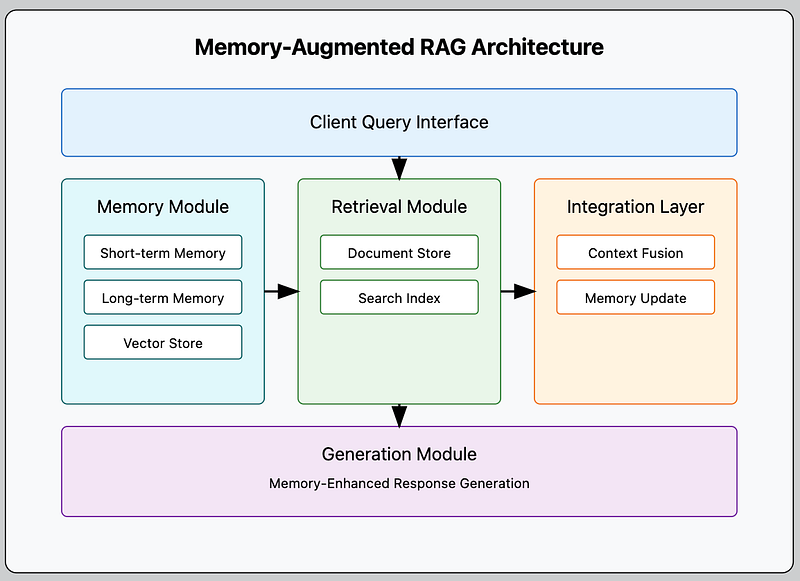
Memory Augmented RAG Architecture
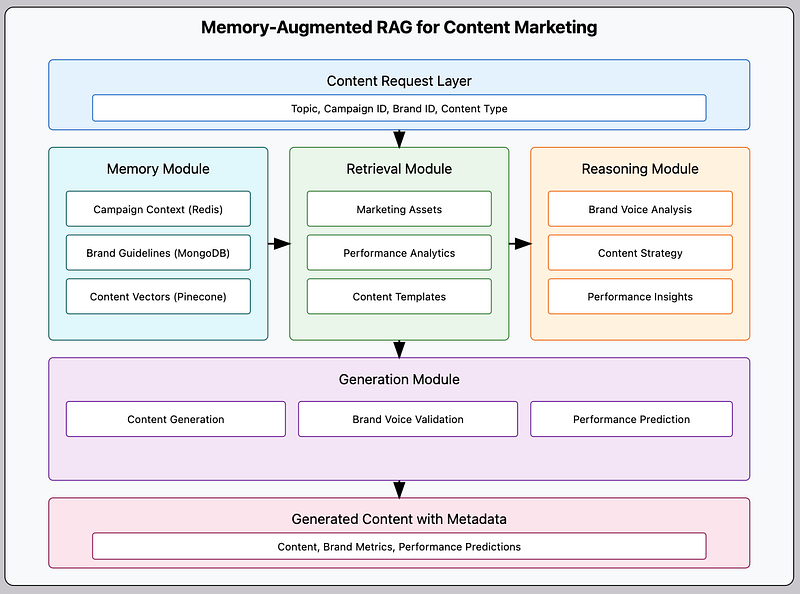
Mapping Architecture for content markeing
#### Data Flow
1. Incoming Query: A user query hits the Orchestration Layer. 2. Dual Retrieval: The system queries both the Retrieval Module (for static knowledge) and the Memory Module (for historical/contextual data). 3. Combine Results: The Reasoning Module merges static knowledge and memory-based data to form a rich context. 4. Contextual Generation: The Generation Module produces an output guided by both retrieved documents and memory context. 5. Memory Update: After producing a response, the system updates the Memory Module with new interaction details (session summaries, user feedback, etc.). 6. Response Delivery: The final, context-enriched answer is returned to the user.
Memory Module: Technical Considerations
Data Storage Options: - In-memory Databases (e.g., Redis): Ideal for short-term, session-specific memory (low latency, high throughput). - Vector Databases (e.g., Pinecone, Weaviate): Useful for semantic search over memory entries. Each memory entry is stored as an embedding. - NoSQL Datastores (e.g., MongoDB, DynamoDB): Suitable for long-term, persistent memory with indexing and partitioning for scalability.
Memory Schema: - Short-Term Memory (Session-level): Holds recent queries, system responses, intermediate reasoning steps. TTL-based eviction or session-based keys can be applied. - Long-Term Memory (User-level): Stores persistent user preferences, historical decisions, or domain-specific knowledge acquired over time. Indexed by user or context IDs.
Memory Module Implementation
`
class ContentMemoryModule:
def \_\_init\_\_(self, config: Dict):
\# Short-term memory: Recent campaigns, current content series
self.short\_term = Redis(\\config\['redis'\])
\# Long-term memory: Brand guidelines, historical performance self.long\_term = MongoDB(\\config\['mongodb'\])
\# Vector memory: Similar content, semantic relationships self.vector\_store = Pinecone(\\config\['pinecone'\])
async def retrieve\_marketing\_context( self, topic: str, brand\_id: str, campaign\_id: str ) -> Dict: \# Get campaign-specific recent context recent\_context = await self.short\_term.get( f"campaign:{campaign\_id}:context" )
\# Get brand history and guidelines brand\_context = await self.long\_term.find\_one( {"brand\_id": brand\_id} )
\# Find similar successful content content\_embedding = self.\_embed\_topic(topic) similar\_content = await self.vector\_store.query( vector=content\_embedding, filter={"brand\_id": brand\_id}, top\_k=5 )
return {
"campaign\_context": recent\_context,
"brand\_context": brand\_context,
"similar\_content": similar\_content
}
`
#### Integration Strategies - API-first Memory Service: Expose memory operations (get, put, update) via a secure REST/GraphQL endpoint. - gRPC Microservice: For low-latency, microservice-oriented architectures. - Plugin-based Integration: Use frameworks like LangChain’s memory components, adjusting interfaces to custom data stores.
Reasoning with Memory
To incorporate memory into reasoning:
1. Memory Retrieval: - Compute embeddings of the current query. - Perform a semantic similarity search against memory embeddings to fetch relevant past entries.
`
content\_context = static\_docs + memory\_results
content\_prompt = build\_prompt\_with\_history(
brand\_guidelines=content\_context\["brand\_voice"\],
recent\_content=content\_context\["campaign\_posts"\],
performance\_data=content\_context\["engagement\_metrics"\]
)Contextual Fusion:
`
- Combine static knowledge (docs from retrieval module) and memory entries.
- Form a composite context that includes relevant historical user interactions, previously provided solutions, or user preferences.
Implementation
`
class ContentReasoningModule:
async def process\_content\_context( self,
retrieval\_context: Dict,
content\_request: Dict ) -> Dict:
\# Analyze brand voice consistency
voice\_analysis = self.\_analyze\_brand\_voice(
retrieval\_context\["memory"\]\["brand\_context"\]\["voice\_guidelines"\]
)
\# Evaluate content performance patterns performance\_patterns = self.\_analyze\_performance( retrieval\_context\["metrics"\] )
\# Generate content strategy content\_strategy = self.\_generate\_strategy( voice\_analysis, performance\_patterns, content\_request )
return { "strategy": content\_strategy, "voice\_guidelines": voice\_analysis, "performance\_insights": performance\_patterns }
class ContentRetrievalModule: def \_\_init\_\_(self): self.memory = ContentMemoryModule(config) self.content\_store = ContentDatabase()
async def get\_content\_context( self, topic: str, brand\_id: str, campaign\_id: str ) -> Dict: \# Get memory context memory\_context = await self.memory.retrieve\_marketing\_context( topic, brand\_id, campaign\_id )
\# Get relevant content assets content\_assets = await self.content\_store.query( topic=topic, brand\_id=brand\_id, performance\_threshold=0.7 )
return {
"memory": memory\_context,
"assets": content\_assets,
"metrics": await self.get\_performance\_metrics(
similar\_content=memory\_context\["similar\_content"\]
)
}Model Inference:
`
- Pass the enriched input (with memory context) into a reasoning model (e.g., a transformer finetuned on multi-turn QA).
- Extract the final reasoning chain or structured intermediate outputs before generation.
`
reasoning\_model\_output = reasoning\_model(reasoning\_input)
`
Generation Module: Personalizing Outputs
The Generation Module uses the reasoning model’s output plus the memory-enriched context to produce responses: - Prompt Templates: Include placeholders for memory references:
`
\# Instead of generic template:
prompt\_template = """
Based on our brand voice ({brand\_voice}),
recent campaign content ({recent\_content}),
and performance data ({performance\_metrics}),
create a blog post about {topic} that maintains
consistency with our content strategy.
"""
`
- Post-Processing: Validate generated responses against memory constraints. For instance, ensure no conflicting information is presented if memory indicates a previous product is already shipped.
`
generation\_input = build\_generation\_prompt(reasoning\_model\_output, memory\_snippets)
generated\_response = generation\_model.generate(generation\_input, max\_length=512, temperature=0.7)
`
Implementation
`
class ContentGenerationModule:
async def generate( self,
reasoning\_output: Dict,
content\_type: str ) -> Dict:
prompt = self.\_build\_content\_prompt(
strategy=reasoning\_output\["strategy"\],
guidelines=reasoning\_output\["voice\_guidelines"\]
)
content = await self.llm.generate( prompt=prompt, parameters={ "max\_length": 2000, "temperature": 0.7, "top\_p": 0.9 } )
\# Validate brand voice compliance validated\_content = await self.\_validate\_brand\_voice( content, reasoning\_output\["voice\_guidelines"\] )
return {
"content": validated\_content,
"metadata": {
"type": content\_type,
"strategy\_used": reasoning\_output\["strategy"\],
"performance\_predictions": self.\_predict\_performance(
content,
reasoning\_output\["performance\_insights"\]
)
}
}
`
Performance and Scalability
Caching: - Cache frequently accessed memory entries (e.g., recent session data) to reduce retrieval latency. - Use a write-through or write-back strategy when updating memory stores.
Indexing: - Maintain efficient indexes on metadata fields (e.g., user\_id, session\_id) in NoSQL stores. - Update vector indexes periodically or asynchronously for memory embeddings.
Load Balancing: - Deploy multiple instances of the Memory Module behind a load balancer. - Auto-scale based on query volume and memory write operations.
Latency Considerations: - Use asynchronous I/O for memory lookups and retrieval operations. - Consider precomputing embeddings or summaries of memory entries to speed up contextual fusion.
Monitoring, Observability, and Maintenance
Metrics: - Memory Hit Rate: Ratio of queries that leverage relevant memory entries. - Latency Metrics: Time spent in memory retrieval, reasoning fusion, and generation steps. - Update Frequency: How often memory is appended or pruned.
Logging and Tracing: - Log each query and the memory entries used to provide transparency and auditability. - Use distributed tracing (e.g., OpenTelemetry) to visualize end-to-end request flow, including memory lookups.
Automated Maintenance: - Schedule periodic memory pruning tasks to remove stale data. - Implement differential storage: store only deltas to reduce memory bloat. - Regularly retrain or update embedding models to ensure semantic relevance over time.
Security and Compliance
Access Controls: - Enforce RBAC/ABAC on memory endpoints to restrict who can read or modify memory.
Encryption: - Encrypt memory data at rest (AES-256) and in transit (TLS).
Compliance: - Anonymize or tokenize sensitive user data. - Comply with regulations (GDPR, CCPA) by supporting data deletion and user consent mechanisms.
Common Challenges and Solutions
Memory Overload: - Use summarization techniques or vector-based relevance scoring to keep memory concise. e.g. Summarize past content performance while retaining key insights
Stale Context: - Implement time-to-live (TTL) and decay policies to discard old, irrelevant entries. e.g. Archive outdated brand guidelines while maintaining version history
Conflicting Information: - Apply conflict resolution strategies: recent memory entries supersede older ones, or trust high-confidence sources over ambiguous ones. e.g. Resolve conflicts between different campaign messaging
Lifecycle Management & MLOps Integration
Model Versioning & Registries: Manage and version reasoning and generation models with MLflow or SageMaker Model Registry, ensuring reproducibility and easy rollbacks.
CI/CD Pipelines: Automate embedding updates, memory schema migrations, and model deployments. Run unit and integration tests on each commit, and deploy verified models to production through a CI/CD pipeline.
Continuous Data & Pipeline Management: Regularly validate and clean memory entries, refresh vector indexes, and ensure data quality as memory grows. Incorporate DataOps best practices to maintain consistent performance as usage scales.
Examples
Content Marketing Assistant: - Maintains brand voice consistency across campaigns - Learns from content performance metrics - Adapts to audience engagement patterns - Ensures thematic consistency in content series - Optimizes content based on historical performance
Personalized Digital Assistants: - Memory stores user-specific preferences (e.g., preferred product lines) to tailor recommendations.
Continuous Learning Systems: - Memory captures successful or failed reasoning steps, allowing the system to refine prompts or reasoning logic continually.
Conclusion
Memory-Augmented RAG enhances RAG architectures by adding a dynamic memory component that enables systems to learn from and adapt to evolving contexts. By following the architectural patterns, data management strategies, performance optimizations, and security practices outlined in this guide, engineering teams can design, deploy, and maintain Memory-Augmented RAG systems at scale. This approach ensures highly contextualized, continuously improving AI-driven experiences that resonate with both enterprise needs and user expectations.
> For additional details on other type of RAGs, navigate to — [A Complete Guide to Retrieval-Augmented Generation (RAG): 16 Different Types, Their Implementation, and Use Cases](https://medium.com/aingineer/a-complete-guide-to-retrieval-augmented-generation-rag-16-different-types-their-implementation-10d48248517b)
— Gaurav
Responses