A Complete Guide to Implementing Recursive/Multi-Step RAG
A Complete Guide to Implementing Recursive/Multi-Step RAG
As AI applications become more sophisticated, the need to handle complex, multi-faceted queries and tasks grows. Recursive or Multi-Step… -
A Complete Guide to Implementing Recursive/Multi-Step RAG
As AI applications become more sophisticated, the need to handle complex, multi-faceted queries and tasks grows. Recursive or Multi-Step Retrieval-Augmented Generation (Recursive/Multi-Step RAG) enhances traditional RAG architectures by introducing iterative retrieval and reasoning processes. This approach allows the system to break down complex problems into manageable sub-tasks, recursively retrieving and refining information to produce accurate and comprehensive answers.
This guide outlines architectural patterns, iterative processing strategies, performance considerations, and best practices for implementing Recursive/Multi-Step RAG. It aims to help architects, engineering leads, and senior engineers design scalable, intelligent systems capable of deep reasoning and complex problem-solving through recursive augmentation.
Core Concepts of Recursive/Multi-Step RAG
Recursive/Multi-Step RAG extends the standard RAG framework by incorporating iterative processes that handle complex queries through multiple retrieval and reasoning cycles: - Iterative Retrieval: Perform multiple rounds of information retrieval, each informed by the outcomes of previous steps. - Stepwise Reasoning: Decompose complex queries into sub-questions or sub-tasks, addressing each iteratively to build a comprehensive answer. - Contextual Refinement: Continuously refine the context based on intermediate results, ensuring that each retrieval step is more targeted and relevant. - Error Correction & Validation: Incorporate mechanisms to detect and correct errors or inconsistencies during the recursive process.
For example, a Recursive RAG system tasked with planning a detailed project might first retrieve high-level guidelines, then iteratively delve into specific sections such as budgeting, scheduling, and resource allocation, refining each aspect through multiple retrieval and reasoning cycles.
Architectural Patterns & Data Flow
Reference Architecture:
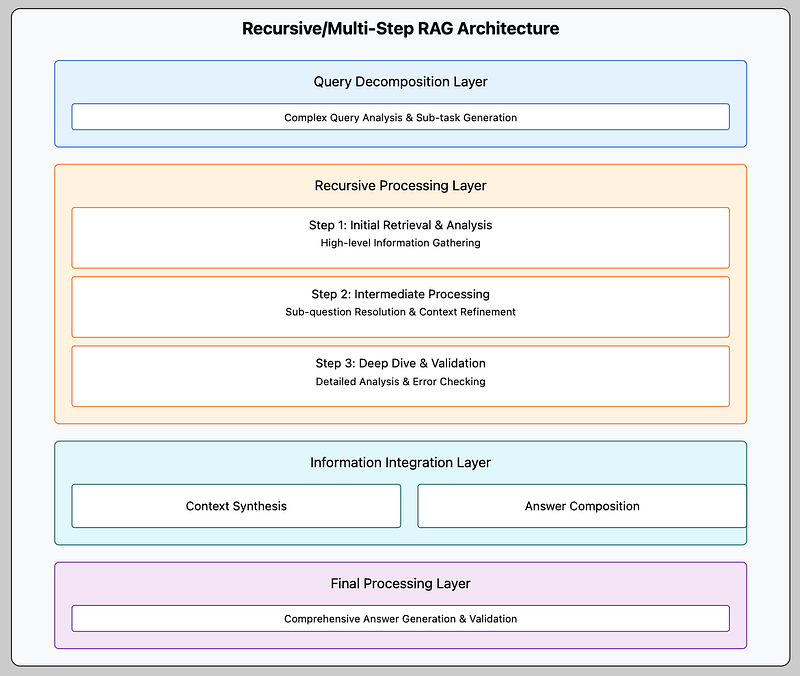
Recursive/Multi-Step RAG
Data Flow:
1. Complex Query: The user submits a multi-faceted or complex query requiring detailed reasoning. 2. Initial Retrieval & Reasoning: The system conducts an initial retrieval of relevant documents and performs preliminary reasoning to identify sub-questions or areas needing further exploration. 3. Iterative Retrieval & Refinement: Based on the initial reasoning, the system recursively retrieves additional information, addressing each sub-question or refining the context in successive steps. 4. Final Reasoning & Generation: After multiple iterations, the system synthesizes all gathered information to generate a comprehensive, accurate, and coherent final answer. 5. Response Delivery: The final answer is returned to the user, encapsulating the results of the recursive retrieval and reasoning process.
Iterative Retrieval & Reasoning Process
Key Techniques: - Query Decomposition: Break down complex queries into manageable sub-questions or tasks. - Feedback Loops: Use outputs from each reasoning step to inform subsequent retrievals. - Context Accumulation: Maintain and update a growing context that encapsulates all intermediate findings and reasoning steps. - Termination Criteria: Define conditions to stop the iterative process, such as reaching a predefined number of steps or achieving sufficient answer confidence.
Integration Strategies: - Hierarchical Processing: Structure the retrieval and reasoning steps in a hierarchical manner, addressing broader topics first before delving into specifics. - Dependency Tracking: Keep track of dependencies between sub-questions to ensure logical coherence and avoid redundant retrievals. - Parallel vs. Sequential Iterations: Decide whether to handle multiple sub-questions in parallel or process them sequentially based on dependencies and resource constraints.
Implementing Iterative Retrieval Modules
Each iteration involves retrieving relevant information based on the refined context from previous steps:
`
class RecursiveRetrievalModule:
def \_\_init\_\_(self, vector\_store, keyword\_search, llm):
self.vector\_store = vector\_store
self.keyword\_search = keyword\_search
self.llm = llm
async def iterative\_retrieve(self, initial\_query: str, max\_steps: int = 5) -> List\[Dict\]: context = "" query = initial\_query retrieved\_documents = \[\]
for step in range(max\_steps): \# Retrieve documents based on the current query and context combined\_query = f"{query}\\nContext: {context}" docs = await self.vector\_store.similarity\_search(self.\_embed(combined\_query), top\_k=10) retrieved\_documents.extend(docs)
\# Generate sub-questions or refine context using LLM sub\_questions = await self.\_generate\_sub\_questions(docs, context)
if not sub\_questions: break
\# Update context and prepare for next iteration context += " " + " ".join(sub\_questions) query = " ".join(sub\_questions)
return retrieved\_documents
async def \_generate\_sub\_questions(self, docs: List\[Dict\], context: str) -> List\[str\]:
prompt = f"Based on the following documents and context, generate a list of sub-questions to further explore the topic:\\nDocuments: {docs}\\nContext: {context}"
response = await self.llm.generate(prompt)
return self.\_parse\_sub\_questions(response)
`
Reasoning & Generation with Recursive Context
After gathering documents through multiple retrieval steps, the reasoning and generation modules synthesize the information: - Contextual Synthesis: Combine information from all retrieved documents to form a unified understanding. - Iterative Refinement: Continuously refine the answer as more information is integrated. - Coherence & Consistency: Ensure the final answer maintains logical flow and consistency, addressing all aspects of the original query.
`
class RecursiveReasoningModule:
async def process\_documents(self, retrieved\_docs: List\[Dict\], initial\_query: str) -> Dict:
\# Synthesize information from all documents
synthesized\_info = self.\_synthesize(retrieved\_docs, initial\_query)
\# Apply domain-specific logic or constraints refined\_insights = self.\_apply\_domain\_logic(synthesized\_info)
return {"insights": refined\_insights}
class RecursiveGenerationModule:
async def generate\_final\_answer(self, reasoning\_output: Dict, initial\_query: str) -> str:
prompt = self.\_build\_final\_prompt(reasoning\_output\["insights"\], initial\_query)
final\_answer = await self.llm.generate(prompt, parameters={"max\_length": 1500})
return final\_answer
`
Performance and Scalability
Efficiency Tips: - Caching Intermediate Results: Cache outputs from each retrieval and reasoning step to avoid redundant processing. - Optimized Embeddings: Use efficient embedding models and vector stores that support fast similarity searches. - Resource Allocation: Allocate resources dynamically based on the complexity and depth of iterative steps.
Load Balancing: - Distributed Retrieval: Distribute retrieval tasks across multiple nodes to handle high query volumes. - Parallel Processing: Where possible, perform retrieval and reasoning steps in parallel to reduce overall latency.
Throughput Management: - Adaptive Iteration Limits: Adjust the number of iterative steps based on real-time performance metrics and query complexity. - Batch Processing: Group similar queries and process them together to optimize resource usage.
Monitoring, Observability, and Maintenance
Metrics: - Iteration Depth: Track the number of iterative steps taken per query. - Response Quality: Measure accuracy and relevance of answers through user feedback and validation datasets. - Latency Metrics: Monitor end-to-end response times, including each iterative step. - Resource Utilization: Assess CPU, memory, and network usage to ensure efficient operation.
Logging & Tracing: - Step-by-Step Logs: Record each retrieval and reasoning step for auditing and debugging purposes. - Distributed Tracing: Use tools like OpenTelemetry to visualize the flow of data through recursive steps. - Error Tracking: Monitor for failures or inconsistencies at any iteration to enable rapid remediation.
Automated Maintenance: - Periodic Retraining: Regularly update embedding models and reasoning logic to incorporate new data and improve performance. - Dynamic Indexing: Continuously update and optimize retrieval indexes based on usage patterns and data changes. - Health Checks: Implement automated health checks for each component in the recursive pipeline to ensure reliability.
Security and Compliance
Access Controls: - Role-Based Access: Ensure that only authorized users can initiate or access certain types of queries and data. - Data Segmentation: Segregate data based on sensitivity and apply appropriate access restrictions during retrieval.
Encryption & Compliance: - Data Encryption: Encrypt all data at rest and in transit to protect against unauthorized access. - Compliance Adherence: Ensure the system complies with relevant regulations (e.g., GDPR, HIPAA) by implementing necessary data handling and privacy controls. - Audit Trails: Maintain comprehensive logs of all retrieval and reasoning steps for compliance auditing and forensic analysis.
Common Challenges and Solutions
Complexity Management: - Challenge: Managing multiple iterative steps can increase system complexity and maintenance overhead. - Solution: Modularize components, use clear interfaces, and implement comprehensive documentation and testing practices to manage complexity.
Error Propagation: - Challenge: Errors or inaccuracies in early iterations can propagate and compound in later steps. - Solution: Implement validation and error-checking mechanisms at each step to catch and correct errors before they propagate.
Latency Concerns: - Challenge: Multiple retrieval and reasoning steps can introduce significant latency. - Solution: Optimize each component for performance, use parallel processing where possible, and implement adaptive iteration limits to balance accuracy with responsiveness.
Resource Constraints: - Challenge: Recursive processes can be resource-intensive, potentially leading to scalability issues. - Solution: Employ efficient resource management strategies, such as dynamic scaling, caching, and optimized data storage solutions.
Lifecycle Management & MLOps Integration
Model Versioning & Registries: - Track and manage versions of embedding models, LLMs, and reasoning algorithms to ensure reproducibility and facilitate rollbacks if necessary.
CI/CD Pipelines: - Automate the deployment of updates to retrieval and reasoning modules. - Implement automated testing for multi-step scenarios to ensure changes do not degrade performance or accuracy.
Continuous Data & Pipeline Management: - Monitor data ingestion and indexing processes to ensure data freshness and relevance. - Integrate with DataOps practices to maintain high data quality and pipeline reliability as the system scales.
Automated Testing: - Develop comprehensive test suites that simulate complex, multi-step queries to validate the system’s performance and accuracy under various scenarios.
Example Use Cases
Complex Research Assistants: - Assist researchers by iteratively breaking down complex scientific questions, retrieving relevant studies, and synthesizing comprehensive literature reviews.
Strategic Business Planning Tools: - Help organizations develop detailed business strategies by recursively analyzing market data, financial reports, and internal documents to generate actionable insights.
Advanced Legal Advisors: - Support legal professionals by iteratively exploring case law, statutes, and legal precedents to provide thorough and well-reasoned legal opinions.
Technical Support Systems: - Guide users through multi-step troubleshooting processes by recursively addressing each layer of technical issues, ensuring comprehensive problem resolution.
Conclusion
Recursive/Multi-Step RAG elevates traditional Retrieval-Augmented Generation by enabling iterative retrieval and reasoning processes that handle complex, multi-faceted queries with greater accuracy and depth. By decomposing challenges into manageable sub-tasks, refining context through each iteration, and maintaining continuity across multi-step interactions, engineering teams can build intelligent systems capable of deep reasoning and comprehensive problem-solving. Following the architectural patterns, iterative strategies, and best practices outlined in this guide, organizations can harness the full potential of Recursive/Multi-Step RAG to deliver sophisticated, reliable, and contextually aware AI-driven solutions.
> For additional details on other type of RAGs, navigate to — [A Complete Guide to Retrieval-Augmented Generation (RAG): 16 Different Types, Their Implementation, and Use Cases](https://medium.com/aingineer/a-complete-guide-to-retrieval-augmented-generation-rag-16-different-types-their-implementation-10d48248517b)
— Gaurav
Responses