AI-assisted, not AI-generated: The New Imperative for Today’s Professionals
AI-assisted, not AI-generated: The New Imperative for Today’s Professionals
In the past year, I’ve deeply immersed myself in the generative AI ecosystem. From ChatGPT and Claude to Gemini, from Runway to Eleven… -
AI-assisted, not AI-generated: The New Imperative for Today’s Professionals
In the past year, I’ve deeply immersed myself in the generative AI ecosystem. From ChatGPT and Claude to Gemini, from Runway to Eleven Labs, and recently NotebookLM — these tools haven’t just entered my workflow; they’ve transformed it entirely.
Yet, I still frequently hear dismissive remarks:
> “It’s just AI-generated content.”
> “Oh, ChatGPT wrote that.”
> “AI isn’t sophisticated enough.”
> “It gets you 90% there but fails at the crucial 10%.”
These reactions betray a fundamental misunderstanding of today’s technological landscape.
New Tool
It’s imperative to recognize that it’s a tool, and AI tools like ChatGPT are not adversaries but allies. They assist us in performing our jobs more efficiently by eliminating mundane tasks and workflows. This liberation allows us to dedicate more time to critical thinking and creative endeavors — the very areas where human expertise is unmatched.
In my own experience, AI tools have become a cornerstone of my daily routine. They automate reviews, organize my week, structure my calendar, generate weekly reports, and even provide constructive feedback. They’ve become so integrated that they serve as proxies, delivering end-of-day summaries of my learnings and areas for improvement — a true embodiment of continuous learning.
The Cost of Resistance
Yet, it perplexes me when I come across proposals that lack polish or pull requests that don’t meet established standards. Such instances suggest a failure to leverage available technology to one’s advantage. Every development practice is rife with repetitive and redundant tasks. Neglecting to use AI for automation and generation isn’t just a missed opportunity; it’s a step backward in a rapidly progressing field.
When someone says, “It’s AI-generated,” we should reframe it as “AI-assisted.” After all, we don’t criticize mathematicians for using calculators or architects for using CAD software. Why should we stigmatize tools that enhance our cognitive capabilities?
> The Future Belongs to the Adaptable — I’m convinced that while AI will reshape the professional landscape, it won’t displace those who embrace it — instead, it will elevate them to unprecedented levels of productivity and innovation.
Breaking the Adoption Barrier: 5 Strategic Steps
If you’re struggling to integrate AI into your workflow, here’s a structured approach:
Embrace an AI-First Mindset - Make AI integration a conscious priority - Identify high-impact areas for initial implementation - Start with small, manageable changes
Commit to Continuous Learning - Stay current with AI developments in your field - Invest in targeted learning resources - Follow industry leaders and their AI adoption strategies
Practice Through Experimentation - Test different AI tools systematically - Customize solutions to your specific needs - Learn from both successes and failures
Build a Collaborative Network - Connect with AI-forward professionals - Share experiences and best practices - Learn from others’ implementation journeys
Implement Feedback Loops - Regularly assess AI integration impact - Document improvements and challenges - Adjust strategies based on outcomes
The Key to Getting Started
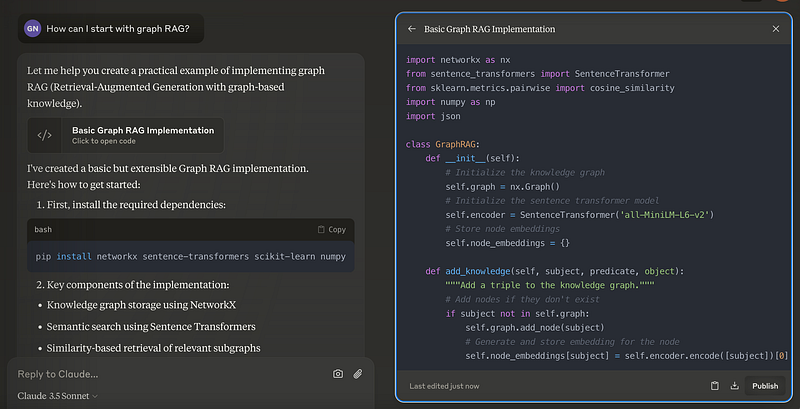
Remember this crucial insight: the barrier to entry has never been lower. The key to learning this technology is simply to ask for it. How can I start with graph RAG? Need to optimize your coding workflow? Looking to automate documentation? Just ask.
> The tools are ready. The question is: are you?
— Gaurav
Responses