Building AI Agents with Claude 3.7: A Comprehensive Guide (Part 1)
Building AI Agents with Claude 3.7: A Comprehensive Guide (Part 1)
I’ve been thoroughly impressed by Claude 3.7’s capabilities beyond just code generation. After watching Anthropic’s official announcement… -
Building AI Agents with Claude 3.7: A Comprehensive Guide (Part 1)
I’ve been thoroughly impressed by Claude 3.7’s capabilities beyond just code generation. After watching Anthropic’s [official announcement](https://www.anthropic.com/news/claude-3-7-sonnet) showcasing the model’s enhanced reasoning abilities, I wanted to explore what could be achieved using it as the foundation for autonomous AI agents, beyond just the code. What started as casual experimentation quickly evolved into a deeper exploration of building agents without relying on specialized frameworks.
This two-part guide shares everything I’ve learned along the way. Whether you’re new to AI agents or looking to build more sophisticated solutions without the constraints of existing frameworks, you’ll find practical concepts, architecture patterns, and complete implementation examples that leverage Claude 3.7’s unique strengths.
> Part 1: Core concepts and architecture — designing intelligent agents with memory, planning capabilities, and decision-making frameworks. -
> Part 2: Complete implementation of a Deep Research Agent — with full code for creating an AI that can plan research, analyze documents, synthesize findings, and generate insights.
What Are AI Agents?
AI agents are autonomous or semi-autonomous systems designed to perform specific tasks with minimal human intervention. Unlike simple chatbots, these agents are built to: - Maintain persistent goals: Retain state and context across multiple interactions. - Plan and execute operations: Break down complex tasks into actionable steps. - Integrate external tools: Leverage APIs and software tools for enhanced functionality. - Make contextual decisions: Adapt responses based on environmental and historical context. - Learn from feedback: Continuously improve through iterative interactions.
The ideal AI agent combines Claude 3.7’s powerful language capabilities with specialized knowledge and tool integrations to solve specific problems within a defined domain.
Why Claude 3.7 Is Ideal for Building Agents
Claude 3.7 Sonnet brings several critical improvements that make it particularly well-suited for agent development:
1. Enhanced reasoning capabilities: Claude 3.7 demonstrates superior performance on complex reasoning tasks, allowing agents to make more nuanced decisions. 2. Improved tool use: The model can more effectively understand how to use external tools and APIs, creating more capable agents. 3. Better contextual understanding: Claude 3.7 maintains coherent understanding across longer contexts, enabling agents to handle complex, multi-step tasks. 4. Reduced hallucination: Compared to previous models, Claude 3.7 shows improved factual accuracy, reducing the risk of agents making decisions based on incorrect information. 5. Advanced coding capabilities: For development-oriented agents, Claude 3.7’s improved code generation enables more sophisticated automation.
Key Components of an Effective AI Agent
#### 1\. Clear Purpose and Scope
Begin with a crystal-clear definition of your agent’s objectives. Identify: - Problem Domain: What challenge is the agent solving? - Core Functions: Which tasks will the agent perform? - Success Metrics: How will you measure performance and outcomes? - Boundaries: What are the operational limitations and ethical considerations?
Example: A research assistant agent might autonomously search academic databases, extract key findings, and generate literature reviews based on user queries.
#### 2\. Memory and Persistence
For true conversational depth, your agent must remember past interactions. Implement both short-term and long-term memory systems:
`
class AgentMemory:
def \_\_init\_\_(self):
self.working\_memory = \[\] \# Short-term context
self.long\_term\_memory = {} \# Persistent information
def store(self, information, importance=0): self.working\_memory.append(information) if importance > 7: \# Store important information long-term self.long\_term\_memory\[information\["key"\]\] = information
def retrieve(self, query, context):
\# Implement retrieval logic based on relevance to query and context
relevant\_items = \[\]
for item in self.working\_memory + list(self.long\_term\_memory.values()):
if self.\_is\_relevant(item, query, context):
relevant\_items.append(item)
return relevant\_items
`
#### 3\. Tool Integration Framework
Enhance your agent’s capabilities by integrating external tools and APIs. A flexible toolkit framework can manage these integrations seamlessly:
`
class ToolKit:
def \_\_init\_\_(self):
self.available\_tools = {}
def register\_tool(self, name, function, description, required\_params): self.available\_tools\[name\] = { "function": function, "description": description, "required\_params": required\_params }
def use\_tool(self, tool\_name, parameters): if tool\_name not in self.available\_tools: return {"error": f"Tool {tool\_name} not found"}
tool = self.available\_tools\[tool\_name\]
\# Validate parameters for param in tool\["required\_params"\]: if param not in parameters: return {"error": f"Missing required parameter: {param}"}
\# Execute tool function
try:
result = tool\["function"\](\\parameters)
return {"success": True, "result": result}
except Exception as e:
return {"error": str(e)}
`
4\. Planning and Execution Engine
Develop agents that can create detailed multi-step plans and execute them effectively:
`
class PlanningEngine:
def \_\_init\_\_(self, claude\_client, toolkit):
self.claude = claude\_client
self.toolkit = toolkit
def create\_plan(self, goal, constraints=None): \# Use Claude 3.7 to generate a multi-step plan prompt = self.\_construct\_planning\_prompt(goal, constraints) response = self.claude.messages.create( model="claude-3-7-sonnet-20250219", max\_tokens=2000, system="You are a planning assistant that creates detailed step-by-step plans.", messages=\[{"role": "user", "content": prompt}\] )
\# Parse the response into structured plan steps return self.\_parse\_plan(response.content)
def execute\_plan(self, plan): results = \[\] for step in plan\["steps"\]: \# Use Claude to determine how to execute each step execution\_prompt = self.\_construct\_execution\_prompt(step, results) execution\_decision = self.claude.messages.create( model="claude-3-7-sonnet-20250219", max\_tokens=1000, messages=\[{"role": "user", "content": execution\_prompt}\] )
\# If the step requires a tool, execute it if step\["requires\_tool"\]: tool\_result = self.toolkit.use\_tool( step\["tool\_name"\], step\["tool\_parameters"\] ) results.append({"step": step, "result": tool\_result}) else: \# Some steps might just need Claude to process information results.append({"step": step, "result": execution\_decision.content})
return results
`
#### 5\. Decision-Making Framework
Agent effectiveness depends on making good decisions based on available information:
`
class DecisionEngine:
def \_\_init\_\_(self, claude\_client):
self.claude = claude\_client
def make\_decision(self, options, context, criteria): decision\_prompt = f""" Context: {context}
Available options: {self.\_format\_options(options)}
Decision criteria: {self.\_format\_criteria(criteria)}
Analyze each option against the criteria and select the best option. Explain your reasoning for each criterion and provide your final decision. """
response = self.claude.messages.create( model="claude-3-7-sonnet-20250219", max\_tokens=1500, messages=\[{"role": "user", "content": decision\_prompt}\] )
decision = self.\_parse\_decision(response.content)
return decision
`
Building Your First Claude 3.7 Agent
Now let’s combine these components to build a complete agent:
`
import anthropic
from typing import Dict, List, Any
class Claude37Agent: def \_\_init\_\_(self, api\_key, agent\_name, agent\_purpose): self.client = anthropic.Anthropic(api\_key=api\_key) self.name = agent\_name self.purpose = agent\_purpose self.memory = AgentMemory() self.toolkit = ToolKit() self.planner = PlanningEngine(self.client, self.toolkit) self.decision\_engine = DecisionEngine(self.client)
\# Register built-in tools self.\_register\_default\_tools()
def \_register\_default\_tools(self): \# Register some default tools like web search, calculator, etc. pass
def process\_input(self, user\_input: str) -> Dict\[str, Any\]: \# Store the user input in memory self.memory.store({"type": "user\_input", "content": user\_input})
\# Analyze the input to determine intent intent = self.\_analyze\_intent(user\_input)
if intent\["type"\] == "question": \# Direct question - simple response return self.\_generate\_response(user\_input)
elif intent\["type"\] == "task": \# Task request - requires planning and execution plan = self.planner.create\_plan(user\_input) execution\_results = self.planner.execute\_plan(plan) return self.\_summarize\_execution(execution\_results)
elif intent\["type"\] == "clarification": \# Need more information return {"type": "clarification", "questions": intent\["clarification\_questions"\]}
def \_analyze\_intent(self, user\_input: str) -> Dict\[str, Any\]: \# Use Claude 3.7 to determine the user's intent intent\_prompt = f""" Analyze the following user input and determine the intent:
User input: "{user\_input}"
Possible intents: 1. Question - The user is asking for information 2. Task - The user wants something done 3. Clarification - More information is needed
For each intent type, provide a confidence score (0-100). If clarification is needed, provide specific questions to ask. """
response = self.client.messages.create( model="claude-3-7-sonnet-20250219", max\_tokens=1000, messages=\[{"role": "user", "content": intent\_prompt}\] )
\# Parse the response to extract intent return self.\_parse\_intent(response.content)
def \_generate\_response(self, query: str) -> Dict\[str, Any\]: \# Retrieve relevant context from memory context = self.memory.retrieve(query, self.\_get\_current\_context())
response = self.client.messages.create( model="claude-3-7-sonnet-20250219", max\_tokens=2000, system=f"You are {self.name}, an AI agent designed to {self.purpose}.", messages=\[ {"role": "user", "content": f"Context: {context}\\n\\nQuery: {query}"} \] )
\# Store the response in memory self.memory.store({"type": "agent\_response", "content": response.content})
return {"type": "response", "content": response.content}
def \_get\_current\_context(self): \# Implement logic to determine current context pass
def \_parse\_intent(self, claude\_response: str) -> Dict\[str, Any\]: \# Implement parsing logic pass
def \_summarize\_execution(self, execution\_results: List\[Dict\[str, Any\]\]) -> Dict\[str, Any\]: \# Summarize the results of executing a plan summary\_prompt = f""" Summarize the following execution results in a clear, concise way:
{execution\_results}
Focus on: 1. Whether the overall task was completed successfully 2. Key outcomes and findings 3. Any issues encountered 4. Next steps or recommendations """
summary = self.client.messages.create( model="claude-3-7-sonnet-20250219", max\_tokens=1500, messages=\[{"role": "user", "content": summary\_prompt}\] )
return {"type": "execution\_summary", "content": summary.content}
`
Advanced Agent Architectures
#### Multi-Agent Systems
For more sophisticated applications, consider breaking down tasks across multiple specialized agents. An Agent Coordinator can assign and synthesize subtasks:
`
class AgentCoordinator:
def \_\_init\_\_(self, api\_key):
self.client = anthropic.Anthropic(api\_key=api\_key)
self.agents = {}
def register\_agent(self, agent\_id, agent): self.agents\[agent\_id\] = agent
def coordinate\_task(self, task): \# Determine which agents should handle which parts of the task task\_allocation = self.\_allocate\_tasks(task)
results = {} for agent\_id, subtask in task\_allocation.items(): if agent\_id in self.agents: results\[agent\_id\] = self.agents\[agent\_id\].process\_input(subtask)
\# Synthesize results from multiple agents synthesis = self.\_synthesize\_results(results) return synthesis
def \_allocate\_tasks(self, task): \# Use Claude 3.7 to break down the task for different agents allocation\_prompt = f""" Task: {task}
Available agents: {self.\_format\_agents()}
Allocate appropriate subtasks to each agent based on their specialties. """
allocation\_response = self.client.messages.create( model="claude-3-7-sonnet-20250219", max\_tokens=1500, messages=\[{"role": "user", "content": allocation\_prompt}\] )
return self.\_parse\_allocation(allocation\_response.content)
def \_format\_agents(self): \# Format the list of available agents with their purposes formatted = "" for agent\_id, agent in self.agents.items(): formatted += f"- {agent\_id}: {agent.name} (Purpose: {agent.purpose})\\n" return formatted
def \_parse\_allocation(self, allocation\_text): \# Parse the allocation response into a structured format pass
def \_synthesize\_results(self, agent\_results): \# Synthesize results from multiple agents into a coherent response synthesis\_prompt = f""" Synthesize the following results from multiple agents into a coherent response:
{agent\_results} """
synthesis = self.client.messages.create( model="claude-3-7-sonnet-20250219", max\_tokens=2000, messages=\[{"role": "user", "content": synthesis\_prompt}\] )
return synthesis.content
`
#### Reflexive Agents
Agents can also be designed to self-reflect and optimize their performance over time. A Reflexive Agent logs interactions and uses periodic reviews to improve its behavior:
`
class ReflexiveAgent(Claude37Agent):
def \_\_init\_\_(self, api\_key, agent\_name, agent\_purpose):
super().\_\_init\_\_(api\_key, agent\_name, agent\_purpose)
self.performance\_log = \[\]
def process\_input(self, user\_input: str) -> Dict\[str, Any\]: \# Process the input normally result = super().process\_input(user\_input)
\# Log the interaction self.performance\_log.append({ "input": user\_input, "output": result, "timestamp": time.time() })
\# Periodically reflect on performance if len(self.performance\_log) % 10 == 0: self.\_reflect\_on\_performance()
return result
def \_reflect\_on\_performance(self): \# Use Claude 3.7 to analyze recent interactions recent\_interactions = self.performance\_log\[-10:\]
reflection\_prompt = f""" Review the following recent interactions and analyze performance:
{recent\_interactions}
For each interaction: 1. Was the response appropriate and helpful? 2. Were there missed opportunities or misunderstandings? 3. How could the response have been improved?
Provide specific recommendations for improvement. """
reflection = self.client.messages.create( model="claude-3-7-sonnet-20250219", max\_tokens=2000, messages=\[{"role": "user", "content": reflection\_prompt}\] )
\# Extract improvement strategies improvements = self.\_parse\_improvements(reflection.content)
\# Update agent behavior based on reflection self.\_implement\_improvements(improvements)
def \_parse\_improvements(self, reflection): \# Parse the reflection response to extract improvement strategies pass
def \_implement\_improvements(self, improvements):
\# Update agent behavior based on reflection
\# This could involve adjusting prompts, thresholds, etc.
pass
`
Deploying Claude 3.7 Agents in Production
#### Infrastructure Considerations
When deploying Claude 3.7 agents in production, consider:
1. Scalability: Implement proper queue management for handling multiple concurrent requests. 2. Latency management: Optimize prompt design and response handling to minimize response times. 3. Cost optimization: Implement caching strategies and token usage monitoring to control API costs. 4. Monitoring and logging: Set up comprehensive monitoring to track agent performance, errors, and usage patterns.
`
\# Example of a simple production-ready agent wrapper with monitoring
import time
import logging
from typing import Dict, Any
class ProductionAgent: def \_\_init\_\_(self, agent, logger=None): self.agent = agent self.logger = logger or logging.getLogger(\_\_name\_\_) self.request\_times = \[\] self.error\_count = 0 self.total\_requests = 0
async def handle\_request(self, user\_input: str) -> Dict\[str, Any\]: self.total\_requests += 1 start\_time = time.time()
try: \# Process the request with the underlying agent result = await self.agent.process\_input(user\_input)
\# Log success request\_time = time.time() - start\_time self.request\_times.append(request\_time) self.logger.info(f"Request processed in {request\_time:.2f}s")
\# Basic monitoring if len(self.request\_times) >= 100: avg\_time = sum(self.request\_times) / len(self.request\_times) error\_rate = self.error\_count / self.total\_requests self.logger.info(f"Recent performance: Avg time: {avg\_time:.2f}s, Error rate: {error\_rate:.2%}")
\# Reset for next window self.request\_times = \[\]
return result
except Exception as e: \# Log error self.error\_count += 1 self.logger.error(f"Error processing request: {str(e)}")
\# Return graceful error response
return {
"error": "An error occurred while processing your request.",
"success": False
}
`
#### Security and Safety Considerations
Deploying AI agents requires careful attention to security and safety:
1. Input validation: Always validate and sanitize user inputs before processing. 2. Output filtering: Implement safeguards to prevent harmful or inappropriate outputs. 3. Rate limiting: Prevent abuse by implementing proper rate limiting. 4. Authorization controls: Ensure agents can only access resources they’re explicitly authorized to use. 5. Regular auditing: Periodically review agent behavior and interactions for potential issues.
`
class SecureAgentWrapper:
def \_\_init\_\_(self, agent, rate\_limit=100):
self.agent = agent
self.rate\_limit = rate\_limit \# Requests per hour
self.request\_timestamps = \[\]
async def process\_request(self, user\_id, user\_input): \# Check rate limit if not self.\_check\_rate\_limit(user\_id): return {"error": "Rate limit exceeded", "retry\_after": self.\_get\_retry\_after(user\_id)}
\# Validate input sanitized\_input = self.\_sanitize\_input(user\_input) if sanitized\_input != user\_input: self.\_log\_sanitization(user\_id, user\_input, sanitized\_input)
\# Process with the agent result = await self.agent.process\_input(sanitized\_input)
\# Filter output filtered\_result = self.\_filter\_output(result) if filtered\_result != result: self.\_log\_output\_filtering(user\_id, result, filtered\_result)
\# Log the interaction self.\_log\_interaction(user\_id, sanitized\_input, filtered\_result)
return filtered\_result
def \_check\_rate\_limit(self, user\_id): \# Implement rate limiting logic current\_time = time.time() self.request\_timestamps = \[ts for ts in self.request\_timestamps if current\_time - ts < 3600\] \# Keep last hour
if len(self.request\_timestamps) >= self.rate\_limit: return False
self.request\_timestamps.append(current\_time)
return True
`
Measuring and Improving Agent Performance
#### Evaluation Framework
Develop an evaluation framework to test and refine your agent using automated test cases:
`
class AgentEvaluator:
def \_\_init\_\_(self, test\_cases):
self.test\_cases = test\_cases
self.results = {}
async def evaluate\_agent(self, agent): for case\_id, case in self.test\_cases.items(): \# Run the test case start\_time = time.time() result = await agent.process\_input(case\["input"\]) response\_time = time.time() - start\_time
\# Evaluate the result score = self.\_evaluate\_result(result, case\["expected\_output"\])
\# Store the results self.results\[case\_id\] = { "score": score, "response\_time": response\_time, "actual\_output": result }
\# Calculate overall metrics return self.\_calculate\_metrics()
def \_evaluate\_result(self, actual, expected): \# Implement evaluation logic based on the type of output \# This could be custom logic or using Claude 3.7 to evaluate pass
def \_calculate\_metrics(self): \# Calculate aggregate metrics total\_score = sum(case\["score"\] for case in self.results.values()) avg\_score = total\_score / len(self.results) avg\_response\_time = sum(case\["response\_time"\] for case in self.results.values()) / len(self.results)
return {
"overall\_score": avg\_score,
"average\_response\_time": avg\_response\_time,
"case\_results": self.results
}
`
#### Continuous Improvement Process
Implement a feedback loop for continuous improvement:
1. User feedback collection: Gather explicit feedback on agent responses. 2. Implicit feedback analysis: Track user behaviors that suggest satisfaction or frustration. 3. Periodic review: Regularly review agent interactions to identify patterns and improvement opportunities. 4. A/B testing: Test new approaches against existing ones to validate improvements.
Summary
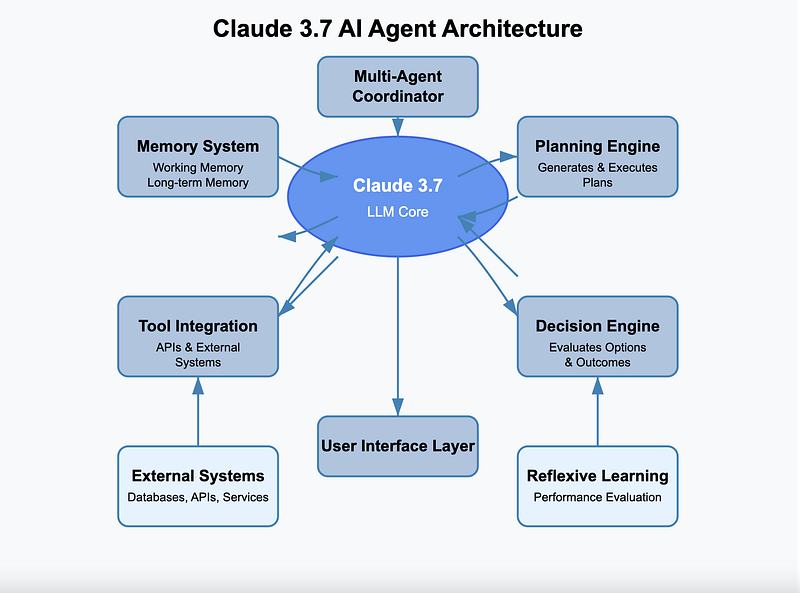
Agent Architecture
Best Practices
1. Start small and focused: Begin with a narrowly defined agent before expanding capabilities. 2. Design for transparency: Make the agent’s capabilities and limitations clear to users. 3. Implement graceful fallbacks: Always have a plan for when the agent cannot complete a task. 4. Prioritize user feedback: Create mechanisms for users to provide feedback on agent performance. 5. Continuous monitoring: Regularly review agent interactions to identify issues and improvement opportunities.
Common Pitfalls
1. Scope creep: Trying to build an agent that does too many things at once. 2. Insufficient guardrails: Not implementing proper validation and safety measures. 3. Poor error handling: Not designing for edge cases and unexpected inputs. 4. Ignoring user context: Not adapting agent behavior based on user preferences and history. 5. Overreliance on Claude: Expecting the model to handle tasks that would be better implemented as code.
Coming in Part 2: Building a Deep Research Agent
In the second part of this series, I’ll put these concepts into practice by building a complete, production-ready Deep Research Agent that leverages Claude 3.7’s capabilities. I’ll provide the full implementation, including: - A comprehensive architecture for research planning and execution - Code for document retrieval and information extraction - Techniques for synthesizing findings and generating insights - A web interface for interacting with the agent - Deployment instructions and advanced feature ideas
> Stay tuned for Part 2, where I’ll bring these concepts to life with a practical, working implementation!
— Gaurav
Responses