Deep Dive into Knowledge Graph Components for LLM RAG Applications — With a Real World Example
Deep Dive into Knowledge Graph Components for LLM RAG Applications — With a Real World Example
In my previous blog, “Enterprise GraphRAG: Building Production-Grade LLM Applications with Knowledge Graphs,” I explored how GraphRAG — an… -
Deep Dive into Knowledge Graph Components for LLM RAG Applications — With a Real World Example
In my previous blog, “[Enterprise GraphRAG: Building Production-Grade LLM Applications with Knowledge Graphs](https://medium.com/aingineer/enterprise-graphrag-building-production-grade-llm-applications-with-knowledge-graphs-b4d567c95cbf),” I explored how GraphRAG — an advanced architecture blending Large Language Models (LLMs) with Knowledge Graphs — can address the limitations of traditional RAG setups. We examined how this integration enhances accuracy, preserves data lineage, and enables explainability in complex enterprise environments. The high-level architecture and implementation considerations laid the groundwork for building intelligent, scalable, and context-aware LLM solutions.
As a follow-up to that discussion, this piece dives deeper into the essential components that make Knowledge Graphs indispensable for RAG architectures. Specifically, we will break down the roles of Entities, Relationships, Properties, and Ontology — the foundational elements that enable robust, production-grade LLM applications.
Why Components Matter in GraphRAG
When integrating Knowledge Graphs with LLMs, the richness and structure of the data are pivotal to the system’s performance. While vector search retrieves semantically similar content, Knowledge Graphs introduce a second layer of context by offering structured, interconnected data. This dual approach — traversing graph relationships while leveraging vector embeddings — produces highly relevant, accurate, and explainable results.
However, the effectiveness of this hybrid system hinges on the quality and design of the graph itself. Entities must be well-defined, relationships properly modeled, and properties meticulously curated. Moreover, the ontology — the schema that governs the graph — must provide a coherent blueprint for representing the domain.
Let’s dive into these components with a real world example: Restaurant Ordering and Delivery App Knowledge Graph; considering how Knowledge Graphs can transform restaurant ordering and delivery platforms, like DoorDash.
Scenario: A restaurant delivery app leverages a Knowledge Graph to connect customers, restaurants, dishes, couriers, and delivery zones. By integrating GraphRAG, the platform can recommend restaurants, optimize delivery routes, and personalize user experiences based on past orders and preferences.
1\. Entities: The Core Building Blocks
Definition: Entities represent the primary nodes in the Knowledge Graph, corresponding to real-world objects, concepts, or instances.
In GraphRAG Context:
Entities anchor LLM responses by providing concrete reference points. For a restaurant ordering app, entities include Customer, Restaurant, Dish, Order, Courier, and Delivery Zone.
Key Benefits: - Precision in Responses: Anchoring to entities mitigates hallucinations common in LLM outputs by focusing on verifiable data. - Entity Resolution: Consolidates different references to the same restaurant or dish, ensuring accurate recommendations. - Contextual Linking: Entities maintain user context, enabling personalized recommendations and tracking order histories.
Example:
Querying for Customer:Jane_Doe surfaces past orders, favorite restaurants, and current deliveries, allowing the LLM to offer personalized dining suggestions.
2\. Relationships: Connecting the Dots
Definition: Relationships define how entities interact or relate to one another, forming the edges of the Knowledge Graph.
In GraphRAG Context: Relationships enable LLMs to traverse the graph and discover connections between customers, orders, couriers, and restaurants.
Key Benefits:
- Multi-Hop Reasoning: Helps LLMs trace complex paths, such as Customer -> Orders -> Courier -> Delivery Zone.
- Semantic Depth: By traversing relationships, the system can recommend dishes frequently ordered together or find couriers available in real-time.
- Dynamic Traversal: Adjusting traversal depth can uncover connections like delayed orders, allowing the system to prioritize updates.
Example:
A query about “order status” might traverse from the Order entity to the courier’s real-time location, providing delivery updates.
3\. Properties: Adding Granularity
Definition: Properties are metadata or attributes that describe entities and relationships.
In GraphRAG Context: Properties describe aspects like dish prices, delivery times, ratings, and customer preferences.
Key Benefits:
- Fact Extraction: Enables LLMs to extract structured information (e.g., dish ingredients or estimated delivery times).
- Filtering and Ranking: Filters results by property values, such as top-rated restaurants or delivery times under 30 minutes.
- Traceability: Properties like order_status or delivery_estimate ensure customers receive transparent updates.
Example:
Retrieving orders with status=delivered or dishes with dietary_label=vegan allows LLMs to personalize the customer experience.
4\. Ontology: Governing the Structure
Definition: Ontology is the schema that dictates the types of entities, relationships, and properties, along with the rules and constraints that govern them.
In GraphRAG Context: Ontology defines the structural blueprint of the graph, ensuring consistency, guiding reasoning, and enforcing domain-specific logic. For restaurant delivery apps, the ontology might define relationships between customers, orders, restaurants, and couriers.
Key Benefits:
- Schema-Driven Queries: Ontology-aligned queries ensure that LLMs operate within the bounds of defined data structures.
- Consistency and Validation: Ontologies validate incoming data, preventing erroneous or incomplete entity creation.
- Inference and Expansion: LLMs can leverage ontologies to infer missing data (e.g., predicting that an Order entity will have HAS_DISH and DELIVERED_BY relationships).
Example:
In the restaurant delivery Knowledge Graph, the ontology enforces rules ensuring that each Order must relate to a Customer, Dish, and Courier, maintaining consistency across the platform.
-
Query Processing in GraphRAG: Vector Search and Knowledge Graph Traversal
Query processing in GraphRAG systems typically involves a combination of vector search and Knowledge Graph traversal to enhance accuracy and context awareness.
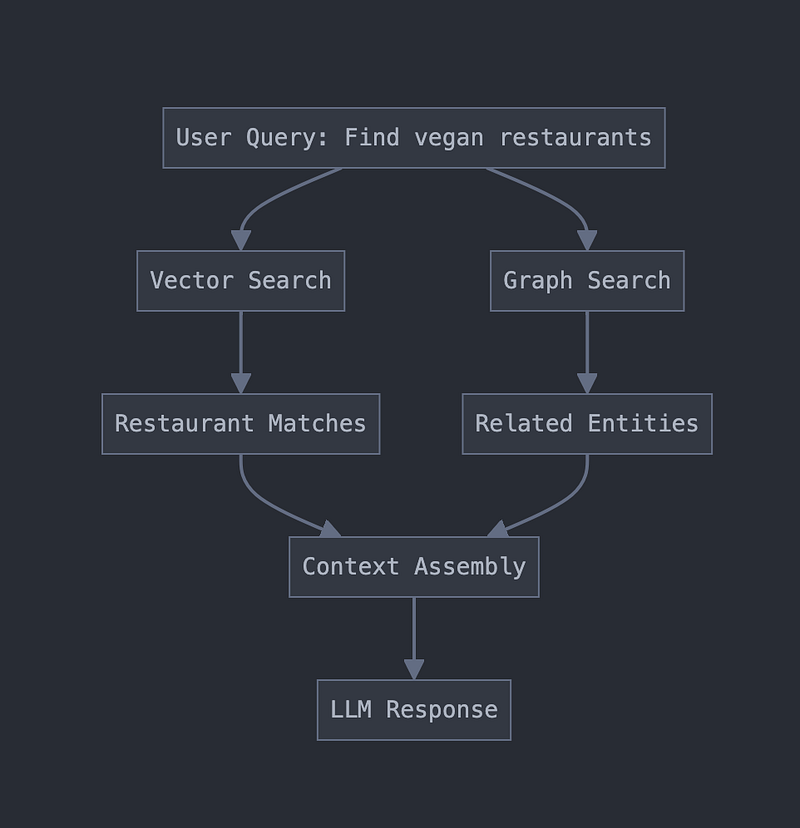
query processing in knowledge graphRAG
These two approaches complement each other but operate through distinct mechanisms:
1\. Vector Search — Semantic Matching - Purpose: Vector search leverages embeddings to find semantically similar documents or entities. - Process: The input query is transformed into an embedding vector. This vector is compared against pre-indexed vectors in a vector database to retrieve the most relevant matches. - Use Case: Best suited for unstructured data, such as retrieving relevant documents, emails, or event descriptions based on abstract user queries.
Example in Restaurant Ordering Context: A query like “Find vegan restaurants near me” retrieves restaurants tagged with dietary preferences or descriptions containing “vegan,” even if the exact wording varies.
2\. Knowledge Graph Search — Structured Querying - Purpose: Knowledge Graph traversal retrieves structured data based on defined relationships and properties. - Process: A structured query (e.g., Cypher or SPARQL) navigates the graph, pulling entities and relationships that directly address the user query. - Use Case: Ideal for structured queries involving dependencies, relationships, or entity hierarchies (e.g., finding couriers linked to a restaurant’s orders).
Example in Restaurant Ordering Context: Once vector search retrieves relevant restaurants, graph traversal identifies dishes available at those locations, their delivery zones, and associated couriers.
Are They Dependent? Vector search and Knowledge Graph traversal are not dependent on each other but are highly complementary. - Vector search offers broad initial recall by surfacing semantically related data. - Graph traversal refines and enriches those results through structured exploration of entity relationships.
Example Workflow in GraphRAG:
1. Vector Search — A query retrieves candidate restaurants or dishes based on semantic similarity. 2. Graph Traversal — The system traverses to linked couriers, available delivery zones, and customer order histories. 3. Context Assembly — Retrieved results are combined to provide the LLM with enriched, context-aware data for final response generation. -
Implementation Details for Restaurant Delivery GraphRAG
#### 1\. Entity and Relationship Management
`
class RestaurantGraphManager:
def \_\_init\_\_(self, config: GraphConfig):
self.neo4j\_client = Neo4jClient(config)
self.vector\_store = VectorStore(dimension=1536) \# For OpenAI embeddings
self.validator = SchemaValidator()
async def create\_restaurant(self, restaurant\_data: Dict) -> Entity: """Creates a restaurant entity with vector embedding.""" try: \# Generate embedding for vector search description = f"{restaurant\_data\['name'\]} {restaurant\_data\['cuisine\_type'\]} {restaurant\_data\['description'\]}" embedding = await self.generate\_embedding(description)
\# Validate against schema self.validator.validate\_restaurant(restaurant\_data)
\# Create graph node query = """ CREATE (r:Restaurant { id: $id, name: $name, cuisine\_type: $cuisine\_type, rating: $rating, created\_at: datetime(), embedding\_id: $embedding\_id }) RETURN r """ params = { 'id': str(uuid4()), 'name': restaurant\_data\['name'\], 'cuisine\_type': restaurant\_data\['cuisine\_type'\], 'rating': restaurant\_data.get('rating', 0.0), 'embedding\_id': str(uuid4()) }
\# Store in graph and vector store await self.neo4j\_client.execute(query, params) await self.vector\_store.add\_embedding(params\['embedding\_id'\], embedding)
return params\['id'\]
except Exception as e:
logger.error(f"Failed to create restaurant: {str(e)}")
raise GraphOperationError(f"Restaurant creation failed: {str(e)}")
`
#### 2\. Hybrid Search Implementation
`
class HybridSearchEngine:
def \_\_init\_\_(self, graph\_client, vector\_store):
self.graph\_client = graph\_client
self.vector\_store = vector\_store
self.cache = TTLCache(maxsize=1000, ttl=3600)
async def search\_restaurants( self, query: str, user\_location: Dict\[str, float\], dietary\_preferences: List\[str\] = None ) -> List\[Dict\]: """Combines vector and graph search for restaurant recommendations.""" cache\_key = f"{query}:{user\_location}:{dietary\_preferences}" if cache\_key in self.cache: return self.cache\[cache\_key\]
\# Vector search for semantic matching query\_embedding = await self.generate\_embedding(query) vector\_results = await self.vector\_store.search( query\_embedding, k=20, filter\_by\_type="restaurant" )
\# Graph search for filtering and enrichment graph\_query = """ MATCH (r:Restaurant) WHERE r.id IN $restaurant\_ids AND r.status = 'active' WITH r MATCH (r)-\[:IN\_ZONE\]->(z:DeliveryZone) WHERE point.distance(z.center, point($user\_location)) <= z.radius RETURN r, collect(z) as zones """
restaurant\_ids = \[r\['id'\] for r in vector\_results\] graph\_results = await self.graph\_client.execute( graph\_query, { 'restaurant\_ids': restaurant\_ids, 'user\_location': user\_location } )
\# Merge and rank results combined\_results = self.\_merge\_results(vector\_results, graph\_results) if dietary\_preferences: combined\_results = self.\_filter\_by\_preferences( combined\_results, dietary\_preferences )
self.cache\[cache\_key\] = combined\_results
return combined\_results
`
#### 3\. Context Assembly for LLM
`
class ContextAssembler:
def \_\_init\_\_(self, config: Config):
self.max\_context\_length = config.max\_context\_length
self.relevance\_threshold = config.relevance\_threshold
def assemble\_restaurant\_context( self, restaurant: Dict, user\_history: Dict, current\_order: Optional\[Dict\] = None ) -> str: """Assembles context for LLM from various sources.""" context\_parts = \[\]
\# Basic restaurant information context\_parts.append( f"Restaurant: {restaurant\['name'\]}\\n" f"Cuisine: {', '.join(restaurant\['cuisine\_type'\])}\\n" f"Rating: {restaurant\['rating'\]}/5.0" )
\# User preferences and history if user\_history.get('previous\_orders'): context\_parts.append( "User has previously ordered: " f"{', '.join(user\_history\['favorite\_dishes'\])}" )
\# Current order context if current\_order: context\_parts.append( f"Current order status: {current\_order\['status'\]}\\n" f"Estimated delivery: {current\_order\['delivery\_estimate'\]}" )
\# Merge and truncate to fit context window return self.\_truncate\_context("\\n\\n".join(context\_parts))
def \_truncate\_context(self, context: str) -> str:
"""Ensures context fits within LLM context window."""
if len(context) > self.max\_context\_length:
return context\[:self.max\_context\_length\] + "..."
return context
`
#### 4\. Query Processing Pipeline
`
class RestaurantQueryProcessor:
def \_\_init\_\_(self, config: Config):
self.search\_engine = HybridSearchEngine(config)
self.context\_assembler = ContextAssembler(config)
self.llm\_client = LLMClient(config.llm\_api\_key)
async def process\_query( self, query: str, user\_id: str, location: Dict\[str, float\] ) -> Dict: """Processes user queries about restaurants and orders.""" try: \# 1. Extract query intent and parameters query\_params = await self.\_extract\_query\_parameters(query)
\# 2. Retrieve relevant restaurants restaurants = await self.search\_engine.search\_restaurants( query=query, user\_location=location, dietary\_preferences=query\_params.get('dietary\_preferences') )
\# 3. Get user context user\_history = await self.\_get\_user\_history(user\_id)
\# 4. Assemble context for LLM context = self.context\_assembler.assemble\_restaurant\_context( restaurants=restaurants\[:5\], \# Top 5 matches user\_history=user\_history )
\# 5. Generate response using LLM response = await self.llm\_client.generate\_response( query=query, context=context, max\_tokens=300 )
return { 'response': response, 'restaurants': restaurants, 'user\_context': user\_history }
except Exception as e:
logger.error(f"Query processing failed: {str(e)}")
raise QueryProcessingError(str(e))
`
#### 5\. Property Validation and Schema Enforcement
`
class RestaurantSchemaValidator:
"""Validates entities against the restaurant delivery domain schema."""
def validate\_restaurant(self, data: Dict) -> bool: required\_fields = { 'name': str, 'cuisine\_type': list, 'operating\_hours': dict, 'delivery\_zones': list }
for field, field\_type in required\_fields.items(): if field not in data: raise ValidationError(f"Missing required field: {field}") if not isinstance(data\[field\], field\_type): raise ValidationError( f"Invalid type for {field}. Expected {field\_type}" )
return True
def validate\_order(self, data: Dict) -> bool: """Validates order data against schema.""" required\_fields = { 'customer\_id': str, 'restaurant\_id': str, 'items': list, 'delivery\_address': dict }
\# Validate basic structure for field, field\_type in required\_fields.items(): if field not in data: raise ValidationError(f"Missing required field: {field}")
\# Validate items structure for item in data\['items'\]: if not all(k in item for k in \['dish\_id', 'quantity'\]): raise ValidationError("Invalid item structure in order")
return True
`
-

visualizing the graph in thoughts
Final Thoughts
The backbone of any successful LLM-powered RAG application lies in the meticulous design and implementation of its Knowledge Graph components — Entities, Relationships, Properties, and Ontology. These components serve as the critical infrastructure, enabling systems to transcend basic information retrieval and provide deeply contextual, precise, and explainable outputs.
In my exploration of the 16 different types of RAG techniques detailed in [A Complete Guide to Retrieval-Augmented Generation (RAG): 16 Different Types, Their Implementation, and Use Cases](https://medium.com/aingineer/a-complete-guide-to-retrieval-augmented-generation-rag-16-different-types-their-implementation-10d48248517b), it became evident that Knowledge Graph RAG consistently emerges as one of the most versatile and effective approaches for enterprise-level LLM applications. Its ability to capture complex relationships and provide structured, context-aware information aligns perfectly with the demands of dynamic, large-scale systems.
As organizations continue to scale AI solutions, the fusion of vector search with structured graph traversal becomes not just advantageous, but essential for enterprise-grade applications. This synergy drives greater accuracy, allowing LLMs to navigate complex data ecosystems with the nuance and agility required for dynamic, real-time environments.
Looking ahead, the value of investing in robust Knowledge Graph architectures cannot be overstated. Enterprises that prioritize well-defined schemas, rich relationships, and comprehensive ontologies will unlock unparalleled performance, personalization, and operational efficiency.
> The future of intelligent systems belongs to those who master the dual power of semantics and structure. GraphRAG, backed by thoughtful Knowledge Graph design, will stand at the forefront of this transformation — ushering in the next era of AI-driven enterprise solutions.
— Gaurav
Responses