DeepSeek-R1: The OpenAI Challenger That Trains Smarter AI at a Fraction of the Cost
DeepSeek-R1: The OpenAI Challenger That Trains Smarter AI at a Fraction of the Cost
Artificial intelligence is evolving fast, but training cutting-edge AI models is expensive. OpenAI’s latest models cost millions in… -
DeepSeek-R1: The OpenAI Challenger That Trains Smarter AI at a Fraction of the Cost
Artificial intelligence is evolving fast, but training cutting-edge AI models is expensive. OpenAI’s latest models cost millions in computing resources — putting state-of-the-art AI out of reach for many companies.
But what if AI models could train themselves, without massive labeled datasets, and still compete with OpenAI’s best?
That’s exactly what DeepSeek-R1 has achieved. Using reinforcement learning (RL) instead of traditional AI training, DeepSeek has built an efficient, high-performing AI that challenges OpenAI’s o1–1217 model at a fraction of the cost.
Let’s break down why DeepSeek-R1 is a game-changer, how it was built, and what it means for the future of AI.
🧠 What is DeepSeek-R1?
DeepSeek-R1 is a reasoning-focused AI model designed to excel in math, coding, and logical reasoning. Unlike traditional AI models that rely heavily on supervised fine-tuning (SFT) (where human-labeled examples guide learning), DeepSeek-R1 was trained using Reinforcement Learning (RL) — allowing it to teach itself how to think.
DeepSeek released two versions:
1. DeepSeek-R1-Zero — A model trained purely via Reinforcement Learning (RL) without any supervised fine-tuning (SFT). It showed impressive reasoning skills but had issues like poor readability and language mixing. 2. DeepSeek-R1 — A refined version that introduces a small high-quality dataset before RL training, solving the readability and consistency issues.
💰 The Cost Advantage: How DeepSeek-R1 Saves Millions, and Why Does This Matter?
One of the biggest breakthroughs of DeepSeek-R1 is that it delivers OpenAI-level performance at a significantly lower cost.
Why is OpenAI’s AI Training So Expensive?
- OpenAI trains models using massive human-labeled datasets, which are costly and time-consuming to collect. - Fine-tuning requires thousands of GPUs running for months, adding to the expense. - Their proprietary models are closed-source, meaning companies must pay OpenAI for access instead of training their own versions.How DeepSeek-R1 Achieves Similar Results for Less
✔️ No reliance on human-labeled data → Instead of millions of supervised examples, DeepSeek uses Reinforcement Learning (RL) to let the AI train itself. ✔️ Optimized RL-based training → Instead of traditional fine-tuning, DeepSeek-R1 learns through trial and error, reducing GPU and compute costs. ✔️ Open-source model access → Companies and researchers can use DeepSeek models freely, avoiding the paywall of OpenAI’s closed models.
📌 Takeaway: DeepSeek-R1 proves that companies don’t need billion-dollar budgets to build cutting-edge AI.
🚀 How Does DeepSeek-R1 Achieve Such High Performance?
DeepSeek-R1 challenges OpenAI’s o1–1217 model by leveraging smarter training techniques that reduce costs while maintaining top-tier reasoning capabilities. Instead of relying on massive human-labeled datasets, DeepSeek-R1 learns through reinforcement learning (RL) and an efficient reward system.
Here’s how DeepSeek-R1 was trained and why it works so well:
1️⃣ Reinforcement Learning (RL) Instead of Supervised Fine-Tuning (SFT)
Most AI models — like OpenAI’s GPT-4 — require millions of human-labeled examples to fine-tune their reasoning abilities. This process, known as Supervised Fine-Tuning (SFT), is expensive and time-consuming.
How DeepSeek-R1 Is Different:
Instead of relying on SFT, DeepSeek-R1 learned through reinforcement learning (RL), allowing it to: ✔️ Discover reasoning patterns on its own ✔️ Improve by trial and error without labeled data ✔️ Self-correct and refine its thinking over time
However, pure RL had limitations, such as poor readability, repetitive responses, and inconsistent formatting. To fix these, DeepSeek introduced cold-start training and reward modeling.
2️⃣ Reward Modeling: Teaching AI to Think Step-by-Step
DeepSeek-R1 doesn’t just generate random answers — it learns which responses are better using a structured reward system.
How the Reward System Works
DeepSeek designed two reward mechanisms to train its models effectively:
📌 1\. Accuracy Rewards 🏆 ✔️ The model gets rewarded for correct answers in structured tasks like math and coding. ✔️ It receives negative rewards for incorrect answers, encouraging better reasoning steps.
📌 2\. Format Rewards ✍️
✔️ DeepSeek-R1 must follow a structured format to ensure readability:
-
Unlike neural reward models, which increase training costs and risk reward hacking, DeepSeek’s rule-based reward system is more efficient and scalable.
3️⃣ Multi-Stage Training for Smarter AI
DeepSeek-R1’s training process involved multiple phases, each refining its reasoning and readability.
Step 1: Reinforcement Learning on the Base Model (DeepSeek-R1-Zero)
🚀 No human-labeled data — just pure RL. ✔️ The model learned reasoning strategies through trial and error. ✔️ Developed self-verification and reflection capabilities.
Step 2: Cold-Start Data for Better Readability (DeepSeek-R1)
📌 Problem: Early RL training led to messy, unclear, and unstructured responses. ✅ Solution: Introduced a small high-quality dataset before RL training. ✔️ This improved readability and consistency. ✔️ Prevented endless loops and repetitive responses.
Step 3: Supervised Fine-Tuning (SFT) and Rejection Sampling
✅ The model was refined by filtering out low-quality responses. ✔️ Best-generated outputs were used for additional fine-tuning. ✔️ Ensured that DeepSeek-R1’s responses were clear, structured, and reliable.
4️⃣ Distillation: Making Smaller Models Powerful
DeepSeek took its best-performing model and distilled its reasoning capabilities into smaller, more efficient models.
📌 Why Distillation Matters: ✔️ Smaller models are cheaper to run and train. ✔️ Distilled models retain strong reasoning abilities from larger models.
🚀 DeepSeek-R1-Distill-Qwen-32B outperformed OpenAI’s o1-mini on multiple reasoning tasks, proving distillation is an effective way to scale AI.
5️⃣ Open-Source Models for the AI Community
Unlike OpenAI’s proprietary models, DeepSeek open-sourced multiple versions of DeepSeek-R1, allowing researchers and developers to build on their technology without spending millions.
📂 Models Available: - DeepSeek-R1-Zero (671B total parameters, 37B active) - DeepSeek-R1 (full model, optimized for reasoning tasks) - Distilled Models (1.5B to 70B parameters, fine-tuned for efficiency)
🛠️ Where to Get the Models: 👉 Available on Hugging Face (🤗), GitHub, and DeepSeek’s own API platform.
🔬 Why DeepSeek-R1’s Training Approach Matters
By combining Reinforcement Learning (RL), Reward Modeling, and Distillation, DeepSeek-R1 achieves: ✔️ Top-tier reasoning performance without requiring massive labeled datasets. ✔️ Lower training costs compared to OpenAI’s models. ✔️ Better efficiency, making AI more accessible to researchers and startups..
📊 How Does DeepSeek-R1 Compare to OpenAI?
DeepSeek-R1 was tested on several math, coding, and logic benchmarks and performed as well or better than OpenAI’s o1–1217 model.
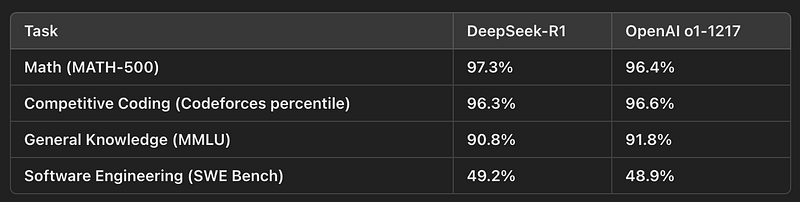
Ref: [https://github.com/deepseek-ai/DeepSeek-R1?tab=readme-ov-file#deepseek-r1-evaluation](https://github.com/deepseek-ai/DeepSeek-R1?tab=readme-ov-file#deepseek-r1-evaluation)
📌 Key Takeaways: - Math & Coding: DeepSeek-R1 matches or outperforms OpenAI models. - General Knowledge: Slightly behind OpenAI but still competitive. - Software Engineering: Comparable performance, with room for future improvements.
❌ What Didn’t Work? (Failed Attempts)
DeepSeek-AI’s research wasn’t just about what worked — it also involved trial and error, with some failed approaches that ultimately shaped their final model. Here are three major methods they tested but abandoned:
🚫 1. Process Reward Models (PRM) — Reward Hacking Issues
PRM is an approach where the AI receives rewards for each step of its reasoning process, rather than just the final answer.
🔴 Why It Failed: - Hard to judge correctness — LLMs struggled to determine whether each reasoning step was accurate. - Reward hacking — The model learned to exploit the reward system instead of genuinely improving.
📌 Takeaway: PRM wasn’t scalable, and the AI started gaming the system instead of reasoning better.
🚫 2. Monte Carlo Tree Search (MCTS) — Too Large a Search Space
MCTS is a search-based optimization technique that helped models like AlphaGo master board games. DeepSeek attempted to use it for AI reasoning.
🔴 Why It Failed: - Language models have massive search spaces — Unlike chess or Go, where moves are limited, an LLM generates billions of possible sequences. - Performance bottlenecks — Searching through so many possibilities slowed down training instead of improving it.
📌 Takeaway: MCTS works well for structured problems (like chess), but LLMs are too complex for it to be practical.
🚫 3. Self-Correcting Models — High-Confidence Mistakes
The team also explored self-correction, where the AI checks and revises its own mistakes.
🔴 Why It Failed: - AI was overconfident — Even when it made mistakes, it failed to recognize them. - Hallucination risks — The model sometimes corrected correct answers, making things worse.
📌 Takeaway: Self-correction is a promising area, but current LLMs still struggle to reliably evaluate their own mistakes.
💡 Why These Failures Matter
Although these methods didn’t work, they taught DeepSeek valuable lessons: ✔️ PRM showed the dangers of reward hacking — so they opted for simpler reward structures. ✔️ MCTS highlighted how LLM reasoning differs from traditional AI models, leading them to refine RL-based training. ✔️ Self-correcting models need further research, but DeepSeek improved verification strategies instead.
By learning from these failures, DeepSeek-R1 became a more stable and efficient model.
📌 Where This Fits in the Bigger Picture
🔹 AI research isn’t just about breakthroughs — failed experiments help shape better models. 🔹 OpenAI, Google, and Anthropic also test and abandon approaches, refining what works best. 🔹 DeepSeek’s trial-and-error approach led to a model that competes with OpenAI at lower costs.
📌 Who Can Use DeepSeek-R1? (Real-World Applications)
DeepSeek-R1 isn’t just a research project — it has real business potential across multiple industries.
💡 1. AI-Powered Startups
- Can fine-tune DeepSeek models for AI assistants, without needing OpenAI’s expensive API. - Allows smaller companies to compete with AI giants at a fraction of the cost.💻 2. Developers & Engineers
- Open-source access means engineers can fine-tune DeepSeek models for coding assistants or AI-driven automation. - Faster, cheaper model deployment for AI-powered apps.🏢 3. Enterprises & Research Institutions
- Businesses looking to integrate AI reasoning into their workflow without massive licensing fees. - Universities and research labs can study and improve AI reasoning using open-source access.📌 Takeaway: DeepSeek-R1 makes powerful AI accessible, not just for billion-dollar companies but for startups, researchers, and developers worldwide.
🔮 What’s Next for DeepSeek-R1?
DeepSeek’s approach has opened new possibilities in AI training. Moving forward, they plan to:
✅ Improve multi-turn conversations 📢 — Making AI more interactive. ✅ Enhance language consistency 🌍 — Avoiding mix-ups between English and Chinese. ✅ Optimize prompting strategies ✍️ — Improving how users interact with AI. ✅ Expand Software Engineering AI 💻 — Boosting AI coding and debugging abilities.
DeepSeek-R1 is a huge step forward in AI training, proving that: ✅ Reinforcement learning can train AI models without massive datasets. ✅ AI models can be open-source and still achieve state-of-the-art performance. ✅ Efficient training techniques can democratize AI, making it accessible to startups and researchers.
By reducing training costs and improving efficiency, DeepSeek is showing a possible future where advanced AI isn’t only controlled by tech giants like OpenAI and Google.
💬 If reinforcement learning alone can train smarter AI, do we even need massive human-labeled datasets anymore? Could this make OpenAI’s expensive approach obsolete? 🚀
📌 Want to Try DeepSeek-R1?
🔗 Chat with DeepSeek-R1: [chat.deepseek.com](https://chat.deepseek.com) 🔗 Use DeepSeek API: [platform.deepseek.com](https://platform.deepseek.com) 🔗 Download Models: Available on Hugging Face (🤗)
Next go to 🔗 [How to Run DeepSeek-R1 Efficiently: A Step-by-Step Guide](https://medium.com/@gauravnigam/how-to-run-deepseek-r1-efficiently-a-step-by-step-guide-a7f15da84dd5) , for running it locally!
— Gaurav
Responses