Mastering Prompting for Enterprise Applications
Mastering Prompting for Enterprise Applications
In the world of generative AI, prompting is the art and science of crafting inputs so that AI models produce outputs aligned with our… -
Mastering Prompting for Enterprise Applications
In the world of generative AI, prompting is the art and science of crafting inputs so that AI models produce outputs aligned with our intentions. In an enterprise context, the stakes are high: prompts must reflect business requirements like accuracy, compliance, and usability — often across large-scale or mission-critical environments.
This blog is a continuation of the [Advanced Prompt Techniques](https://medium.com/@gauravnigam/prompt-techniques-5639da76406b), where I talked about the advanced prompt techniques; in this blog, we will explore various prompting strategies, their enterprise-specific applications, actionable tips for success, and a comprehensive table summarizing the approaches. We’ll also include suggestions for incorporating real-world outcomes, governance considerations, and potential pitfalls so you can elevate your prompt engineering expertise.
Why Prompting Matters in Enterprise Settings
1. Compliance & Policy Alignment Enterprises must adhere to internal governance policies (e.g., data privacy, security regulations). Proper prompting helps ensure your AI models stay within compliance guidelines. 2. Context & Domain Expertise Large language models don’t inherently know your company’s unique processes or jargon. Supplying domain context ensures responses are on-point and relevant. 3. Scalability & Cost-Efficiency Repeated misalignment can be expensive. Well-designed prompts reduce time spent on manual review and rework — vital for high-volume workflows. 4. Consistency & Reliability In enterprise applications, consistency is crucial. You want your AI to handle edge cases, follow corporate style guidelines, and deliver uniform answers even when queries vary in phrasing.
Prompt Templates
Below is a commonly used, high-level “prompt template” that engineers and data practitioners often seek out when refining their prompt engineering. It can be adapted to a variety of enterprise use cases — whether you’re building a customer support chatbot or creating a compliance-focused AI assistant.
`
\[ROLE / CONTEXT\]:
“You are an expert in \[domain / role\], such as a \[financial analyst / HR manager / security consultant\].
Your primary objective is to \[summarize / analyze / generate / advise\] based on the provided context and instructions.”
\[RELEVANT BACKGROUND / CONTEXT\]: \- Important data or documents - Summaries of company policies - Key constraints (compliance considerations, style guidelines, etc.) - Additional instructions, e.g., “If data is missing, ask for clarification.”
\[TASK / QUESTION\]: “Given the context above, \[perform a task / answer a question / provide a summary / solve a problem\]. Please focus on \[specific details or sub-tasks\]. Explain your reasoning if necessary (unless specified otherwise).”
\[INSTRUCTIONS FOR OUTPUT\]: \- Formatting or style requirements: “Return your answer as bullet points / JSON / plain text.” - Word or character limits: “Keep it under X words/characters.” - Tone or level of detail: “Ensure the language is accessible to non-technical readers.”
\[OPTIONAL VALIDATION / SELF-CHECK\]:
\- “Before finalizing, double-check your reasoning for internal consistency.”
- “If any part of the context is unclear or contradictory, note the concern rather than guessing.”
`
How to Use It
Role / Context - Begin by clearly stating who or what the model should “be.” This anchors the AI’s persona or domain perspective. In an enterprise setting, you might say “You are a senior compliance officer…” or “You are an experienced data scientist…”
Relevant Background / Context - Next, embed the crucial business logic, documents, or conditions the model needs to reference. Examples include a snippet of an HR manual, a product specification, or details on corporate style guides.
Task / Question - Clearly articulate the specific request, whether it’s to “Summarize the key differences between two policies,” “Identify potential fraud,” or “Draft an email responding to a customer complaint.”
Instructions for Output - Specify the exact style, format, or tone. In enterprises, outputs often need to be integrated into other tools, so requiring JSON or a bullet-point format can streamline that process.
Optional Validation / Self-Check - Encourage the model to evaluate its own reasoning or highlight uncertainties. This step helps reduce incorrect or misleading answers, especially critical in regulated industries like finance or healthcare.
Example in Practice
Let’s say you’re building a chatbot for internal HR support:
`
ROLE / CONTEXT:
"You are an HR specialist with 10 years of experience in corporate HR management. Your role is to advise employees on our internal policies accurately."
RELEVANT BACKGROUND / CONTEXT: \- Company Policy Handbook (excerpt included below) \- The policy states: 'Employees are entitled to 20 days of paid leave per year after completing 6 months at the company.' \- The employee has 8 months of service.
TASK / QUESTION: "An employee wants to know if they can take a 2-week vacation next month. Given the policy and their service time, advise them on whether they are eligible. Please be concise and provide references to the relevant policy sections if necessary."
INSTRUCTIONS FOR OUTPUT: \- Provide the answer in short paragraphs, referencing the policy by section number if needed. \- Maintain a friendly, informative tone. \- Keep the total answer under 150 words.
OPTIONAL VALIDATION / SELF-CHECK:
\- Check if there are any contradictory statements in the policy about leave eligibility.
\- If unsure, prompt for clarification or note the conflict explicitly.
`
Prompting Techniques with Enterprise Examples
1\. Zero-Shot Prompting
Definition: Presenting the model with a task or question without providing any examples.
Mini Template
`
Prompt:
"You are a \[ROLE/CONTEXT: e.g., IT Support Chatbot\].
Here is my question: \[INSERT QUERY\].
\- Task: Please answer concisely and accurately. \- Constraints: Use plain language, avoid speculation. \- Output Format: \[Optional formatting instruction, e.g., 'Answer in one paragraph'\]"
Question:
"Explain \[TOPIC\] in simple terms."
`
Enterprise Example - Simple Query: “Explain the main differences between Product A and Product B.” - HR Application: “Give a high-level summary of our new leave policy.”
Why It Helps: Rapid, straightforward approach if you have a well-scoped query. Great for quick checks or user-facing chatbots. Downside: May yield less accurate or context-aware results, especially for complex tasks.
2\. One-Shot Prompting
Definition: Providing exactly one example of input-output behavior alongside your query.
Mini Template
`
Prompt:
"You are a \[ROLE/CONTEXT: e.g., Customer Service Chatbot\].
Below is one example of how to respond to a user query:
Example: User says: 'My VPN keeps disconnecting.' Response: 'Try rebooting the router, checking your firewall settings, and contacting the IT helpdesk if it persists.'
Now please respond to the new user question:
'\[NEW QUESTION\].'
`
Enterprise Example - IT Support Bot: - Example: “If a user says, ‘My VPN keeps disconnecting,’ then respond with a short troubleshooting guide.” - New query: “How to troubleshoot an email login issue?”
Why It Helps: Shows the model how you expect it to respond. Downside: One example might not capture different edge cases (e.g., different software or user permissions).
3\. Few-Shot Prompting
Definition: Providing multiple examples (two or more) of input-output pairs.
Mini Template
`
Prompt:
"You are a \[ROLE: e.g., Finance Assistant Bot\].
Use the following examples to guide your response:
Example 1: Input: 'Classify the expense: Employee training course.' Output: 'Category: Professional Development.'
Example 2: Input: 'Classify the expense: Monthly office internet bill.' Output: 'Category: Office Utilities.'
Now classify the new expense:
'\[NEW EXPENSE HERE\].'
`
Enterprise Example - Customer Support: Provide several real (or representative) Q&A pairs on topics like billing, returns, and shipping, then ask the model to handle a new user query. - Finance: Show the model how to categorize expenses from multiple examples, then prompt it on a new, unseen transaction.
Why It Helps: Improves accuracy by illustrating a pattern. Downside: Requires more effort to craft multiple examples and can be token-expensive.
4\. Instruction Prompting
Definition: Giving the model detailed, explicit instructions about how to respond — often combined with examples.
Mini Template
`
Prompt:
"You are a \[ROLE: e.g., HR Policy Explainer\].
Instructions:
1. Summarize the \[POLICY SECTION\] in under 150 words.
2. Use a friendly, but formal tone.
3. Reference the relevant section numbers.
Context: \[INSERT POLICY SNIPPET HERE\]
Question: 'Could you summarize the above policy section for a new hire?'"
`
Enterprise Example - Technical Documentation: “Explain our software architecture in bullet points for new hires. Limit your explanation to under 200 words and use plain language.” - Policy Summaries: “Summarize the legal compliance checklist in a concise manner for the compliance team.”
Why It Helps: Provides structure. Great for ensuring the model returns data in a specific format (e.g., bullet points, JSON). Downside: If instructions conflict or are too vague, the model can produce unexpected or low-quality output.
5\. Chain-of-Thought Prompting
Definition: Encouraging the model to explicitly show its reasoning steps to arrive at an answer.
Mini Template
`
Prompt:
"You are a \[ROLE: e.g., Fraud Analyst Bot\].
\- Step 1: Summarize the relevant data or logs.
\- Step 2: Cross-check with the company's fraud policy.
\- Step 3: Provide a final conclusion with a short explanation.
Data: \[INSERT ACTIVITY LOG / DATA SNIPPET\]
Question:
'Does this activity appear fraudulent based on the policy?'
`
Enterprise Example - Analytical Queries: “Determine if this user activity log shows potential fraud. Think step by step: 1) Summarize relevant data, 2) Cross-check with policy, 3) Conclude.” - Budget Allocations: “Calculate the total budget across multiple departments; first break down each department’s expenses, then sum them up.”
Why It Helps: Encourages model “transparency” and often yields more accurate, logically consistent answers. Downside: Generates lengthier outputs and can still be prone to logical missteps if not carefully reviewed.
6\. Contextual Prompting (Context Packing)
Definition: Embedding relevant documents or context in the prompt so the model can reference specific information.
Mini Template
`
Prompt:
"You are a \[ROLE: e.g., Internal HR Chatbot\].
Here is the relevant policy document snippet:
\[INSERT POLICY TEXT OR SUMMARY HERE\]
Question:
'Based on the above context, does the policy allow employees to take paternity leave for up to 2 weeks?
Please cite the policy and provide a concise explanation.'
`
Enterprise Example - HR Knowledge Base: Embedding relevant employee policy snippets so the AI chatbot can accurately answer leave and benefits questions. - Sales & CRM: Including product specifications or customer history in the prompt for personalized recommendations.
Why It Helps: Greatly enhances relevance and correctness by supplying the model with authoritative information. Downside: Managing token limits can be challenging. Also, must ensure data is up to date and accurate.
7\. Role or Persona Prompting
Definition: Asking the model to adopt a specific role or persona to guide its voice and style.
Mini Template
`
Prompt:
"You are a \[ROLE: e.g., Senior Financial Analyst\].
Your goal: Analyze the portfolio’s risk factors based on the data below.
Data Provided: \[INSERT PORTFOLIO DATA\]
Instruction: Provide an executive summary in a formal, concise tone."
`
Enterprise Example - Finance Advisor Role: “You are a senior financial analyst. Analyze this portfolio’s risk factors and suggest improvements.” - Security Consultant Persona: “Act as a security consultant to review these log files for suspicious activities.”
Why It Helps: Maintains domain-specific voice and ensures a consistent style. Downside: If the role is too broad or ambiguous, the model’s output can deviate from expectations.
8\. Self-Consistency Prompting
Definition: Asking the model to generate multiple answers or reasoning paths, then selecting the most consistent or correct answer.
Mini Template
`
Prompt:
"You are a \[ROLE: e.g., Legal Compliance Bot\].
Generate 3 possible interpretations of the new compliance rule:
1) Interpretation A
2) Interpretation B
3) Interpretation C
Then decide which interpretation is most consistent with our existing policies and briefly explain why."
`
Enterprise Example - Critical Risk Assessments: For compliance or legal tasks, the model could propose multiple interpretations, and the most common or consistent interpretation is chosen. - Performance Reviews: The system could evaluate an employee’s performance from multiple angles (manager’s perspective, peer feedback, self-review) to find a balanced outcome.
Why It Helps: Reduces errors by “voting” among multiple model outputs. Downside: Computationally expensive and requires a secondary process for reconciliation.
9\. Program-Aided Prompting
Definition: Integrating external tools, functions, or data lookups into the model’s workflow.
Mini Template
`
Prompt:
"You are a \[ROLE: e.g., Data Analytics Bot\].
Task:
1\. Call getQuarterSalesData() to retrieve last quarter's sales.
2\. Summarize revenue trends in under 100 words.
Function to Call: getQuarterSalesData() \[No direct input needed; function returns JSON with 'sales\_by\_month', etc.\]
After retrieving data, provide an overview of monthly performance."
`
Enterprise Example
- Data Pipeline: Prompt instructs the model to “Retrieve sales data from last quarter using getQuarterSalesData() and then summarize the revenue trend.”
- System Integrations: The model calls specialized APIs to fetch user details, inventory levels, or compliance checklists, then compiles an answer.
Why It Helps: Improves accuracy by combining AI’s reasoning with real-time, verified data. Downside: Requires robust integrations and well-defined APIs. If the external system is slow or inaccurate, the model’s final output may be affected.
10\. Meta-Prompting (Prompting About Prompting)
Definition: A higher-level approach where you instruct the model on how to formulate or revise prompts, effectively “coaching” it.
Mini Template
`
Prompt:
"You are a \[ROLE: e.g., AI Strategist Bot\].
Please outline the steps you need to take to respond effectively:
1. Identify key questions.
2. Propose a structure for the final answer.
3. Provide the final answer.
4. Double-check for inconsistencies.
Topic: \[INSERT SPECIFIC SCENARIO OR TASK\]"
`
Enterprise Example - Iterative Analysis: “Before answering, outline the steps you think you should take. Then answer. Finally, reevaluate your answer for completeness.” - Complex Decision Flow: “List the questions you need to ask yourself about project feasibility. Then propose an action plan, and check if it meets all previously listed requirements.”
Why It Helps: Encourages self-reflection or self-checking in the model’s output. Downside: Can be cumbersome for long conversations and must be carefully managed so the model doesn’t “forget” earlier instructions.
Best Practices
1. Combine Techniques Don’t be afraid to mix strategies. For instance, use Contextual Prompting with Role Prompting for a highly specialized chatbot. 2. Specify Formatting Especially when results feed into other systems, define the output format clearly (e.g., JSON, CSV, bullet points). 3. Iterate & Validate Use a feedback loop. Capture incorrect or low-quality responses, refine your prompt strategy, and re-prompt. 4. Stay Mindful of Token Limits Large prompts cost more and can hit system constraints. Summarize or chunk context where possible. 5. Governance, Security & Privacy - Prompt Auditing: Consider periodic reviews of prompts to ensure they conform to organizational policy. - Data Security: If prompts contain sensitive data, adopt encryption or anonymization. - Compliance Frameworks: Reference frameworks like SOC 2, HIPAA, or GDPR where relevant. - Privacy: Restrict sensitive context from going into external models. Use anonymization or on-premise solutions if needed.
7. Common Pitfalls - Conflicting Instructions: E.g., telling the model “be brief” and “provide a detailed explanation” in the same prompt. - Context Overstuffing: Pasting too much irrelevant text can overwhelm the model and cause token-limit issues. - Over-Reliance on Role: Simply naming a persona without supplying domain-specific details can produce inconsistent outputs.
8\. Benchmark Comparisons - Conduct A/B tests with different prompting strategies and share the results (e.g., improved accuracy, reduced manual overhead).
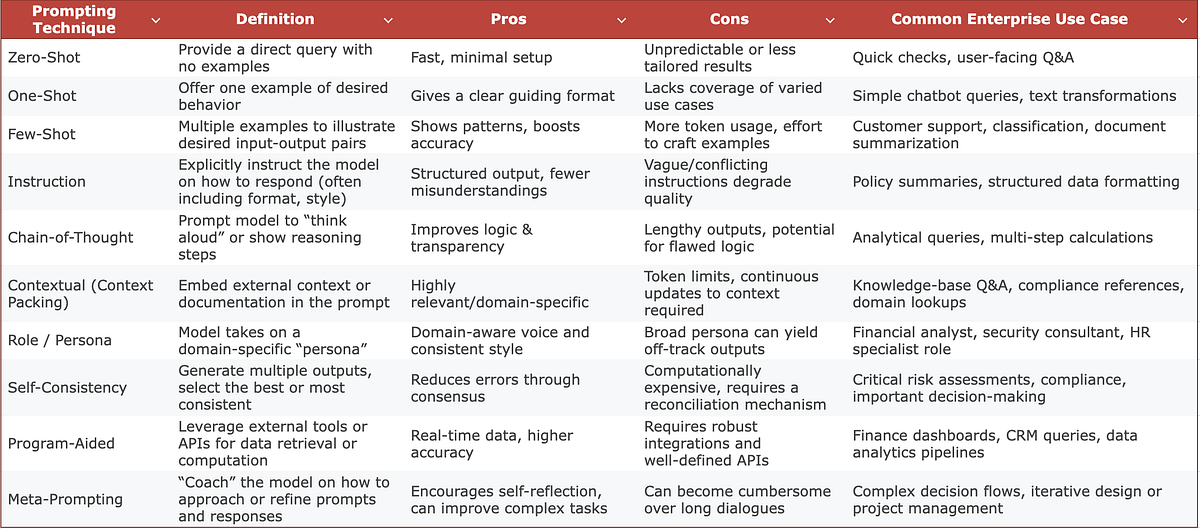
Summary Table of Prompting Strategies
Final Thoughts
Prompting is both an art and a technical craft — particularly in enterprise scenarios. From zero-shot to meta-prompting, each technique offers unique strengths and challenges. By blending and adapting these approaches to your domain, you can significantly elevate your AI’s ability to deliver business value — securely, reliably, and at scale.
Key Takeaways - Continually iterate on prompts, measure performance against real-world metrics, and refine based on the results. - Consider implementing anonymized case studies or A/B tests to showcase tangible benefits. - Integrate compliance, governance, and security strategies so your LLM deployment remains trustworthy. - Use the summary table as a reference to quickly decide which technique suits your immediate needs and constraints.
Armed with these strategies, real-world outcomes, and cautionary tales, you’ll be well on your way to mastering prompt engineering within the enterprise.
— Gaurav
Responses