OpenAI o3-mini: A Strategic Answer to Open-Source, DeepSeek?
OpenAI o3-mini: A Strategic Answer to Open-Source, DeepSeek?
The AI landscape is evolving faster than ever. Just last week, DeepSeek-R1 shook the field by demonstrating that a… -
OpenAI o3-mini: A Strategic Answer to Open-Source, DeepSeek?
The AI landscape is evolving faster than ever. Just last week, DeepSeek-R1 shook the field by demonstrating that a reinforcement-learning-first model can deliver competitive reasoning, math, and coding performance — all without the multi‑hundred‑million‑dollar training budgets typical of some US-based AI giants. This breakthrough has reinvigorated the conversation around open‑source models and their role in the market.
Now, OpenAI has stepped up with its new release: o3‑mini. With this model, OpenAI signals a strategic shift toward smaller, faster, and more cost‑efficient AI that still delivers high‑quality reasoning. In other words, rather than relying solely on massive, compute‑heavy models, OpenAI is proving that leaner architectures and smarter training strategies can lead the pack.
But how does o3‑mini stack up against DeepSeek-R1? And what does this release say about the future of AI economics? Let’s break it down this supernova.

🚀 What is OpenAI o3-mini?
OpenAI o3‑mini is a lightweight yet powerful model optimized for reasoning, coding, and STEM problem‑solving. It is designed as a cost‑effective alternative to larger AI models and offers: - Stronger Reasoning Without Massive Compute Costs: o3‑mini delivers robust performance in reasoning tasks (think math, coding, and logic) while operating on a lean architecture. - Lower Latency & Faster Response Times: With a response time that is reportedly 24% faster than its predecessor, o3‑mini ensures that speed is not sacrificed for accuracy. - Production‑Ready Features: Integrated support for function calling, structured outputs, and seamless API integration makes it a practical tool for real‑world applications.
A standout feature of o3‑mini is its adaptive reasoning. Instead of forcing a one‑size‑fits‑all approach, o3‑mini dynamically adjusts its reasoning effort — thinking more deeply on complex tasks and prioritizing speed for simpler queries.
🔍 How Does OpenAI o3-mini Compare to DeepSeek-R1?
To provide a balanced view, let’s compare key features of both models:
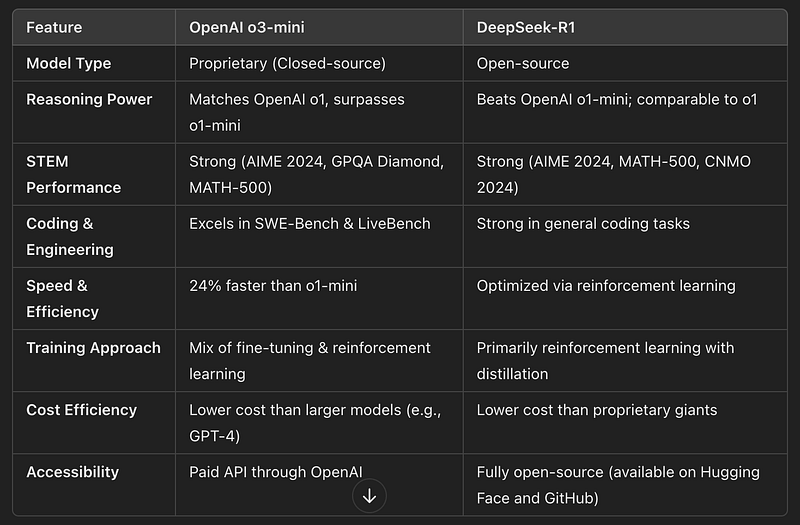
Key Takeaways: - For Software Engineering & Structured Outputs: o3‑mini is designed for production, with built‑in features that support enterprise use cases. - For Open Access & Customization: DeepSeek‑R1 stands out as an impressive open‑source alternative that offers transparency and adaptability. - Both Models Reflect a Broader Trend: They are part of an industry-wide move toward smaller, more efficient AI that balances performance with cost and accessibility.
🧠 Adaptive Reasoning: A Closer Look at o3-mini
One of the most notable innovations in o3‑mini is its adaptive reasoning capability. The model can operate in three distinct modes:
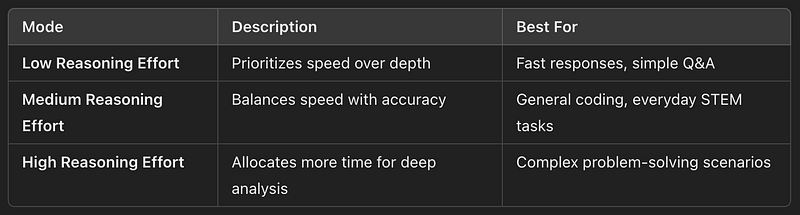
This flexibility directly addresses a common limitation in previous models, where users had to choose between rapid responses and in‑depth reasoning. With o3‑mini, you can have both — tailoring the model’s effort to the task at hand.
💻 Why This Matters for AI Users & Businesses
Whether you’re an enterprise leader, a startup founder, or an AI practitioner, o3‑mini unlocks new possibilities:
1. Enterprise‑Grade Production Readiness: OpenAI’s API delivers structured outputs, function calling, and seamless integration — ideal for robust, commercial applications. 2. Cost‑Efficient AI for Developers & Startups: o3‑mini offers high performance at a fraction of the cost of larger models, bridging the gap between expensive proprietary systems and lower‑quality open‑source solutions. 3. Enhanced Coding & STEM Support: With strong performance on benchmarks like SWE‑Bench Verified and LiveBench, o3‑mini is particularly well‑suited for competitive coding and STEM applications. 4. Improved Safety & Alignment: OpenAI’s introduction of Deliberative Alignment means the model “thinks through” potential risks before responding. This results in: - Stronger resistance to jailbreak attempts - Lower risk of biased or unsafe outputs - More robust handling of ethical dilemmas
While DeepSeek‑R1 offers excellent performance and transparency, its open‑source nature means safety guardrails depend on the user’s implementation — a notable trade‑off in many production environments.
The Future of AI: Open-Source vs. Proprietary
The emergence of models like DeepSeek‑R1 alongside OpenAI’s o3‑mini signals a major strategic shift: - Proprietary AI is Becoming Leaner & More Efficient: OpenAI is moving away from monolithic models toward flexible, cost‑optimized solutions. - Open‑Source AI is Driving Innovation: DeepSeek‑R1 has proven that high‑performance reasoning can emerge without enormous training budgets, challenging traditional economic models. - The Battle for AI Accessibility Continues: Will cost‑efficient, closed‑source models dominate the market, or will open‑source approaches drive further disruption? The answer may lie in the convergence of both paradigms.
Additional Context for the Curious
Reinforcement Learning (RL) is a training approach where models learn by receiving rewards for desired behaviors. DeepSeek‑R1 uses RL extensively, allowing it to develop sophisticated reasoning patterns without needing as much hand‑labeled data. This stands in contrast to traditional supervised learning, which relies heavily on curated datasets.
OpenAI o3‑mini and DeepSeek‑R1 each offer compelling advantages for different users. If you’re seeking a high‑performance, cost‑efficient AI with robust safety features and ready‑to‑use APIs, o3‑mini is an excellent choice. On the other hand, if you value open‑source transparency, customization, and cutting‑edge research potential, DeepSeek‑R1 is a powerful alternative.
These developments reflect a broader trend: the democratization of AI is pushing both proprietary and open‑source solutions to become leaner, faster, and more accessible — reshaping the future of AI economics.
🔗 [OpenAI o3-mini Official Release](#) 🔗 [DeepSeek-R1 GitHub Repository](#)
— Gaurav
Responses