Prompt Techniques
Prompt Techniques
-Advanced Prompt Techniques
In the rapidly evolving world of artificial intelligence, the way we communicate with AI models significantly impacts the quality and relevance of their outputs. Mastering prompt techniques is crucial for engineers, researchers, implementers, and technologists who wish to harness the full potential of AI models like GPT-4, Sonnet, Gemini and others. This guide delves into essential prompt techniques that can enhance interactions with AI, leading to more accurate and insightful results.
Prompt techniques involve crafting inputs or “prompts” to effectively guide an AI model toward producing relevant, useful, and high-quality outputs. By refining your prompts, you control the scope, depth, and quality of the model’s responses, optimizing it for tasks such as natural language understanding, code generation, data analysis, and creative content creation.
Key Prompt Techniques
Below is an exploration of essential prompt techniques, complete with examples and templates to help you apply them effectively.
#### 1\. Define the Task Clearly
Purpose: Obtain focused and relevant answers by clearly stating the intent of your query.
Explanation: Before crafting a prompt, precisely identify your goal. Defining the task helps tailor the prompt’s structure and language to suit your requirements.
Template: - “Explain \[specific topic\] in terms that are understandable for \[specific audience, e.g., beginners, students\].”
Example: - “Explain blockchain technology for a high school audience, focusing on simple terms and key concepts.”
#### 2\. Use Explicit Instructions and Constraints
Purpose: Ensure outputs meet your needs by guiding model responses with specific formats, lengths, or detail requirements.
Explanation: Define parameters such as response length or format, and specify conditions or constraints if needed.
Template: - “Provide a \[format, e.g., 200-word summary\] of \[topic\] covering \[specific aspects\].”
Example: - “In 150 words, summarize the core benefits of cloud computing for small businesses.”
#### 3\. Iterative Prompt Refinement
Purpose: Achieve the desired response by fine-tuning prompts through trials.
Explanation: Experiment with various prompt iterations to evaluate the model’s response range. Begin with a general prompt, then refine based on the output quality.
Template: - “First try: ‘Explain \[topic\].’ Refine: ‘In 100 words, explain \[topic\] with two real-world examples.’”
Example: - Initial prompt: “Explain the Internet of Things.” - Refined: “Explain the Internet of Things (IoT) in 100 words, including one example of IoT in everyday life.”
#### 4\. Leverage Context and Examples
Purpose: Set response expectations by providing background or sample responses, especially for complex tasks.
Explanation: Providing context or examples in the prompt can direct the model toward a more accurate or creative response.
Template: - “Provide a \[translation or paraphrase\] of \[sentence\] to \[language or style\]. Example: \[Example sentence and translated response\].”
Example: - “Translate this sentence to French. Example: ‘Hello’ to ‘Bonjour.’ Now, translate: ‘See you tomorrow.’”
#### 5\. Harness Role-Based Prompts
Purpose: Align responses with a specific perspective or style by assigning a role.
Explanation: Role-based prompts instruct the model to “assume a role,” which helps align responses with specific perspectives or levels of expertise.
Template: - “As a \[specific role, e.g., software engineer\], explain \[topic\] with an emphasis on \[specific focus, e.g., practical use\].”
Example: - “As a cybersecurity analyst, explain the importance of data encryption to a non-technical audience.”
#### 6\. Incorporate Conditional Instructions
Purpose: Shape nuanced answers with conditional guidance.
Explanation: Adding “if-then” conditions to your prompt can help refine responses based on criteria.
Template: - “Describe \[topic\] and include \[specific aspects\]. If positive, provide an example; if negative, mention a risk.”
Example: - “Describe the impact of artificial intelligence in education. If positive, provide an example of improved learning experiences; if negative, discuss privacy concerns.” -
Advanced Techniques
#### 7\. Chain-of-Thought Prompting
Purpose: Encourage step-by-step reasoning for complex problem-solving.
Explanation: For multi-step tasks, chain-of-thought prompting guides the model to think step-by-step.
Template: - “To solve \[problem\], go through each step: Step 1: \[action\], Step 2: \[next action\]. Explain your reasoning.”
Example: - “If you start with 20 items and give away 5, how many are left? Think through each step and explain your answer.”
#### 8\. Zero-shot and Few-shot Prompting
Purpose: Guide the model by providing few examples for open-ended tasks.
Explanation: Few-shot prompting (providing a few examples) excels in guiding models for creative or unpredictable tasks.
Template: - “For \[task\], provide an example: Example 1: \[sample input and output\]. Use the format for \[new input\].”
Example: - “Translate to German. Example 1: ‘Good morning’ becomes ‘Guten Morgen.’ Example 2: ‘Goodbye’ becomes ‘Auf Wiedersehen.’ Translate: ‘Thank you.’”
#### 9\. Prompt Stacking for Enhanced Consistency
Purpose: Use sequential prompts for multi-part tasks or layered responses.
Explanation: Chaining multiple prompts allows each prompt to build upon previous outputs.
Template: - “Step 1: \[initial query\]. Step 2: \[follow-up query based on the first result\].”
Example: - “Step 1: List three programming languages popular in data science. Step 2: For each, describe one key feature.” -
Summary
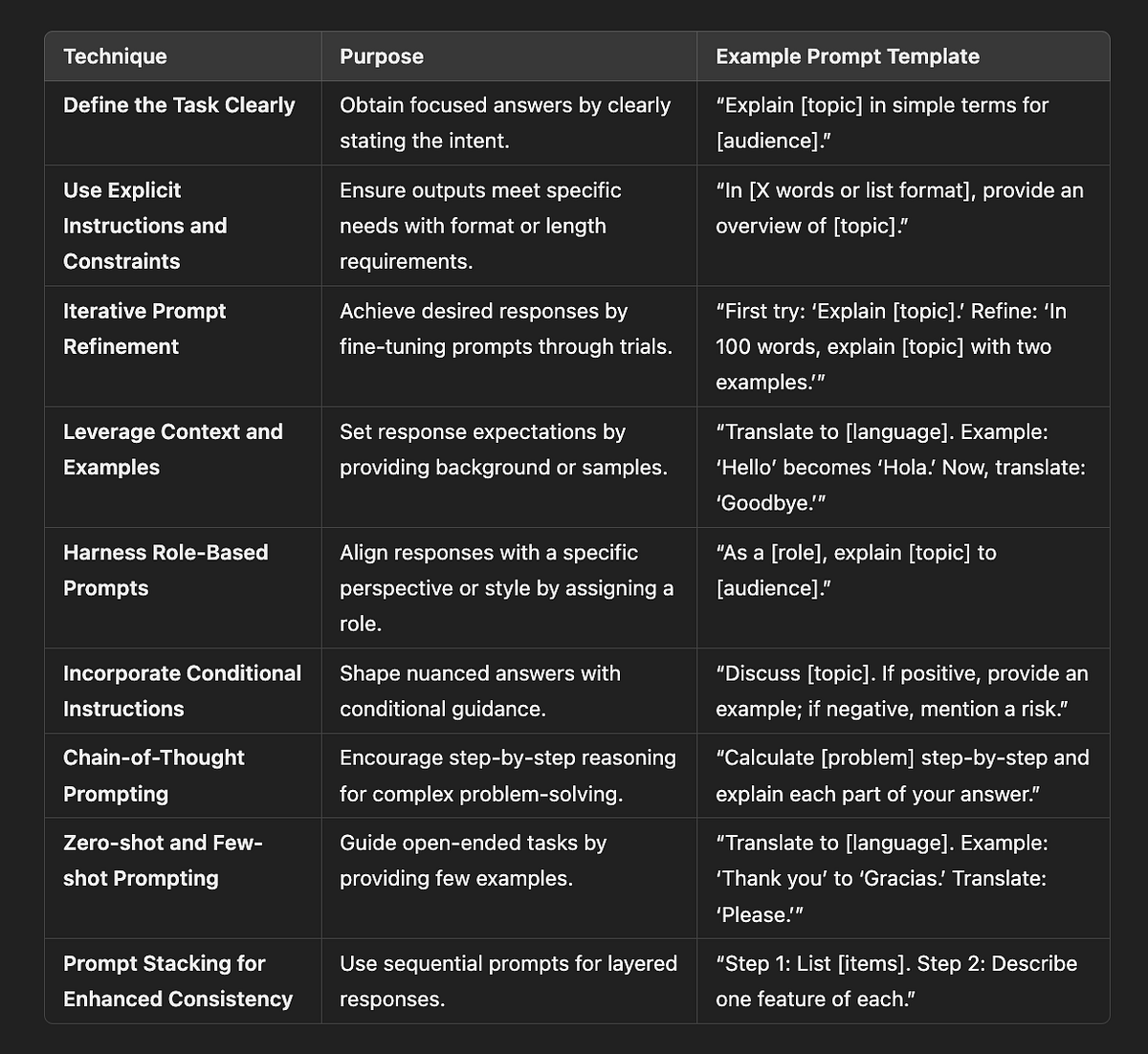
Summary Table -
Common Pitfalls and How to Avoid Them
1. Ambiguity in Prompts: Avoid vague language; the clearer the input, the more relevant the output. 2. Overloading Prompts: Packing too much into a single prompt can confuse the model. Use prompt stacking for multi-part tasks. 3. Ignoring Model Limitations: Be mindful of the model’s data limitations, biases, and inherent constraints. -
Recap: The Role of Prompting
Prompting is the discipline that encompasses these techniques. By mastering prompt , you gain the ability to communicate effectively with models, enhancing their usefulness and the quality of their outputs.
Why Prompting Matters: - Enhanced Model Performance: Well-crafted prompts minimize misunderstandings. - Efficient Resource Use: Reduces trial and error, saving time. - Alignment with Objectives: Refines model outputs to match specific goals.
By applying the prompt techniques discussed, you are essentially engaging in prompt engineering — crafting and refining prompts to guide AI models effectively. These techniques prove invaluable in daily use cases ranging from content generation and review to complex reasoning tasks.
> Much like explaining a concept to a six-year-old — where clarity, simplicity, and directness are key — approaching prompt crafting with the same mindset ensures that the AI model understands and executes the task effectively. This approach minimizes ambiguity and focuses on getting the job done efficiently.
As AI continues to permeate diverse industries, mastering prompt techniques will set apart effective AI practitioners. From enhancing business intelligence to advancing academic research, the skillful design of prompts is essential to unlocking the potential of AI-driven tools.
Feel free to leave a comment if you come across other effective prompting techniques.
— Gaurav
Responses