A Complete Guide to Implementing Contextual Retrieval RAG
A Complete Guide to Implementing Contextual Retrieval RAG
In many AI applications, the relevance of retrieved data depends not only on keyword matches or embeddings but also on the surrounding… -
A Complete Guide to Implementing Contextual Retrieval RAG
In many AI applications, the relevance of retrieved data depends not only on keyword matches or embeddings but also on the surrounding context — such as user history, session metadata, domain-specific rules, or temporal factors. Contextual Retrieval RAG extends the standard Retrieval-Augmented Generation architecture by incorporating rich context into the retrieval process, ensuring that the system fetches not just relevant documents, but also the most context-appropriate ones.
This guide outlines architectural patterns, context modeling techniques, performance optimizations, and best practices for implementing Contextual Retrieval RAG. It aims to help architects, engineering leads, and senior engineers design scalable, adaptive solutions that tailor retrieval results to evolving context signals.
Core Concepts of Contextual Retrieval RAG
Traditional RAG pipelines often rely on generic retrieval mechanisms that treat all queries equally. Contextual Retrieval RAG introduces a more nuanced approach: - Context-Aware Retrieval: Incorporate session data, user profiles, timeframes, or domain-specific indicators into retrieval queries. - Dynamic Scoring: Adjust retrieval scores based on context signals, such as recent user behavior, query history, or domain constraints. - Adaptive Reasoning & Generation: Reasoning and generation modules then operate on a more contextually aligned set of documents, producing answers that fit the user’s current situation and needs.
For example, a contextual retrieval system might adjust the retrieved documents for a user’s second query in a session based on what they asked previously, ensuring continuity and reducing repetitive or irrelevant results.
Architectural Patterns & Data Flow
Reference Architecture:
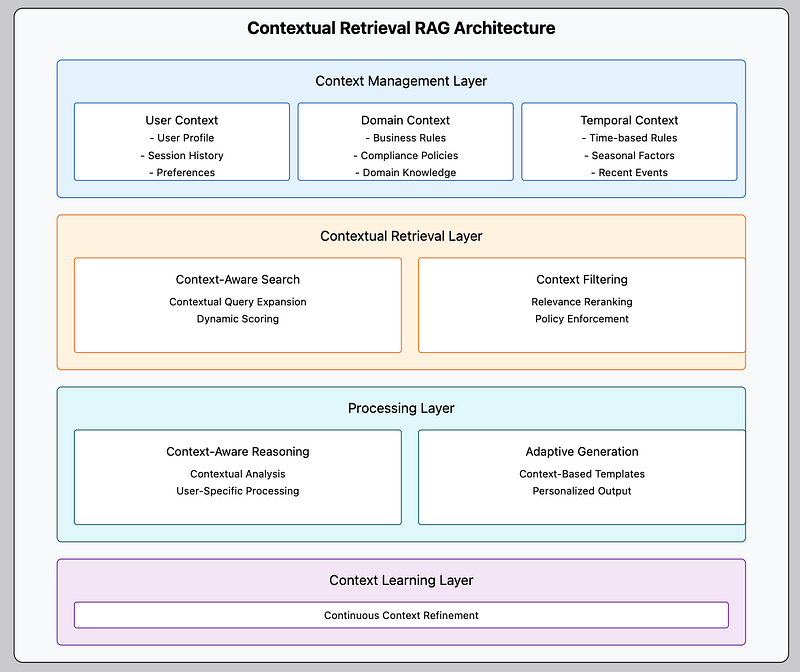
CR RAG
Data Flow:
1. User Query + Context: The incoming request includes not just a query, but also context signals (session data, user profile, time). 2. Contextualization: The Context Manager interprets these signals, translating them into retrieval constraints or boosts. 3. Contextual Retrieval: The Retrieval Module uses these context-derived parameters to filter, rank, or adjust document selection. 4. Reasoning & Generation: With contextually matched documents, the Reasoning and Generation Modules produce more accurate, user-specific responses. 5. Response Delivery: The final, context-enhanced answer is returned to the user.
Context Modeling and Integration
Context Sources: - User Profiles: Preferences, expertise level, or permissions. - Session History: Previous queries, answers, clicked documents. - Temporal Signals: Current time, recent trends, seasonal content relevance. - Domain Rules: Specialized constraints like compliance filters, language preferences, or geographic restrictions.
Integration Strategies: - Feature Injection: Add context features to the query embedding or retrieval scoring function. - Contextual Filters: Pre-filter documents by user attributes, geography, or recency before ranking. - Adaptive Reranking: Apply context-aware rerankers (e.g., boosted scores for documents from a previous user session).
Retrieval Module: Contextual Adaptations
The Retrieval Module must dynamically incorporate context: - Contextual Indexing: Maintain separate indexes or metadata fields that capture contextual attributes (timestamp, region, user group). - Hybrid Scoring: Combine standard relevance signals with context-driven boosts or penalties. - Selective Corpus Segmentation: Partition the corpus into segments aligned with context (e.g., region-specific indexes), querying only the relevant subsets.
`
class ContextualRetrievalModule:
def \_\_init\_\_(self, vector\_store, metadata\_store):
self.vector\_store = vector\_store
self.metadata\_store = metadata\_store
async def retrieve(self, query: str, context: Dict, top\_k: int = 10) -> List\[Dict\]:
query\_embedding = self.\_embed\_query\_with\_context(query, context)
candidates = await self.vector\_store.similarity\_search(query\_embedding, top\_k=50)
filtered\_candidates = self.\_apply\_contextual\_filters(candidates, context)
return self.\_rerank\_by\_context(filtered\_candidates, context, top\_k=top\_k)
`
Reasoning & Generation with Contextual Cues
After retrieval, reasoning and generation become more precise: - Context-Aware Reasoning: The Reasoning Module can interpret retrieved documents within the user’s current context, discarding irrelevant info or highlighting user-relevant details. - Contextual Templates: The Generation Module may use prompt templates that reference user preferences or session state, producing outputs that resonate with the user’s current situation. - Feedback Loops: The system might store insights from reasoning in a session state to refine subsequent retrieval steps further.
`
class ContextualReasoningModule:
async def process\_context(self, docs: List\[Dict\], context: Dict) -> Dict:
\# Integrate context signals (e.g., user's known preferences)
insights = self.\_extract\_relevant\_facts(docs, context)
adapted\_insights = self.\_adapt\_to\_user\_profile(insights, context)
return {"insights": adapted\_insights}
class ContextualGenerationModule:
async def generate(self, reasoning\_output: Dict, context: Dict) -> str:
prompt = self.\_build\_prompt\_with\_context(reasoning\_output\["insights"\], context)
response = await self.llm.generate(prompt)
return self.\_adjust\_for\_context(response, context)
`
Performance and Scalability
Index Structures: - Use metadata fields to quickly filter documents by region or time. - Maintain multiple indexes for different user segments or domains.
Dynamic Caching: - Cache context-enriched embeddings for frequent user segments or recurring contexts. - Store intermediate reasoning results keyed by context attributes (e.g., session\_id).
Horizontal Scaling: - Distribute context-managed retrieval workloads across nodes specialized in certain contexts (e.g., region-based clusters). - Implement load balancing that considers both query and context complexity.
Monitoring, Observability, and Maintenance
Metrics: - Contextual Relevance: Measure improvements in accuracy when context is applied versus baseline retrieval. - User Satisfaction: Track user engagement, session length, and click-through rates to gauge the effectiveness of context usage. - Context Feature Utilization: Log how often context signals are used and which improve retrieval quality.
Logging & Tracing: - Log the context attributes used in each query and their impact on the final ranking. - Use distributed tracing to understand how context processing affects latency.
Automated Maintenance: - Regularly update context models or metadata to ensure that evolving preferences or seasonal trends are captured. - Conduct A/B tests to validate that context-aware retrieval improves outcomes.
Security and Compliance
Access Controls: - Enforce policies that restrict certain content based on user roles, location, or other contextual attributes. - If a user’s context includes sensitive data, ensure it’s securely handled and never inadvertently used to retrieve unauthorized documents.
Encryption: - Encrypt data at rest and in transit, especially if context signals contain PII or sensitive information.
Compliance: - Apply domain- or region-specific rules (e.g., GDPR compliance in Europe) that trigger different retrieval filters. - Support user consent frameworks, ensuring that personal context signals are used only when permitted.
Common Challenges and Solutions
Context Drift: Challenge: Over time, user preferences or domain conditions change. Solution: Implement dynamic updates to context models, periodically retrain embeddings or filters, and add decay policies for outdated context signals.
Overfitting to Context: Challenge: The system might rely too heavily on context, ignoring obviously relevant documents. Solution: Maintain a balance. Use hybrid scoring strategies that combine generic relevance with context-driven adjustments.
Limited Context Availability: Challenge: Some queries lack rich contextual signals. Solution: Fallback gracefully to standard retrieval when context is sparse. Use default templates or heuristics to provide baseline results.
Lifecycle Management & MLOps Integration
- Model Versioning & Registries: Track changes in embedding models or contextual weighting schemes. Roll back if a new context integration harms retrieval quality. - CI/CD Pipelines: Automate testing of new context features. For instance, run regression tests comparing query accuracy before and after introducing a new context signal. - Continuous Data & Pipeline Management: Monitor and refine context sources. If user profiles or domain rules evolve, update data pipelines that feed context signals into retrieval logic.Example Use Cases
Personalized E-Learning Systems: - Tailor document retrieval based on a student’s progress, past lessons, and learning style. - Improve comprehension by selecting materials aligned with their current skill level.
Customer Support Platforms: - Refine retrieval based on user account type, support history, and product usage patterns. - Provide answers that match the complexity and relevance needed by a specific customer profile.
Geographically Targeted News Aggregators: - Adjust news article retrieval based on the user’s location and recent local events. - Surface regionally relevant documents, avoiding irrelevant global coverage.
Conclusion
Contextual Retrieval RAG moves beyond generic relevance scoring, leveraging user-specific, temporal, or domain-tailored signals to refine retrieval and downstream reasoning. By following the outlined architectural patterns, integrating contextual features, and adopting performance and security best practices, engineering teams can deliver systems that are not only accurate but also highly responsive to user-specific needs and changing conditions. Contextual Retrieval RAG represents a significant step toward more adaptive, personalized, and context-sensitive AI-driven interactions.
> For additional details on other type of RAGs, navigate to — [A Complete Guide to Retrieval-Augmented Generation (RAG): 16 Different Types, Their Implementation, and Use Cases](https://medium.com/aingineer/a-complete-guide-to-retrieval-augmented-generation-rag-16-different-types-their-implementation-10d48248517b)
— Gaurav
Responses