Change is hard — especially when it comes at the speed of AI.
Change is hard — especially when it comes at the speed of AI.
The same pattern is unfolding today across every department — from HR to finance to engineering. Rather than cling to legacy job… -
How to Transform Teams in the Digital Age: 5 Steps Playbook for Business Leaders
Change is hard — especially when it comes at the speed of AI. History offers a powerful reminder of what’s possible when we adapt: in 1913, Henry Ford introduced the moving assembly line — not to eliminate jobs, but to transform them. The assembly line drastically reduced production time, lowered costs, and, counterintuitively, spurred massive growth in both output and employment. Workers shifted from traditional crafts to specialized roles like quality control, process engineering, and supply-chain coordination. Ford’s innovation not only redefined manufacturing but also created a blueprint for how technology can elevate job roles and drive economic expansion.
The same pattern is unfolding today across every department — from HR to finance to engineering. Rather than cling to legacy job definitions, leaders need a practical playbook that helps teams adapt roles, reskill talent, and capture AI’s upside. Below is a concise, five‑step framework you can apply organization‑wide, followed by a concrete example of how an engineering department might put it into practice immediately.
THE FIVE-STEP PLAYBOOK
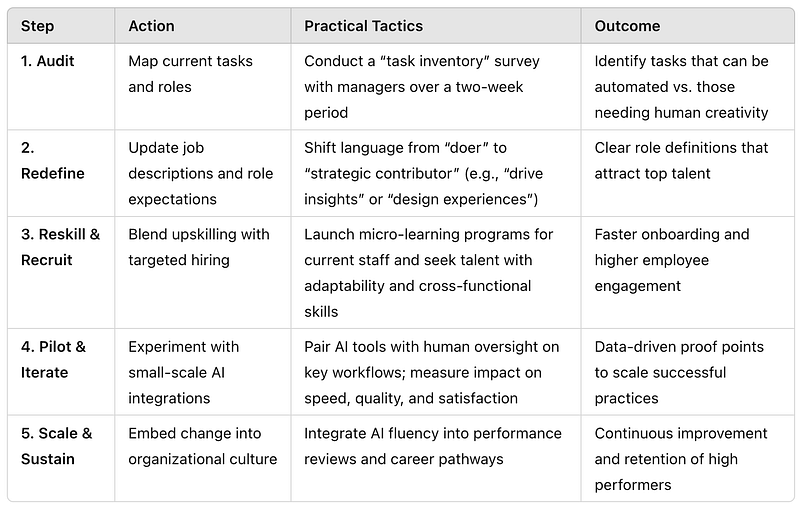
FIVE STEPS Playbook
Universal Applications Across Functions
- Customer Service: Automate routine inquiries; human reps handle complex cases and build loyalty. - Marketing: Use AI for personalization; marketers focus on creative strategy and brand storytelling. - Finance: Automate reporting; analysts focus on strategic forecasting and scenario planning. - HR: Automate resume screening; recruiters focus on culture fit and candidate experience.Engineering Department Case Study: From Code Factory to Innovation Engine
Step 1: Audit
- Map engineer tasks: AI handles boilerplate code, CI/CD scripts, routine bug fixes, migrations, and new developments. - Highlight high‑value work: architecture design, performance tuning, and customer feedback loops. - Success metrics: Identify X% of current engineering time spent on tasks that could be AI-augmented.Step 2: Redefine
- Old role: “Software Engineer — write code.” - New role: “Solution Architect | System Thinkers— conceptualize scalable systems, validate AI‑generated prototypes, and lead cross‑functional problem solving.” - Success metrics: Updated job descriptions that align with future skill requirements; clearer career progression paths.Step 3: Reskill & Recruit
- Upskill existing engineers through weekly AI tool workshops (e.g., GitHub Copilot, Cursor, Windsurf, ClaudeCode). - Hire for systems thinking and product empathy rather than syntax mastery alone. - Success metrics: 85% of team completes AI toolkit training; hiring rubric incorporates AI collaboration skills.Step 4: Pilot & Iterate
- Pilot AI‑assisted sprint: pair senior engineers with junior teammates to co‑review and let AI generate 100% of the code, review, track and update code as per your quality, compliance, demo, share and gather peer feedback. - Iterate by adjusting guardrails (style guidelines, automated tests) to optimize AI outputs. — Don’t let your linters reject the AI code! - Success metrics: Y% increase in velocity without quality degradation; positive sentiment in engineer feedback surveys.Step 5: Scale & Sustain
- Incorporate AI proficiency into annual reviews; recognize and reward AI‑driven efficiency gains. - Establish an “AI Center of Excellence” where engineers share best practices, tool evaluations, and mentor new hires. - Success metrics: Quarterly knowledge-sharing sessions with 75% participation; documented case studies of successful AI implementation.#### VIBE CODING: A NEW PARADIGM IN THE AI ERA
Beyond our five-step implementation framework, it’s worth acknowledging an emerging development approach that AI pioneer Andrej Karpathy has termed “vibe coding” — a phenomenon that’s particularly relevant to our discussion of role transformation.
ref: X
As Karpathy describes it, vibe coding is where developers “fully give in to the vibes, embrace exponentials, and forget that the code even exists.” This approach leverages advanced AI models like Claude to handle the mechanical aspects of coding while humans focus on directing the overall vision and outcome.
In vibe coding: - Developers describe changes conversationally (“decrease the padding on the sidebar by half”) - Error messages are simply pasted back to the AI for resolution - The code may grow beyond immediate comprehension of any single developer - The human’s role shifts from writing syntax to guiding direction and intent
While Karpathy notes this approach works primarily for “throwaway weekend projects” currently, it represents a fascinating glimpse into how roles may continue to evolve. The engineer becomes less a code writer and more a creative director who “sees stuff, says stuff, runs stuff, and copy pastes stuff.”
OVERCOMING COMMON CHALLENGES
- Resistance to change: Address concerns directly through open forums and by highlighting examples where AI elevates rather than eliminates roles. - Tool overwhelm: Start with a curated set of AI tools rather than introducing too many options simultaneously. - Quality concerns: Implement robust review processes and clear guidelines for AI-assisted work to maintain standards. - Skill gaps: Create personalized learning paths that acknowledge varying technical comfort levels.Getting Started Today
1. Schedule a 1‑day cross-functional workshop to map current roles and tasks. 2. Pilot a small AI‑augmented project in engineering or any willing department. 3. Commit to quarterly role reviews to ensure job descriptions and career paths evolve with technology.
Bottom Line: Just as Ford’s moving assembly line reimagined manufacturing a century ago, today’s leaders can transform their organizations by rethinking roles, reskilling teams, and leveraging AI to unlock new levels of creativity and efficiency. Whether you lead engineering, marketing, finance, or any other department, this playbook provides a clear, actionable roadmap to convert disruption into opportunity.
It’s time to lead with vision and courage. Embrace the change, invest in your people, and build a future-ready organization that not only survives but thrives in the age of AI.
— Gaurav
Responses