A Complete Guide to Implementing HyDE RAG
A Complete Guide to Implementing HyDE RAG
Retrieval-Augmented Generation systems depend heavily on the quality of retrieved documents to provide accurate, context-rich answers. HyDE… -
A Complete Guide to Implementing HyDE RAG
Retrieval-Augmented Generation systems depend heavily on the quality of retrieved documents to provide accurate, context-rich answers. HyDE RAG (Hypothetical Document Embeddings) introduces a novel twist: before querying the actual corpus, the system generates a hypothetical document — a guess at what a good answer might look like — and uses that hypothesized text’s embedding as a query vector. By doing so, it often retrieves more semantically aligned documents, improving the quality and coherence of final answers.
This guide outlines architectural patterns, core principles, performance considerations, and best practices for implementing HyDE RAG. It aims to help architects, engineering leads, and senior engineers leverage hypothetical document generation to enhance retrieval accuracy and relevance.
Core Concepts of HyDE RAG
HyDE RAG modifies the retrieval pipeline: - Hypothetical Document Generation: Before searching external data stores, the model generates a hypothetical (synthetic) document that might answer the user’s query. - Embedding-Based Retrieval with Hypotheses: The system then computes embeddings for the hypothetical document and uses these embeddings to query the vector database, often resulting in more contextually aligned documents. - Refinement via Real Documents: After retrieving documents guided by the hypothetical embedding, the system integrates them into a RAG pipeline to produce a final, factually supported answer.
For example, if a user asks a complex technical question, the system first drafts a hypothetical explanation. Even if this guess is imperfect, it often captures key concepts and context, allowing the subsequent embedding-based retrieval to find more semantically relevant real documents.
Architectural Patterns & Data Flow
Reference Architecture:
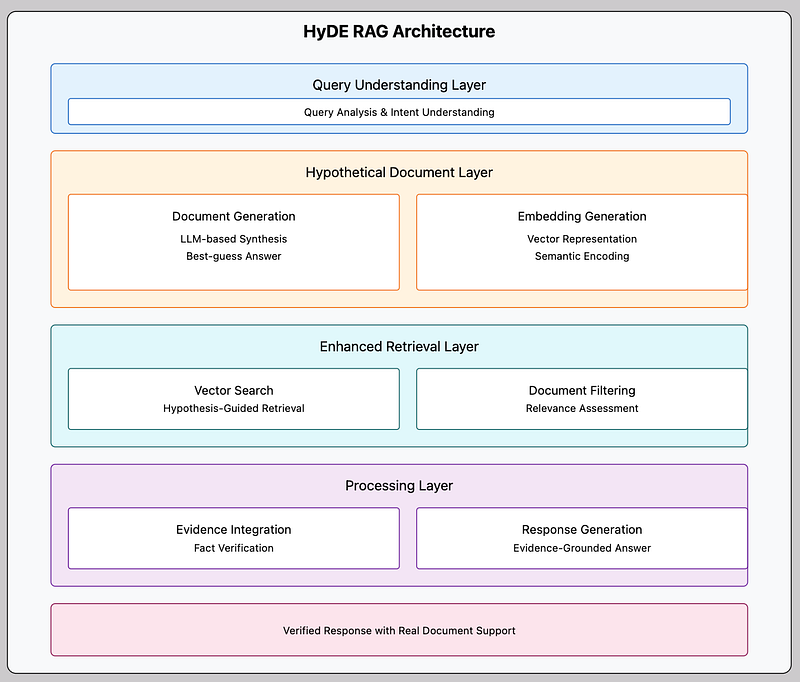
HyDE RAG
Data Flow:
1. User Query: The user asks a question. 2. Hypothetical Generation: The system first generates a hypothetical document that might answer the query. 3. Embedding Query: The hypothetical document is embedded to produce a query vector. 4. Real Document Retrieval: Using this embedding, the system retrieves relevant documents from a vector database. 5. RAG Pipeline Completion: The retrieved documents and initial hypothetical reasoning guide the final reasoning and generation steps, producing a more accurate and contextually supported answer.
Hypothetical Document Generation
Techniques for Hypothetical Documents: - LLM Prompting: Prompt the model to produce a best-guess answer or explanation to the query before performing retrieval. - Minimal Context: Use no external documents for this initial guess — rely solely on the model’s internal knowledge. - Structured or Free-Form: Hypothetical docs can be free-form text or follow a structured template (e.g., Q&A format, bullet points).
Integration Strategies: - Chain-of-Thought: Let the model reason step-by-step internally before producing the hypothetical doc. - Style & Length Constraints: Control the length and detail level so the hypothetical embedding doesn’t become too noisy.
#### Implementing HyDE Retrieval
`
class HyDERetrievalModule:
def \_\_init\_\_(self, vector\_store, llm):
self.vector\_store = vector\_store
self.llm = llm
async def retrieve(self, user\_query: str, top\_k: int = 5) -> List\[Dict\]: \# (1) Generate hypothetical doc hypothetical\_doc = await self.\_generate\_hypothetical\_doc(user\_query)
\# (2) Embed hypothetical doc hyp\_embedding = self.\_embed(hypothetical\_doc)
\# (3) Vector search using hypothetical embedding real\_docs = await self.vector\_store.similarity\_search(hyp\_embedding, top\_k=top\_k) return real\_docs
async def \_generate\_hypothetical\_doc(self, query: str) -> str:
prompt = f"Generate a hypothetical best-guess answer to: {query}"
return await self.llm.generate(prompt)
`
Reasoning & Generation with HyDE
After retrieving documents guided by the hypothetical embedding: - Evidence Alignment: Compare the hypothetical answer’s content with retrieved documents, adjusting reasoning to fact-check and refine details. - Conflict Resolution: If the hypothetical guess conflicts with authoritative retrieved docs, favor the real documents. - Contextual Prompts: Incorporate both the hypothetical doc and the retrieved documents into the final generation prompt, encouraging the model to produce a grounded, evidence-based answer.
`
class HyDEReasoningModule:
async def process(self, hypothetical\_doc: str, real\_docs: List\[Dict\]) -> Dict:
combined\_context = self.\_merge\_hypothetical\_with\_real(hypothetical\_doc, real\_docs)
refined\_insights = self.\_derive\_consistent\_facts(combined\_context)
return {"insights": refined\_insights}
class HyDEGenerationModule:
async def generate(self, reasoning\_output: Dict) -> str:
prompt = self.\_build\_final\_prompt(reasoning\_output\["insights"\])
final\_answer = await self.llm.generate(prompt, parameters={"max\_length": 1024})
return final\_answer
`
Performance and Scalability
Efficiency Tips: - Short Hypothetical Docs: Limit the length of the hypothetical doc to reduce embedding complexity. - Caching Hypothetical Embeddings: If similar queries recur, cache their hypothetical embeddings for faster retrieval. - Adaptive Strategies: If the hypothetical approach fails for certain query types, fallback to a standard retrieval approach.
Load Balancing: - Scale vector search infrastructure to handle the additional load. - If generating hypothetical docs is slow, optimize LLM calls or use faster inference hardware.
Monitoring, Observability, and Maintenance
Metrics: - Accuracy Improvements: Compare query results with and without HyDE to measure precision/recall changes. - User Satisfaction: Track changes in user feedback or engagement after introducing HyDE steps. - Latency Impact: Monitor how much time the hypothetical generation adds to overall response time.
Logging & Tracing: - Log hypothetical documents generated for each query. - Trace embedding queries to ensure that hypothetical embeddings lead to better retrieval results over time.
Automated Maintenance: - Periodically reassess prompt quality for hypothetical generation. - Update embedding models if domain shifts occur, maintaining alignment with user queries.
Security and Compliance
Access Controls: - Hypothetical documents should not circumvent access rules. If the model can guess restricted content, ensure the final retrieval step still respects authorization.
Privacy & Compliance: - Ensure hypothetical docs do not store PII or sensitive data inadvertently. They are synthetic, but prompts should avoid user-sensitive details. - Follow compliance frameworks as if the hypothetical doc were user-generated content.
Common Challenges and Solutions
Inaccurate Hypothetical Answers: Challenge: The hypothetical doc may contain factual errors. Solution: Let the reasoning step rely more on retrieved docs than the hypothetical guess. The guess primarily guides retrieval embeddings, not final content.
Over-Reliance on Hypothetical Content: Challenge: The system might overly trust the hypothetical guess. Solution: Introduce logic in reasoning that prioritizes real documents and treats the hypothetical doc as a guiding hint, not an authoritative source.
Complex Queries: Challenge: Some queries might be too vague for a meaningful hypothetical doc. Solution: Use fallback retrieval methods if the hypothetical approach yields poor results or fails to retrieve relevant documents.
Lifecycle Management & MLOps Integration
- Model Versioning & Registries: Track changes to the prompts used for generating hypothetical docs. Experiment with different prompt templates over time. - CI/CD Pipelines: Run regression tests that compare performance (accuracy, latency) before and after introducing HyDE steps. - Continuous Data & Pipeline Management: Monitor if the corpus or user queries evolve, requiring updates to hypothetical doc generation prompts or embedding models.Example Use Cases
Complex Technical Queries: - For intricate engineering or scientific questions, a hypothetical explanation first captures key concepts, guiding retrieval to more relevant technical papers or manuals.
General Knowledge Assistants: - For broad or ambiguous queries, a hypothetical doc helps the system guess the user’s intent, retrieving better-matched reference materials.
Enterprise Knowledge Management: - In complex enterprise domains, the hypothetical doc can steer retrieval toward the most relevant internal documents, improving answer quality for specialized queries.
Conclusion
HyDE RAG offers a unique approach to improving retrieval quality by generating a hypothetical answer first, then using its embedding to find more contextually aligned documents. By integrating hypothetical document generation, embedding-based retrieval, and evidence-informed reasoning, engineering teams can build more accurate and responsive AI systems. Following the architectural patterns, strategies, and best practices in this guide, organizations can unlock the benefits of HyDE to enhance their RAG pipelines.
— Gaurav
Responses