A Complete Guide to Implementing Knowledge-Enhanced RAG
A Complete Guide to Implementing Knowledge-Enhanced RAG
AI systems often rely on unstructured data and generic language models, which can limit their ability to provide domain-specific insights… -
A Complete Guide to Implementing Knowledge-Enhanced RAG
AI systems often rely on unstructured data and generic language models, which can limit their ability to provide domain-specific insights, adhere to authoritative sources, or leverage structured information. Knowledge-Enhanced Retrieval-Augmented Generation (Knowledge-Enhanced RAG) addresses these limitations by integrating domain ontologies, knowledge graphs, taxonomies, or curated datasets into the RAG pipeline. The result is more accurate, reliable, and explainable outputs driven by well-defined knowledge structures.
This guide outlines architectural patterns, modeling techniques, performance optimization strategies, and best practices for implementing Knowledge-Enhanced RAG. It aims to help architects, engineering leads, and senior engineers design scalable solutions that combine the strengths of language models with structured, domain-specific intelligence.
Core Concepts of Knowledge-Enhanced RAG
Knowledge-Enhanced RAG brings structured knowledge sources into the RAG pipeline: - Structured Retrieval: Retrieve not only unstructured text but also entries from knowledge bases, relational databases, or ontologies. - Domain-Aware Reasoning: Leverage entity relationships, hierarchical taxonomies, or reference data to inform the reasoning process and reduce hallucinations. - Knowledge-Grounded Generation: Produce answers grounded in known facts, verified entities, and authoritative sources, enhancing both correctness and explainability.
For example, a medical assistant could combine patient notes (unstructured text) with a medical ontology or drug reference database, ensuring it provides evidence-based recommendations consistent with authoritative clinical guidelines.
Architectural Patterns & Data Flow
Reference Architecture:
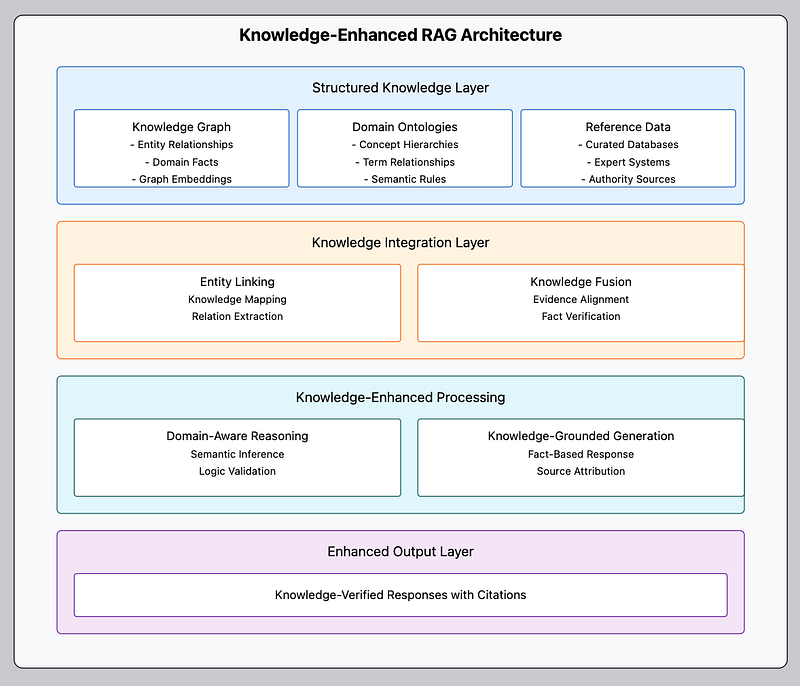
KGE RAG
Data Flow:
1. User Query: The user asks a question potentially requiring domain knowledge. 2. Unstructured & Knowledge Retrieval: The system queries both text-based repositories and structured knowledge sources (e.g., knowledge graphs, ontologies). 3. Evidence Fusion: Merge and align retrieved text snippets with structured data (entities, relationships) to form a richer, domain-aware context. 4. Domain-Aware Reasoning & Generation: Reasoning and generation modules leverage this enriched context to produce answers that are both accurate and explainable. 5. Response Delivery: The final, knowledge-enhanced answer is returned to the user.
Integrating Structured Knowledge
Knowledge Sources: - Knowledge Graphs (KGs): Graph representations of entities and their relationships. - Ontologies & Taxonomies: Hierarchical classification systems defining domain terms and concepts. - Databases & Reference Tables: Curated, authoritative datasets providing reliable facts, metrics, or definitions.
Integration Strategies: - Entity Linking: Identify entities mentioned in user queries and retrieved text, then map them to KG nodes or ontology concepts. - Relation Extraction: Extract relationships from text to cross-check or enrich the KG. - Query Expansion & Constraints: Use ontology terms or KG relations to refine retrieval queries, ensuring they focus on relevant domain concepts.
Retrieval Module: Combining Unstructured and Structured Data
The Retrieval Module now must query both text and structured knowledge: - Hybrid Retrieval Pipelines: First retrieve candidate documents from unstructured indexes (e.g., vector stores, Elasticsearch) and then fetch associated KG triples or database records relevant to identified entities. - Metadata-Based Filtering: Use entity types, domain tags, or hierarchical categories to filter or boost certain documents. - Logical Constraints: If the ontology specifies certain validity constraints (e.g., “Treatment X is for disease Y”), incorporate these rules into the retrieval scoring process.
`
class KnowledgeEnhancedRetrievalModule:
def \_\_init\_\_(self, vector\_store, kg\_client):
self.vector\_store = vector\_store
self.kg\_client = kg\_client
async def retrieve(self, query: str, top\_k: int = 10) -> Dict:
docs = await self.vector\_store.similarity\_search(self.\_embed(query), top\_k=top\_k)
entities = self.\_extract\_entities(query)
kg\_facts = await self.kg\_client.get\_related\_facts(entities)
return {"docs": docs, "kg\_facts": kg\_facts}
`
Reasoning Module: Domain-Aware Reasoning
The Reasoning Module aligns and interprets evidence from both text and structured sources: - Entity Disambiguation: Confirm that mentioned entities in text align with KG entries. - Fact Verification: Cross-check textual claims against authoritative databases or ontology constraints. - Hierarchical Reasoning: Leverage taxonomies to interpret ambiguous concepts. For instance, if the question mentions a “heart condition,” relate it to a cardiovascular disease category in the ontology.
`
class KnowledgeEnhancedReasoningModule:
async def process\_evidence(self, docs: List\[Dict\], kg\_facts: List\[Dict\]) -> Dict:
aligned\_entities = self.\_align\_entities(docs, kg\_facts)
verified\_facts = self.\_verify\_claims(docs, kg\_facts, aligned\_entities)
structured\_insights = self.\_derive\_insights(verified\_facts)
return {"insights": structured\_insights}
`
Generation Module: Knowledge-Grounded Outputs
The Generation Module uses structured knowledge to produce more factually robust answers: - Prompt Templates: Incorporate ontology terms, KG entities, or database references into prompts, encouraging the model to ground its answers in known facts. - Fact Attribution: Cite the relevant sources or KG nodes when providing critical facts. - Explainability: Highlight how certain knowledge nodes informed the answer, increasing user trust.
`
class KnowledgeEnhancedGenerationModule:
async def generate(self, reasoning\_output: Dict) -> str:
prompt = self.\_build\_knowledge\_aware\_prompt(reasoning\_output\["insights"\])
raw\_answer = await self.llm.generate(prompt, parameters={"max\_length": 1024})
final\_answer = self.\_refine\_answer\_with\_citations(raw\_answer, reasoning\_output\["insights"\])
return final\_answer
`
Performance and Scalability
Indexing & Caching: - Precompute embeddings for ontology labels and entity descriptions. - Cache frequent KG queries to reduce latency.
Horizontal Scaling: - Distribute KG queries across multiple shards or services. - Partition large ontologies or knowledge graphs to handle domain expansions.
Efficiency: - Implement a layered retrieval approach: first narrow down relevant ontology branches, then fetch corresponding text documents.
Monitoring, Observability, and Maintenance
Metrics: - Factual Accuracy: Evaluate how often the system provides correct answers, verified against known facts. - Entity Linking Precision/Recall: Measure the accuracy of mapping textual mentions to the correct knowledge nodes. - Coverage of Knowledge: Track what fraction of user queries leverage KG facts or ontologies.
Logging & Tracing: - Log which KG facts were retrieved and used. - Trace queries from embedding to KG lookups and final answer generation.
Automated Maintenance: - Periodically update ontologies or KGs as domain knowledge evolves. - Refresh embeddings when KG structure changes or new entities are added.
Security and Compliance
Access Controls: - Restrict certain parts of the knowledge graph or databases based on user roles or confidentiality constraints. - Enforce data governance policies to ensure only authorized users can query sensitive knowledge.
Encryption: - Encrypt KG data at rest if it contains proprietary or sensitive domain knowledge. - Use TLS for all communications between RAG components.
Compliance: - Adhere to industry regulations (e.g., HIPAA in healthcare) by filtering out non-compliant knowledge sources. - Support data anonymization where required by privacy laws.
Common Challenges and Solutions
Incomplete or Outdated Knowledge: Challenge: The KG might lack coverage or contain outdated facts. Solution: Regularly maintain and expand the knowledge graph; implement fallback strategies to rely more on text when structured data is incomplete.
Conflicting Information: Challenge: Textual documents may contradict authoritative KG facts. Solution: Always prioritize authoritative knowledge; use reasoning rules to downgrade or discard sources that conflict with trusted KG facts.
Complex Domain Modeling: Challenge: Complex ontologies or hierarchical taxonomies may be hard to integrate. Solution: Start with simpler domain models and iteratively refine; use embedding models fine-tuned for entity and relation understanding.
Lifecycle Management & MLOps Integration
- Model Versioning & Registries: Track changes to embedding models and reasoning heuristics as KGs evolve. - CI/CD Pipelines: Test KG updates, ontology expansions, and entity linking improvements before deployment. - Continuous Data & Pipeline Management: Monitor domain changes (e.g., new products, new medical treatments) and update knowledge sources accordingly.Example Use Cases
Healthcare Virtual Assistants: - Integrate clinical guidelines, drug databases, and symptom ontologies. - Offer evidence-based answers that reflect the latest medical knowledge.
Enterprise Knowledge Management: - Incorporate corporate taxonomies, product catalogs, and compliance rules. - Provide consistent, authoritative responses aligned with internal standards.
Legal Research Tools: - Fuse legal code references and case law databases with text-based reasoning. - Deliver legally sound answers grounded in precedent and statutory authority.
Conclusion
Knowledge-Enhanced RAG augments standard retrieval-augmented generation by anchoring answers in structured, authoritative knowledge sources. By integrating knowledge graphs, ontologies, and curated datasets, engineering teams can achieve more accurate, explainable, and reliable results. Following the best practices, architectural patterns, and performance strategies outlined in this guide, organizations can harness the power of domain-specific intelligence to elevate their AI-driven solutions.
> For additional details on other type of RAGs, navigate to — [A Complete Guide to Retrieval-Augmented Generation (RAG): 16 Different Types, Their Implementation, and Use Cases](https://medium.com/aingineer/a-complete-guide-to-retrieval-augmented-generation-rag-16-different-types-their-implementation-10d48248517b)
— Gaurav
Responses