Llama 4: Breaking New Ground in Multimodal AI
Llama 4: Breaking New Ground in Multimodal AI
Artificial intelligence models are growing not just bigger, but also more flexible and accessible. Meta’s newly announced Llama 4 is a… -
Llama 4: Breaking New Ground in Multimodal AI
Artificial intelligence models are growing not just bigger, but also more flexible and accessible. Meta’s newly announced Llama 4 is a prime example: it’s the first natively multimodal open-weight model in the Llama family, built to handle both text and images at scale. Yet as exciting as it sounds, running Llama 4 locally might not be straightforward right out of the gate. Let’s dive in.
1\. What’s New in Llama 4 — and Why It’s Different
Multimodality Most language models today only handle text. Llama 4, on the other hand, was trained from the ground up to process both text and images. Instead of awkwardly bolting on a separate image encoder, it uses a unified “early fusion” approach during pre-training. - Why it matters: With a single model, you can have it read documents, view pictures, and respond intelligently about both. Potential use cases: describing, comparing, or summarizing multiple images alongside text.
Incredible Context Windows - Scout, the smaller Llama 4 variant, supports up to 10 million tokens. - Maverick, the larger variant, supports 1 million tokens.
Remember that 1 token is roughly ~¾ of a word in English; a million tokens is enormous, let alone ten million. - Why it matters: The model can deal with massive data (entire codebases, large sets of documents, long user histories) all at once.
Open Weights, Mixture-of-Experts (MoE) Architecture Both Llama 4 models share a “Mixture-of-Experts” design — only 17B parameters (the “active” subset) are used at any given time, even though the total weight count can be hundreds of billions. - Why it matters: MoE is more efficient in both training and inference, effectively making a large model “feel” smaller to run. This sets Llama 4 apart from the typical “dense” models where all parameters activate with each token.
In summary, the release includes — - Native multimodality: Llama 4 models seamlessly integrate text and vision from the ground up, rather than bolting on vision capabilities to a text-only model. - Unprecedented context length: Llama 4 Scout offers a remarkable 10 million token context window, dwarfing previous generations and most competitors. - Mixture-of-experts architecture: This fundamental shift in design (more on this below) allows for much greater parameter efficiency. - Focus on real-world deployment: These models are engineered with practical constraints in mind, optimizing for the performance-to-cost ratio.
and three models: - Llama 4 Scout: 17B active parameters (109B total) with 16 experts - Llama 4 Maverick: 17B active parameters (400B total) with 128 experts - Llama 4 Behemoth: 288B active parameters (~2T total) with 16 experts (still in training)
This represents Meta’s commitment to open-weight models that can compete with closed commercial alternatives while being accessible to the broader AI community.
2\. MoE in Simple Terms
[“Mixture of Experts”](https://www.ibm.com/think/topics/mixture-of-experts) might sound complex, but the basic idea is:
1. You have multiple ‘expert’ sub-networks, each specializing in handling certain types of data or patterns. 2. Only one (or a small fraction) of these experts is active for any single token or piece of data. 3. This allows the overall model to have a huge capacity — billions of parameters across all experts — without actually needing all that capacity turned on for every token.
How MoE Works
In a mixture-of-experts architecture:
1. The model contains multiple “expert” neural networks, each specializing in different aspects of language or knowledge 2. For each token, a “router” component determines which expert(s) should process it 3. Only a small subset of the total parameters activates for each token
For example, when Llama 4 Maverick processes text, each token activates only the shared expert and one of the 128 specialized experts, using just a fraction of the total 400B parameters.
Why This Matters
The MoE approach delivers several critical advantages: - Efficiency: Despite having hundreds of billions of total parameters, inference remains manageable because only a small portion activates at any moment - Specialization: Experts can develop deeper knowledge in specific domains - Scalability: Adding more parameters doesn’t linearly increase computational costs - Practical deployment: Llama 4 Scout can run on a single H100 GPU despite its effective capacity
This architecture represents a fundamental rethinking of how we build and deploy large language models, prioritizing efficiency alongside raw capability.
3\. How Does Llama 4 Stack Up?
According to Meta’s release notes (and as summarized in the Llama 4 PDFs):
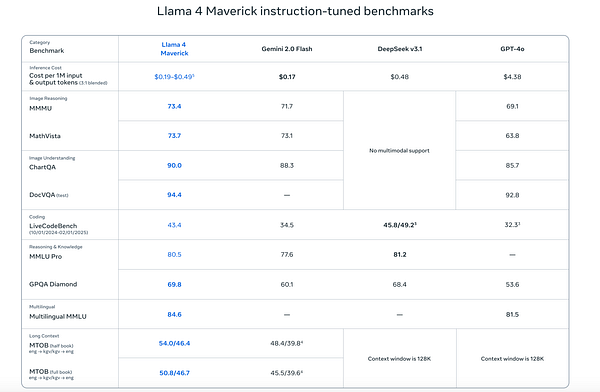
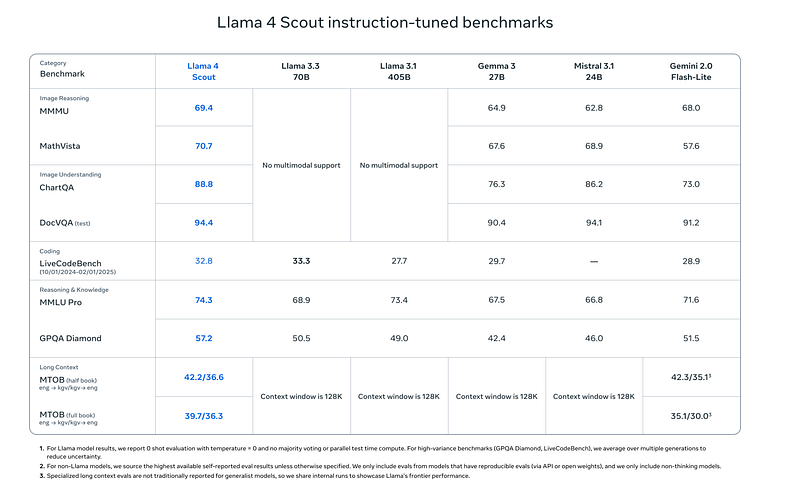
Performance - Scout (17B active params, 16 experts) can match or exceed many prior models in coding tasks (like Mistral 3.1 or Gemma 3) and general reasoning. - Maverick (17B active params, 128 experts) beats GPT-4o and Gemini 2.0 in a range of standard benchmark tests and is more efficient than much larger “dense” models.
Compared to GPT-4 or Claude - Llama 4’s biggest variant, Behemoth, reportedly outperforms GPT-4.5 and Claude Sonnet 3.7 on advanced STEM benchmarks. Behemoth, however, isn’t publicly released — but it taught the smaller Llama 4 models via “distillation,” so Scout and Maverick gained a lot of that bigger model’s expertise.
Edge in Multimodal - Llama 4 is “natively” multimodal — no complicated bridging. That’s a big deal if your use case needs vision + text.
Context Length - Llama 4 Scout’s 10M tokens is a record-breaking context window. For perspective, you could feed it entire books or thousands of pages.
Reference: [https://ai.meta.com/blog/llama-4-multimodal-intelligence/](https://ai.meta.com/blog/llama-4-multimodal-intelligence/)
What These Benchmarks Mean
These comparisons indicate: - Real-world applications: Better code generation, more accurate mathematical problem-solving, and improved multilingual capabilities - Cost efficiency: Achieving comparable or better results than more expensive proprietary models - More accessible AI: Bringing frontier model capabilities to a broader range of users and developers
> The upshot: If your project needs a cutting-edge open model that deals with huge or multi-image contexts, Llama 4 is currently the forerunner.
4\. Running It Locally — Is It Actually Possible?
Short answer: - You can experiment with Llama 4 Scout locally, but the recommended hardware is an NVIDIA H100 GPU. - Officially, INT4 (4-bit quantized) versions can fit Scout on one H100. That’s out of reach for most hobbyists right now, as the H100 is enterprise-grade hardware.
Current Availability
As of April 6, 2025, Meta has made Llama 4 Scout and Llama 4 Maverick available through: - Direct download from [llama.com](https://llama.com) - Hugging Face model repository - Integration with Meta AI in WhatsApp, Messenger, Instagram Direct, and on the Meta.AI website
What if you only have a smaller GPU or a CPU? - Today, running Llama 4 on standard gaming cards (like an RTX 3090) is not formally supported or might be extremely slow or memory-intensive. - Expect the open-source community to attempt partial offloading or advanced quantizations soon. But out of the box, you’ll likely need cloud GPU access for any practical usage.
Cloud-based or Hosted Services - If you can’t run it yourself, you can still try Llama 4 via Meta’s partner platforms or on services like Hugging Face. - Some third-party providers may soon allow “click and run” notebooks for Llama 4.
So, in the near term, think “cloud GPU rental” (e.g. AWS, Azure, etc.) or find a specialized provider to get your hands on it. Locally on consumer GPUs is currently very challenging.
5\. Key Takeaways and Important Details
#### Technical Innovations Worth Noting - Early fusion for multimodality: Unlike models that process images and text separately, Llama 4 integrates them early in the model backbone, enabling more sophisticated multimodal reasoning. - iRoPE architecture: A novel approach for handling long contexts, using interleaved attention layers without positional embeddings and inference-time temperature scaling. - Extensive multilingual capabilities: Trained on 200 languages, with over 100 having more than 1 billion tokens each, representing 10x more multilingual content than Llama 3. - Asynchronous reinforcement learning: Meta developed a fully asynchronous online RL training framework that improved training efficiency by approximately 10x over previous generations.
#### Safeguards and Responsible AI
Meta emphasizes several important safety measures: - Comprehensive evaluations: Systematic testing across diverse scenarios and use cases. - GOAT (Generative Offensive Agent Testing): A new automated adversarial testing approach that complements human red-teaming. - Open-source safety tools: Llama Guard for input/output safety and Prompt Guard for detecting malicious prompts. - Reduced political bias: Meta reports significant improvements in political neutrality, with Llama 4 refusing less on debated topics (under 2% compared to 7% in Llama 3.3).
#### Business and Ecosystem Impact - Ecosystem approach: Meta is working with a broad coalition of partners across cloud providers, hardware manufacturers, and AI startups. - LlamaCon announcement: Meta plans to share more about their vision at LlamaCon on April 29, 2025. - Competitive positioning: These models explicitly target competition with proprietary models from OpenAI, Anthropic, and Google, potentially disrupting the current AI landscape.
Llama 4 is a major leap forward for open, multimodal AI — combining a more efficient Mixture-of-Experts backbone, enormous context windows, and integrated text-image understanding. While true local deployment is still tough unless you have an H100 or enterprise-class GPU setup, the open weights mean the community can (and likely will) build more accessible solutions over time. The Llama 4 release signals several important trends: - Efficiency over raw scale: The focus on MoE architecture indicates the industry is moving beyond simply adding parameters. - Multimodal as standard: Future foundation models will likely be multimodal by default. - Context length race: The 10M token context of Scout suggests extremely long context is becoming a key differentiator. - Open weights momentum: Meta’s continued investment in open-weight models provides a counterbalance to closed commercial systems. - Distillation as strategy: The use of Behemoth as a teacher for smaller models shows how frontier research trickles down to deployable systems.
For now: - If you’re researching or building advanced prototypes, you can spin up a cloud instance with an H100 to try out Llama 4 Scout or Maverick. - If you’re just curious about capabilities, watch for official demos via the Meta AI site or community-run hosting services. - If you care about the future of open AI, Llama 4 is a big milestone — showing that top-tier, multimodal AI can be shared, studied, and built upon.
Llama 4 isn’t simply “another big model.” It’s a hint at where open AI is headed: widely available, highly capable, and ready to handle all the data we can throw at it — whether text, images, or both.
Resources - 📥 [Download on Hugging Fac](https://huggingface.co/meta-llama) - 📄 [Model Card & Prompt Formats](https://www.llama.com/docs/model-cards-and-prompt-formats/llama4_omni/) - 🧠 [Llama 4 Blog](https://ai.meta.com/blog/llama-4-multimodal-intelligence/) - 💬 [Join LlamaCon (April 29)](https://www.llama.com/events/llamacon/signup/)
— Gaurav
Responses