A Complete Guide to Implementing Multi-Modal RAG
A Complete Guide to Implementing Multi-Modal RAG
As enterprises expand their AI capabilities, the need to handle and reason over diverse data types — such as text, images, audio, and… -
A Complete Guide to Implementing Multi-Modal RAG
As enterprises expand their AI capabilities, the need to handle and reason over diverse data types — such as text, images, audio, and video — has grown. Multi-Modal Retrieval-Augmented Generation (Multi-Modal RAG) addresses this need by integrating and processing different modalities within the RAG framework. This enables richer, more contextually aware responses that leverage a wide variety of data sources.
This guide provides detailed architectures, reference patterns, and practical steps to help architects, engineering leads, and senior engineers implement and scale Multi-Modal RAG systems.
Core Concepts of Multi-Modal RAG
Multi-Modal RAG extends the classic Retrieval, Reasoning, and Generation architecture to incorporate multiple data types. In addition to the textual Retrieval Module, new capabilities handle images, audio, or video content. - Retrieval Module: Fetches relevant data from various indexed sources (text documents, image databases, vector embeddings for images/audio). - Modality Integration: Normalizes and represents different modalities (e.g., converting images to embeddings, transcribing audio) to create a unified semantic space. - Reasoning Module: Combines multimodal information to form a rich, contextually informed understanding. - Generation Module: Produces coherent, contextually aware outputs that may describe, reference, or integrate information from multiple modalities.
By leveraging diverse data sources, Multi-Modal RAG can deliver more comprehensive and insightful responses. For example, a product marketing assistant could retrieve product images, branding guidelines, user manuals (text), and promotional videos, then produce a content strategy that visually references product images while adhering to textual brand narratives.
Architectural Patterns & Data Flow
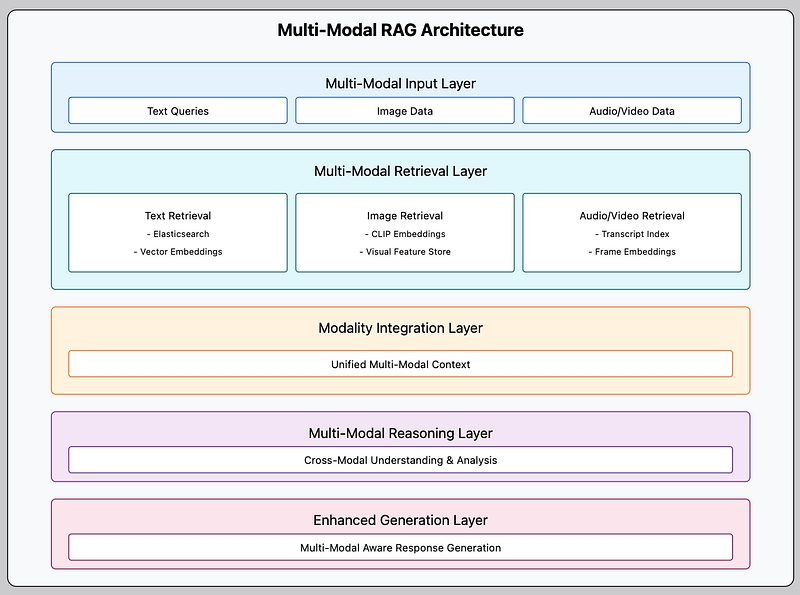
Multi-Modal RAG Architecture
Data Flow:
1. Incoming Query: A user query requests multi-modal information (e.g., “Show me the latest product image and summarize its specifications”). 2. Multi-Modal Retrieval: The system fetches text documents, images, and possibly audio/video transcripts related to the query from dedicated indexes. 3. Modality Integration: Different data modalities (text, image embeddings, audio transcripts) are harmonized into a unified context. 4. Contextual Reasoning: The Reasoning Module uses this integrated, multi-modal context to form a coherent understanding. 5. Contextual Generation: The Generation Module produces output referencing multiple data types (e.g., a textual description that includes details from images and product specs). 6. Response Delivery: The final, multi-modal-aware answer is returned to the user.
Multi-Modal Retrieval: Technical Considerations
Data Sources: - Text Corpora: Documents, manuals, FAQs indexed by Elasticsearch or vector databases (FAISS). - Image Repositories: Product images stored in object storage (S3, GCS) and indexed by image embeddings (CLIP, ViT-based encoders). - Audio/Video Data: Transcripts indexed as text; audiovisual embeddings created using specialized models (e.g., OpenAI Whisper for audio transcripts, CLIP for video frames).
Indexing Strategies: - Convert each modality into a compatible embedding space. - For images, use a vision encoder (CLIP) to produce embeddings stored in a vector database. - For audio/video, generate textual transcripts or frame embeddings and index them similarly.
Integration Example:
`
class MultiModalRetrievalModule:
def \_\_init\_\_(self, config: Dict):
self.text\_index = Elasticsearch(\\config\["text\_index"\])
self.image\_vector\_store = Pinecone(\\config\["image\_embeddings"\])
self.video\_transcript\_index = ChromaDB(\\config\["video\_transcripts"\])
async def retrieve\_context(self, query: str, product\_id: str) -> Dict: \# Text retrieval text\_docs = await self.text\_index.search(query=query, top\_k=5)
\# Image retrieval (using embeddings) image\_embedding = self.\_embed\_query\_for\_images(query) related\_images = await self.image\_vector\_store.similarity\_search( vector=image\_embedding, top\_k=3, filter={"product\_id": product\_id} )
\# Video transcripts retrieval transcripts = await self.video\_transcript\_index.query( query, top\_k=3, metadata\_filters={"product\_id": product\_id} )
return {
"text\_docs": text\_docs,
"images": related\_images,
"transcripts": transcripts
}
`
Modality Integration Layer
Purpose: The Modality Integration Layer transforms and aligns diverse data formats into a common semantic space. It may: - Convert retrieved images to embeddings that map to the same vector space as text. - Normalize transcripts and textual content to a uniform format. - Merge multiple modalities into a single context object that the Reasoning Module can process.
Integration Strategies: - Early Fusion: Convert all modalities into embeddings and concatenate or merge them before reasoning. - Late Fusion: Process each modality separately, then unify results just before reasoning.
`
class ModalityIntegrationLayer:
def integrate(self, retrieval\_results: Dict) -> Dict:
\# Combine text, image embeddings, and transcript segments
unified\_context = {
"text": \[doc\["content"\] for doc in retrieval\_results\["text\_docs"\]\],
"images": retrieval\_results\["images"\],
"transcripts": \[t\["snippet"\] for t in retrieval\_results\["transcripts"\]\]
}
return unified\_context
`
Reasoning with Multi-Modal Context
The Reasoning Module now receives a richer context: - Semantic Fusion: Models like CLIP (image-text) and text-based LLMs fine-tuned for multi-modal QA can handle combined inputs. - Domain Adapters: Fine-tune reasoning models with domain-specific data to understand the relationship between text and image embeddings or transcripts.
`
class MultiModalReasoningModule:
async def process\_context(self, unified\_context: Dict, user\_query: str) -> Dict:
\# Extract and understand brand guidelines from text
brand\_guidelines = self.\_extract\_brand\_guidelines(unified\_context\["text"\])
\# Analyze images (embeddings) to confirm product identity visual\_clues = self.\_interpret\_images(unified\_context\["images"\])
\# Integrate transcripts for additional context (e.g., product demos) performance\_insights = self.\_derive\_insights\_from\_transcripts( unified\_context\["transcripts"\] )
\# Combine all modalities into a coherent understanding
reasoning\_output = {
"brand\_guidelines": brand\_guidelines,
"visual\_clues": visual\_clues,
"performance\_insights": performance\_insights
}
return reasoning\_output
`
Generation Module: Multi-Modal Informed Responses
The Generation Module uses the reasoning output and multi-modal context to produce enriched responses. While outputs are often textual, they can reference images, mention visual characteristics, or summarize video content.
Prompt Templates:
`
prompt\_template = """
You have the following context:
\- Brand guidelines: {brand\_guidelines}
\- Relevant product images identified: {visual\_clues}
\- Performance insights from video transcripts: {performance\_insights}
Based on this multimodal context, create a compelling product description that references the visual attributes of the product and adheres to the brand voice.
"""
`
Implementation
`
class MultiModalGenerationModule:
async def generate(self, reasoning\_output: Dict) -> str:
prompt = prompt\_template.format(
brand\_guidelines=reasoning\_output\["brand\_guidelines"\],
visual\_clues=reasoning\_output\["visual\_clues"\],
performance\_insights=reasoning\_output\["performance\_insights"\]
)
response = await self.llm.generate(
prompt=prompt,
parameters={"max\_length": 1500, "temperature": 0.7}
)
return response
`
Performance and Scalability
Caching: - Cache image embeddings or frequently accessed transcripts. - Store recent multi-modal fusion results for repeated queries.
Indexing: - Maintain separate indexes per modality, each optimized for its data type. - Regularly update vector stores for embeddings as content or models evolve.
Load Balancing: - Deploy multiple instances of modality-specific retrieval services. - Use load balancers to distribute requests among scaling retrieval and reasoning components.
Latency Considerations: - Precompute embeddings for commonly accessed images or transcripts. - Use asynchronous I/O and parallel processing of modalities.
Monitoring, Observability, and Maintenance
Metrics: - Modality Coverage: Track the percentage of queries that utilize multiple data types. - Embedding Quality: Monitor vector retrieval quality, measuring how often retrieved images/transcripts are relevant.
Logging & Tracing: - Log which modalities were used for each response. - Use distributed tracing (OpenTelemetry) to visualize cross-modal queries and their paths.
Automated Maintenance: - Periodically retrain multi-modal embeddings as new data arrives. - Prune outdated images, transcripts, or documents from indexes.
Security and Compliance
Access Controls: - Apply RBAC/ABAC on retrieval endpoints for different modalities to ensure only authorized personnel can access sensitive media.
Encryption: - Encrypt all embeddings, transcripts, and images at rest and in transit.
Compliance: - Anonymize faces in images or remove sensitive video segments per GDPR/CCPA. - Support data deletion requests and user consent mechanisms.
Common Challenges and Solutions
- Modality Alignment: Challenge: Aligning embeddings across different data types. Solution: Use models trained for cross-modal tasks (CLIP) or fine-tune embeddings to unify semantic spaces. - Modal Imbalance: Challenge: Some queries have abundant text but sparse images or no transcripts. Solution: Implement fallback strategies that gracefully handle missing modalities. - Scalability of Multimedia Indexes: Challenge: Large image or video catalogs can slow retrieval. Solution: Use sharding, partitioning, and distributed vector databases to maintain performance.Lifecycle Management & MLOps Integration
- Model Versioning & Registries: Track changes in image encoders, transcript generation models, and reasoning LLMs. Use MLflow or SageMaker Model Registry. - CI/CD Pipelines: Automate embedding updates, index refreshes, and model deployments. Validate performance through integration tests that cover multiple modalities. - Continuous Data & Pipeline Management: Regularly ingest new image datasets, re-generate embeddings, and refine transcripts. Employ DataOps best practices to ensure consistent data quality as the system scales.Example Use Cases
Product Marketing Assistant: - Retrieve product images, promotional videos, and user manuals. - Generate multi-modal marketing collateral that references both textual and visual product characteristics.
Media Content Recommender: - Integrate user watch history (video transcripts), blog posts (text), and posters (images). - Produce personalized recommendations that consider all relevant media forms.
Learning and Training Systems: - Combine educational videos (transcripts), textbooks (text), and illustrative diagrams (images). - Generate study guides that bridge theory (text) and examples (images/video frames).
Conclusion
Multi-Modal RAG enhances RAG architectures by incorporating multiple data modalities — text, images, audio, and video — into a cohesive, context-rich solution. By following the architectural patterns, integration strategies, performance optimizations, and compliance measures outlined in this guide, engineering teams can design, deploy, and maintain powerful, flexible multi-modal systems. Such systems deliver more holistic, informative, and engaging AI-driven experiences that cater to the diverse data environments present in modern enterprises.
> For additional details on other type of RAGs, navigate to — [A Complete Guide to Retrieval-Augmented Generation (RAG): 16 Different Types, Their Implementation, and Use Cases](https://medium.com/aingineer/a-complete-guide-to-retrieval-augmented-generation-rag-16-different-types-their-implementation-10d48248517b)
— Gaurav
Responses