A Complete Guide to Implementing ODQA RAG
A Complete Guide to Implementing ODQA RAG
Open-Domain Question Answering (ODQA) systems aim to answer questions posed in natural language without restricting the domain of… -
A Complete Guide to Implementing ODQA RAG
Open-Domain Question Answering (ODQA) systems aim to answer questions posed in natural language without restricting the domain of knowledge. While traditional QA might rely on curated knowledge bases or specialized datasets, ODQA Retrieval-Augmented Generation (ODQA RAG) systems tap into large, unstructured corpora — such as the open web, corporate document repositories, or massive text archives — to find, reason, and generate answers dynamically.
This guide outlines architectural patterns, technology stacks, evaluation strategies, and best practices for implementing ODQA RAG solutions at scale. It aims to help architects, engineering leads, and senior engineers deploy robust and accurate ODQA systems that leverage RAG techniques to provide reliable, contextually grounded answers.
Core Concepts of ODQA RAG
ODQA RAG integrates standard RAG components — Retrieval, Reasoning, and Generation — to handle broad, open-ended queries: - Unbounded Knowledge Sources: Instead of a fixed domain, ODQA systems may rely on expansive data sources (e.g., web crawls, enterprise wikis). - Retrieval at Scale: Efficiently searching through vast corpora to find the most relevant snippets. - Contextually Informed Reasoning: Processing and combining retrieved evidence to produce coherent and accurate answers. - Evidence-Based Generation: Ensuring the final answer is grounded in retrieved documents, reducing hallucinations and improving trustworthiness.
For instance, an ODQA RAG system could answer questions like “What are the health benefits of green tea?” or “When did the Apollo 11 mission land on the Moon?” by retrieving relevant passages from a large corpus, reasoning about the information, and generating a concise, factually supported answer.
Architectural Patterns & Data Flow
Reference Architecture:
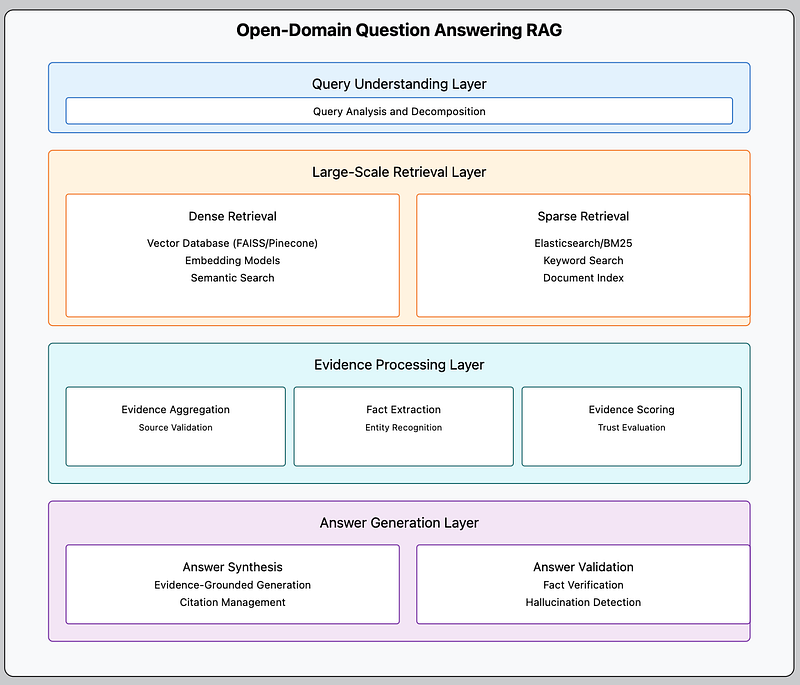
ODQA RAG
Data Flow:
1. User Query: The user poses an open-domain question. 2. Retrieval: The system searches large corpora (web indexes, document repositories) to find top-k relevant documents or passages. 3. Reasoning: The Reasoning Module analyzes retrieved evidence, synthesizes key points, and forms a structured understanding of the answer. 4. Generation: The Generation Module produces a final, coherent answer, referencing the retrieved documents to ensure factual correctness. 5. Response Delivery: The final answer is returned to the user.
Retrieval Module: Scaling to Large Corpora
Key Techniques: - Dense Retrieval: Use vector databases (FAISS, Pinecone) with dense embeddings (e.g., Sentence Transformers) to quickly find relevant documents. - Sparse Retrieval: Combine dense retrieval with traditional keyword search (Elasticsearch, BM25) for hybrid retrieval. - Sharding & Partitioning: Distribute large corpora across multiple nodes, load-balancing retrieval requests.
Example Implementation:
`
class ODQARetrievalModule:
def \_\_init\_\_(self, vector\_store, keyword\_search):
self.vector\_store = vector\_store
self.keyword\_search = keyword\_search
async def retrieve(self, query: str, top\_k: int = 10) -> List\[Dict\]:
embeddings = self.\_embed\_query(query)
dense\_results = await self.vector\_store.similarity\_search(embeddings, top\_k=top\_k)
sparse\_results = await self.keyword\_search.search(query, top\_k=top\_k)
return self.\_merge\_and\_rank(dense\_results, sparse\_results)
`
Reasoning Module: Evidence Aggregation and Validation
The Reasoning Module: - Evidence Aggregation: Filters and prioritizes retrieved documents based on relevance, trust, and redundancy. - Fact Checking: Identifies inconsistencies or conflicting statements, discarding unreliable sources. - Structured Reasoning: Extracts key facts, dates, entities, or relationships to form a robust understanding of the answer’s core elements.
`
class ODQAReasoningModule:
async def process\_evidence(self, retrieved\_docs: List\[Dict\]) -> Dict:
\# Extract key insights (dates, entities, factual statements)
structured\_facts = self.\_extract\_facts(retrieved\_docs)
\# Resolve conflicts by preferring majority or authoritative sources resolved\_facts = self.\_resolve\_conflicts(structured\_facts)
return {"facts": resolved\_facts}
`
Generation Module: Factually Grounded Answers
The Generation Module: - Prompt Templates: Include retrieved snippets or citations within the prompt, encouraging the LLM to base answers on evidence. - Citations & Attribution: Reference source documents in the generated answer when possible. - Hallucination Reduction: Use chain-of-thought prompting or verification steps to minimize unsupported claims.
`
class ODQAGenerationModule:
async def generate(self, reasoning\_output: Dict) -> str:
prompt = self.\_build\_prompt(reasoning\_output\["facts"\])
response = await self.llm.generate(prompt, parameters={"max\_length": 1024})
validated\_response = self.\_verify\_against\_facts(response, reasoning\_output\["facts"\])
return validated\_response
`
Performance and Scalability
Indexing & Storage: - Precompute and store embeddings for large corpora. - Implement incremental indexing for newly added documents.
Caching: - Cache embeddings for frequently asked queries. - Store intermediate reasoning results for recurring patterns of questions.
Load Balancing: - Scale vector databases and keyword search indices horizontally. - Distribute requests among multiple reasoning and generation nodes.
Monitoring, Observability, and Maintenance
Metrics: - Retrieval Quality: Precision@k, Recall@k to evaluate retrieval effectiveness. - Answer Accuracy: Track success rates using human-labeled samples. - Latency Metrics: Monitor end-to-end response time, from retrieval through generation.
Logging & Tracing: - Log queries, selected documents, and generated answers. - Use distributed tracing (OpenTelemetry) to identify bottlenecks in retrieval or reasoning steps.
Automated Maintenance: - Periodically re-embed documents as models improve. - Prune outdated sources to maintain corpus quality.
Security and Compliance
Access Controls: - Restrict which documents certain user roles can access. - Mask or redact PII or sensitive information before indexing.
Encryption: - Encrypt indexes and documents at rest. - Use TLS to secure communications between RAG modules.
Compliance: - Align retrieval sources and storage with data governance policies. - Support data deletion requests and user consent rules, especially if using personal data.
Common Challenges and Solutions
Hallucinations: Challenge: The model fabricates answers not supported by sources. Solution: Enforce chain-of-thought steps, use retrieval-augmented prompts, and perform post-generation verification against retrieved evidence.
Long-Tail Queries: Challenge: Some questions may be obscure or rarely asked. Solution: Maintain a large, diverse corpus and ensure retrieval is robust to rare terms. Fine-tune retrieval and reasoning models on a variety of queries.
Source Quality Variation: Challenge: Open-domain sources may contain contradictory or low-quality information. Solution: Implement source trust scoring, dismiss low-authority documents, and add fact-checking steps.
Lifecycle Management & MLOps Integration
- Model Versioning & Registries: Track changes in embedding models, reasoning LLMs, and prompt templates to revert to previous versions if accuracy drops. - CI/CD Pipelines: Automate the deployment of updated embeddings, reasoners, and generation models. Run regression tests on question-answer pairs before production updates. - Continuous Data & Pipeline Management: Continuously improve corpus coverage and content quality. Integrate DataOps practices to monitor data freshness and integrity.Example Use Cases
Enterprise Knowledge Assistants: - Answer employee queries using internal wikis, documents, and reports. - Provide quick fact-checking to reduce manual research time.
Consumer-Facing QA Bots: - Respond to diverse customer queries using open web sources. - Offer product information, troubleshooting tips, and historical facts.
Research and Analysis Tools: - Assist analysts by aggregating facts from academic papers, news articles, and government data. - Generate synthesized summaries of complex, multi-faceted topics.
Conclusion
ODQA RAG expands the boundaries of what AI-driven question answering can achieve, tapping into vast and diverse data sources without domain limitations. By carefully implementing retrieval at scale, evidence-informed reasoning, and factually grounded generation, engineering teams can build systems that reliably answer open-ended questions. Following the architectural patterns, optimization strategies, and best practices discussed in this guide, organizations can unlock the full potential of open-domain question answering while maintaining accuracy, trust, and scalability.
> For additional details on other type of RAGs, navigate to — [A Complete Guide to Retrieval-Augmented Generation (RAG): 16 Different Types, Their Implementation, and Use Cases](https://medium.com/aingineer/a-complete-guide-to-retrieval-augmented-generation-rag-16-different-types-their-implementation-10d48248517b)
— Gaurav
Responses