A Complete Guide to Implementing Self-RAG
A Complete Guide to Implementing Self-RAG
While traditional RAG systems rely on static knowledge sources and external corpora, Self-Retrieval-Augmented Generation (Self-RAG)… -
A Complete Guide to Implementing Self-RAG
While traditional RAG systems rely on static knowledge sources and external corpora, Self-Retrieval-Augmented Generation (Self-RAG) introduces the concept of using the model’s own intermediate reasoning steps, past decisions, or previously generated artifacts as a retrieval source. By “looking inward” and referencing its own chain-of-thought or prior states, a Self-RAG system can refine future queries, improve consistency, and maintain continuity across complex, multi-turn interactions.
This guide outlines architectural patterns, iterative refinement strategies, performance considerations, and best practices for implementing Self-RAG. It aims to help architects, engineering leads, and senior engineers design solutions that become more coherent and contextually aware by leveraging their own reasoning traces and outputs as a retrieval resource.
Core Concepts of Self-RAG
Self-RAG augments the RAG pipeline with self-referential retrieval: - Self-Referential Retrieval: Treat the model’s intermediate reasoning steps, previous answers, or stored interaction traces as part of the retrieval corpus. - Iterative Refinement: Use previously generated content — chain-of-thought logs, partial summaries, state snapshots — as context to enhance subsequent reasoning. - Contextual Continuity: Maintain thematic and logical consistency over multi-turn dialogs or complex problem-solving sessions by retrieving and aligning with past reasoning states.
For example, a Self-RAG system assisting in a complex research task might recall its earlier rationale, errors detected in previous steps, or outlines it generated, and incorporate them into the next reasoning cycle to produce more accurate and stable answers.
Architectural Patterns & Data Flow
Reference Architecture:
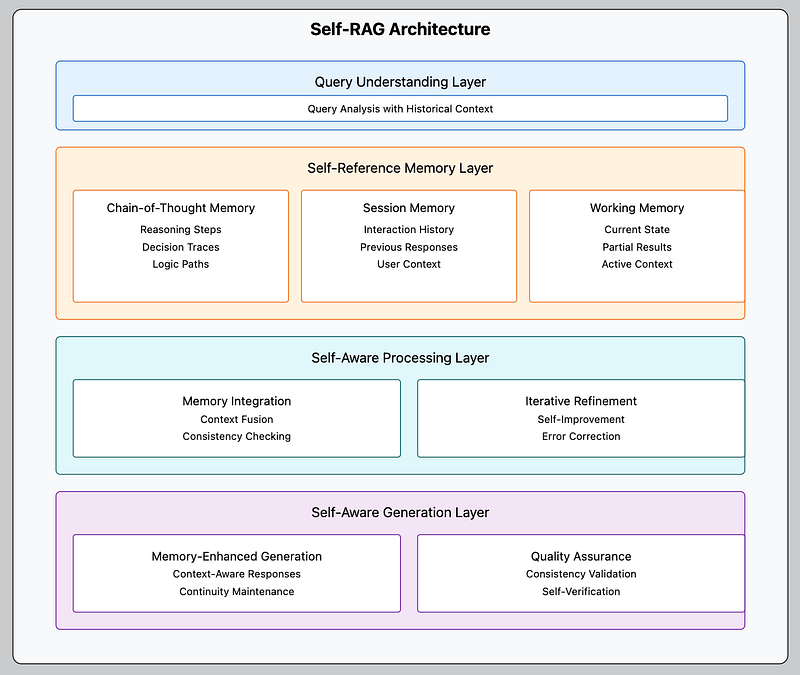
Self RAG
Data Flow:
1. User Query: The user initiates a request. 2. Self-Referential Retrieval: Alongside traditional retrieval from external sources, the system fetches relevant fragments from its internal logs, reasoning traces, or previous answers. 3. Fusion & Reasoning: Merge external documents with self-referential content to form a richer, more coherent context that captures historical reasoning. 4. Adaptive Generation: The generation module produces a refined answer that takes into account both new data and the system’s own historical reasoning. 5. Response Delivery: The system returns an answer that benefits from its cumulative reasoning journey.
Sources for Self-Retrieval
Internal Artifacts: - Chain-of-Thought Logs: Intermediate reasoning steps the model generated in previous turns. - Session Histories: Stored conversation transcripts, user feedback, or prior Q&A exchanges. - Partial Summaries or Drafts: Rough outlines, interim conclusions, or earlier versions of the answer.
Integration Strategies: - Indexing Internal States: Maintain a rolling index of recent reasoning steps or session-specific memory. - Metadata Tagging: Annotate reasoning artifacts with timestamps, relevance scores, or decision rationales to facilitate quick retrieval. - Dynamic Pruning: Periodically remove or summarize outdated internal content to prevent context bloat.
Implementing Self-Referential Retrieval
The retrieval module must now handle internal states:
`
class SelfReferentialRetrievalModule:
def \_\_init\_\_(self, internal\_memory\_store):
self.internal\_memory = internal\_memory\_store
async def retrieve(self, query: str, top\_k: int = 5) -> List\[Dict\]: \# Embed the query along with session context query\_embedding = self.\_embed\_with\_session(query)
\# Search internal reasoning logs or stored answers
internal\_candidates = await self.internal\_memory.similarity\_search(query\_embedding, top\_k=top\_k)
return internal\_candidates
`
Reasoning & Generation with Self-RAG
Once internal and external evidence are merged: - Contextual Alignment: Check that new evidence aligns or conflicts with prior reasoning steps. Reinforce conclusions previously validated or correct earlier misunderstandings. - Iterative Improvement: If the model identified knowledge gaps before, it can now recall them and fill those gaps in the current step. - Reflexive Prompts: Incorporate references to past reasoning states in the prompt, encouraging the LLM to maintain logical consistency and memory.
`
class SelfAwareReasoningModule:
async def process\_context(self, docs: List\[Dict\], internal\_artifacts: List\[Dict\]) -> Dict:
combined = self.\_merge\_external\_and\_internal(docs, internal\_artifacts)
refined\_insights = self.\_resolve\_conflicts\_and\_build\_on\_previous\_logic(combined)
return {"insights": refined\_insights}
class SelfAwareGenerationModule:
async def generate(self, reasoning\_output: Dict, internal\_context: Dict) -> str:
prompt = self.\_build\_prompt\_with\_self\_reference(reasoning\_output\["insights"\], internal\_context)
response = await self.llm.generate(prompt, parameters={"max\_length":1500})
return self.\_validate\_consistency(response, reasoning\_output\["insights"\], internal\_context)
`
Performance and Scalability
Indexing Internal States: - Store reasoning steps in a vector database or a simple key-value cache. - Implement sliding windows: keep only the most recent or most relevant reasoning steps.
Caching & Efficiency: - Cache frequently revisited states or conclusions, so the system can quickly reference them without re-computation. - Pre-embed common reasoning frames or session templates.
Load Management: - Limit the number of retrieved internal artifacts per query to manage latency. - Summarize or cluster older reasoning steps to reduce complexity.
Monitoring, Observability, and Maintenance
Metrics: - Continuity Score: Measure how well the system maintains thematic and logical continuity across multiple turns. - Refinement Improvements: Track error rates or factual inconsistencies before and after introducing self-referential retrieval. - User Satisfaction: Assess whether users perceive more coherent and contextually rich answers over time.
Logging & Tracing: - Log which internal artifacts were retrieved for each answer. - Trace the evolution of reasoning states to identify patterns that improve or degrade performance.
Automated Maintenance: - Periodically prune outdated reasoning steps that no longer contribute to improved answers. - Update embedding models or scoring heuristics for internal artifacts as the system evolves.
Security and Compliance
Access Controls: - Ensure that internal logs or reasoning steps do not expose sensitive user data inadvertently. - Encrypt stored reasoning artifacts if they contain proprietary or user-sensitive information.
Compliance: - If internal reasoning references private data, maintain the same compliance rules as external retrieval sources. - Support data deletion requests: if a user asks to clear history, ensure that internal artifacts are purged.
Common Challenges and Solutions
Context Overload: Challenge: Accumulating too much internal reasoning leads to confusion. Solution: Summarize or archive old reasoning steps. Implement strict size or recency constraints.
Bias Reinforcement: Challenge: The system might repeatedly reference incorrect earlier logic. Solution: Introduce logic checks that prioritize external authoritative data over flawed internal assumptions. Periodically reset or retrain internal embeddings.
Performance Degradation: Challenge: Extra retrieval steps from internal memory might slow responses. Solution: Implement caching, efficient pruning, or parallel retrieval to keep latency manageable.
Lifecycle Management & MLOps Integration
- Versioning Internal Structures: Track schema changes for stored reasoning artifacts or session formats. Roll back if a new scheme causes confusion. - CI/CD Pipelines: Include tests for multi-turn scenarios that rely on self-referential context. Validate improvements against a baseline. - Continuous Improvement: Monitor how often self-referential retrieval leads to better answers. Adjust weights or heuristics if it doesn’t add value.Example Use Cases
Long-Form Assistants: - Complex research assistants that build on their previous outlines and drafts, refining their conclusions in later turns.
Customer Support Bots: - Maintain a record of user preferences or previous support steps, referencing them to offer personalized and consistent assistance over time.
Learning Tutors: - Keep track of a student’s past answers, misconceptions, and learning paths, and reference these insights to provide contextually tailored explanations.
Conclusion
Self-RAG extends Retrieval-Augmented Generation beyond external knowledge sources, tapping into the system’s own historical reasoning and outputs. By referencing its internal chain-of-thought, partial summaries, and past conclusions, a Self-RAG system continuously refines its answers, achieves greater continuity, and adapts over extended interactions. By following the architectural patterns, integration strategies, and best practices in this guide, engineering teams can create truly self-aware AI solutions that grow more coherent and context-rich as they iterate.
> For additional details on other type of RAGs, navigate to — [A Complete Guide to Retrieval-Augmented Generation (RAG): 16 Different Types, Their Implementation, and Use Cases](https://medium.com/aingineer/a-complete-guide-to-retrieval-augmented-generation-rag-16-different-types-their-implementation-10d48248517b)
— Gaurav
Responses