A Complete Guide to Retrieval-Augmented Generation (RAG): 16 Different Types, Their Implementation…
A Complete Guide to Retrieval-Augmented Generation (RAG): 16 Different Types, Their Implementation…
Comprehensive guide with 16 distinct RAG types, detailing their key features, benefits, enterprise suitability, and implementation… -
A Complete Guide to Retrieval-Augmented Generation (RAG): 16 Different Types, Their Implementation, and Use Cases
Comprehensive guide with 16 distinct RAG types, detailing their key features, benefits, enterprise suitability, and implementation strategies!**
As an engineering leader with a deep-rooted passion for technology and innovation, I’ve always been captivated by the intersection of curiosity and application in AI. Over the years, I’ve worked on building systems, solving complex problems, and leading teams and organizations to deliver impactful results. But as the pace of AI evolution accelerated, I spent weekends experimenting, reading, and learning about the latest advancements — most recently, autonomous agents and their foundational piece: Retrieval-Augmented Generation (RAG).
This technical guide represents the culmination of extensive research, practical implementation experience, and systematic evaluation of RAG architectures across various enterprise use cases. Drawing from both theoretical understanding and hands-on implementation, I’ve documented comprehensive insights into 16 distinct RAG approaches, each offering unique solutions to specific technical challenges in AI system design.
My goal in creating this resource is to provide fellow engineers, architects, and technical leaders with a structured framework for understanding and implementing RAG systems that align with enterprise requirements and scalability demands. This guide serves as both a technical reference and a practical roadmap for organizations navigating the complexity of modern AI system architecture. -
Introduction
At its core, RAG integrates retrieval mechanisms directly into the generation pipeline of large language models. This enables systems to transcend purely generative capabilities and ground their outputs in external, reliable, and often dynamic data sources. For engineering leaders revisiting hands-on work or exploring the latest in AI, RAG offers a unique combination of foundational concepts and real-world practicality.
Traditional generative models often falter in three critical areas:
1. Accuracy: Outputs can sometimes be nonsensical or factually incorrect. 2. Contextual Relevance: Models struggle to consistently align responses with the user’s specific query. 3. Adaptability: Static models are limited to the knowledge available during training, making them outdated over time.
RAG addresses these challenges head-on: - Reducing Hallucinations: By referencing factual data, RAG minimizes the risk of nonsensical or incorrect outputs. - Enhancing Context and Relevance: Retrieval ensures that generated responses are grounded in the user’s specific query and its broader context. - Providing Dynamic Knowledge Access: Unlike static models, RAG allows for on-the-fly integration of up-to-date information, making it highly adaptable.
Through this lens, RAG is a versatile tool capable of reshaping how we build AI systems to handle complexity, scale, and real-world variability.
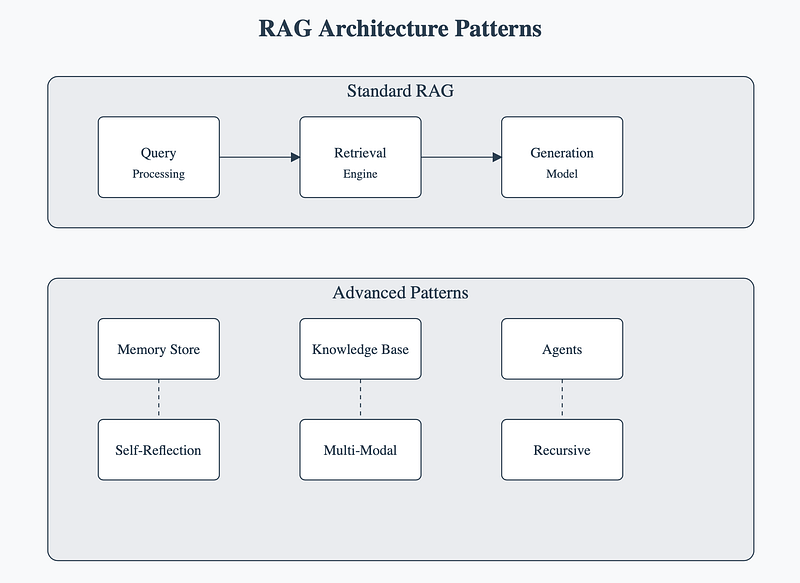 -
The Guide
I wanted to create a guide that serves as both a primer — a resource for engineering leaders, developers, and anyone eager to explore RAG. This guide highlights the 16 distinct types of RAG, illustrating their unique features, applications, and practical implementation strategies. Whether you’re building customer-facing chatbots, designing knowledge systems, or exploring AI for specialized fields, RAG offers methodologies that can transform your approach.
Through this guide, I’m capturing — “what” and “how” of RAG; - Why does RAG matter in today’s AI landscape? - How does it align with the challenges enterprises and developers face? - What potential does it unlock for the future?
If these questions resonate with you, you’re in the right place. Below, I outline these methods, providing an overview of their key features, benefits, and applications —
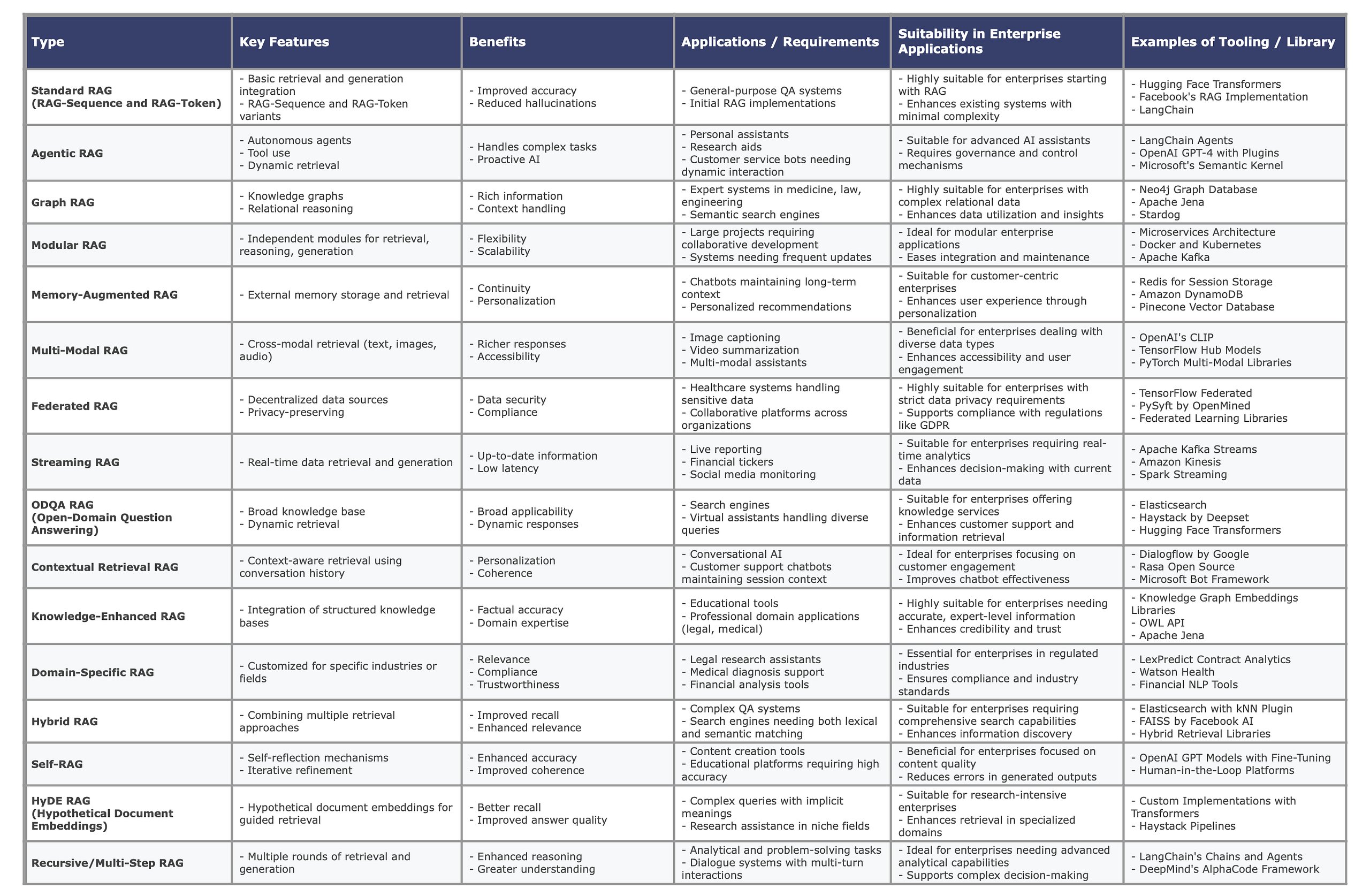
Summary Table
1\. Standard RAG (RAG-Sequence and RAG-Token)
#### Overview
The foundational approach to RAG, Standard RAG integrates information retrieval and generation components to enhance model outputs. It includes two main methods: - RAG-Sequence: Generates sequences conditioned on each retrieved document and combines results. - RAG-Token: Dynamically incorporates retrieved tokens at each generation step.
#### Key Features - Basic Integration: Retrieval models fetch relevant documents, and generative models create context-aware outputs. - Simple Architecture: Combines retrieval and generation without complex intermediaries. - Real-Time Responses: Retrieves and generates dynamically for immediate outputs.
#### Applications - General QA Systems: Answering user queries in open or restricted domains. - Conversational AI: Enhancing chatbot accuracy and relevance. - Content Summarization: Summarizing documents using retrieved data as context.
#### Enterprise Suitability - Highly Suitable for Beginners: Ideal for enterprises starting their RAG journey. - Low Complexity: Easily integrates into existing systems for enhanced generative performance. - Broad Applicability: Supports a wide range of industries and use cases.
#### Examples of Tooling / Libraries - Hugging Face Transformers: Provides pre-trained models and RAG examples. - Facebook RAG Implementation: Reference architecture and open-source code. - LangChain: Framework for creating RAG pipelines with dynamic retrieval and generation.
> For additional details, and architecture, navigate to — [Implementing RAG : Architecture Guide](https://medium.com/aingineer/implementing-rag-architecture-guide-53efb6caed92) -
2\. Agentic RAG
#### Overview
Agentic RAG enables models to act as autonomous agents, capable of dynamically retrieving data, reasoning, and using tools. It empowers systems to handle multi-step, complex queries and external interactions.
#### Key Features - Dynamic Retrieval: Agents can query external APIs or databases in real-time. - Tool Integration: Models can use external tools such as calculators or external search engines. - Autonomous Decision-Making: Enables models to adaptively determine the next steps.
#### Applications - Personal Assistants: Managing schedules, reminders, or answering complex queries. - Customer Service Bots: Accessing external systems to retrieve order status or troubleshoot. - Research Automation: Aggregating and synthesizing information from multiple sources.
#### Enterprise Suitability - Advanced Use Cases: Suitable for organizations deploying complex AI systems. - Control and Governance: Requires oversight to ensure safe and ethical interactions. - Dynamic Problem-Solving: Ideal for scenarios needing flexible, real-time responses.
#### Examples of Tooling / Libraries - LangChain Agents: Tools to build agentic workflows. - OpenAI GPT-4 Plugins: Allows LLMs to interact with APIs and external tools. - Microsoft Semantic Kernel: SDK for integrating external systems with LLMs.
> For additional details, and architecture, navigate to — [Agentic RAG with ReAct: A Practical Guide to Building Autonomous Agents](https://medium.com/aingineer/agentic-rag-with-react-a-practical-guide-to-building-autonomous-agents-ac02216ff570) -
3\. Graph RAG
#### Overview
Graph RAG leverages knowledge graphs to enhance contextual understanding and provide relational insights. By integrating graph data into retrieval, it allows the model to reason over relationships.
#### Key Features - Knowledge Graph Integration: Uses nodes (entities) and edges (relationships) to structure information. - Relational Reasoning: Understands how entities relate to each other. - Semantic Depth: Provides richer and more coherent responses.
#### Applications - Semantic Search: Enabling search systems to consider relationships and hierarchies. - Expert Systems: Supporting decision-making in healthcare, law, and finance. - Knowledge Management: Organizing and retrieving enterprise data efficiently.
#### Enterprise Suitability - For Data-Rich Organizations: Suitable for companies with relational or interconnected datasets. - Improves Decision-Making: Adds depth to AI-driven insights. - Scalable Knowledge Systems: Enhances large-scale knowledge graphs for enterprise use.
#### Examples of Tooling / Libraries - Neo4j: Graph database for storing and querying relational data. - Apache Jena: Framework for building semantic web applications. - Stardog: Enterprise-grade knowledge graph platform.
> For additional details, and architecture, navigate to — [Enterprise GraphRAG: Building Production-Grade LLM Applications with Knowledge Graphs](https://medium.com/aingineer/enterprise-graphrag-building-production-grade-llm-applications-with-knowledge-graphs-b4d567c95cbf) -
4\. Modular RAG
#### Overview
Modular RAG separates retrieval, reasoning, and generation into independent components, allowing for flexibility, scalability, and optimization of each module.
#### Key Features - Component Independence: Each module can be developed and optimized separately. - Scalable Architecture: Supports expansion and upgrades without impacting other components. - Customizability: Enables domain-specific tweaks for retrieval or generation.
#### Applications - Agile Development: Suited for iterative development cycles with evolving requirements. - Collaborative Systems: Allows multiple teams to work on different modules. - Large-Scale Systems: Designed for enterprise-scale AI deployments.
#### Enterprise Suitability - Ideal for Enterprises Requiring Flexibility: Supports rapid innovation and experimentation. - Eases Integration: Modules can be replaced or upgraded independently. - Supports Maintenance: Simplifies troubleshooting and iterative improvements.
#### Examples of Tooling / Libraries - Microservices Architecture: Decompose systems into individual services. - Docker and Kubernetes: Manage and deploy containerized components. - Apache Kafka: Facilitates communication between modules.
> For additional details, and architecture, navigate to — [A Comprehensive Guide to Implementing Modular RAG for Scalable AI Systems](https://medium.com/@gauravnigam/a-comprehensive-guide-to-implementing-modular-rag-for-scalable-ai-systems-3fb47c46dc8e) -
5\. Memory-Augmented RAG
#### Overview
Memory-Augmented RAG introduces a memory layer to store and retrieve past interactions, enabling context-aware and long-term engagement.
#### Key Features - Persistent Memory: Stores historical interactions or data for future reference. - Dynamic Recall: Retrieves relevant information from memory to enhance responses. - Context-Aware Interaction: Maintains continuity across user sessions.
#### Applications - Chatbots: Remembering user preferences and prior conversations. - Personalized Recommendations: Tailoring suggestions based on history. - Customer Support: Providing contextually aware support across multiple sessions.
#### Enterprise Suitability - Customer-Centric Enterprises: Enhances user engagement and satisfaction. - Personalization-Driven Services: Adds value by remembering user-specific details. - Improves Continuity: Critical for support systems and conversational agents.
#### Examples of Tooling / Libraries - Redis: In-memory storage for session data. - Pinecone: Vector database for embedding-based memory. - Amazon DynamoDB: Scalable NoSQL database for persistent storage.
> For the complete guide, and architecture, navigate to — [A Complete Guide to Implementing Memory-Augmented RAG](https://medium.com/@gauravnigam/a-complete-guide-to-implementing-memory-augmented-rag-c3582a8dc74f) -
6\. Multi-Modal RAG
#### Overview
Multi-Modal RAG retrieves and integrates data from multiple modalities, such as text, images, and audio, to create richer and more comprehensive outputs.
#### Key Features - Cross-Modal Retrieval: Accesses diverse types of data sources. - Integrated Outputs: Combines information across modalities into a unified response. - Enhanced Accessibility: Broadens the AI’s ability to interact with varied inputs.
#### Applications - Image Captioning: Generating textual descriptions from images. - Video Summarization: Producing coherent summaries of video content. - Multi-Modal Assistants: Handling diverse input formats in real-time.
#### Enterprise Suitability - Creative Industries: Supports media and content production. - Accessibility Solutions: Improves interaction for users with disabilities.
#### Diverse Data Systems: Ideal for enterprises managing heterogeneous datasets.
#### Examples of Tooling / Libraries - OpenAI CLIP: Connects text and image modalities. - TensorFlow Hub: Multi-modal pre-trained models. - PyTorch Multi-Modal Libraries: Frameworks for custom multi-modal applications.
> For the complete guide, and architecture, navigate to — [A Complete Guide to Implementing Multi-Modal RAG](https://medium.com/@gauravnigam/a-complete-guide-to-implementing-multi-modal-rag-269d4d29e953) -
7\. Federated RAG
#### Overview
Federated RAG operates across decentralized data sources, ensuring data privacy while enabling collaborative knowledge retrieval. This approach is ideal for industries where data cannot be centralized due to privacy or compliance requirements.
#### Key Features - Privacy-Preserving: Ensures sensitive data stays local while retrieving relevant insights. - Decentralized Access: Aggregates knowledge without centralizing datasets. - Collaborative Frameworks: Supports shared learning without compromising security.
#### Applications - Healthcare Systems: Accessing patient data across institutions without exposing sensitive details. - Cross-Enterprise Collaboration: Enabling shared insights without data sharing. - Regulated Industries: Complying with GDPR, HIPAA, or similar standards.
#### Enterprise Suitability - Privacy-Focused Organizations: Suitable for enterprises handling sensitive or confidential data. - Compliance-Driven Use Cases: Essential for meeting legal and regulatory requirements. - Collaborative Workflows: Supports distributed teams and organizations.
#### Examples of Tooling / Libraries - TensorFlow Federated: Framework for building federated learning systems. - PySyft by OpenMined: Tools for secure and private deep learning. - Federated Learning Libraries: Open-source platforms supporting decentralized AI.
> For the complete guide, and architecture, navigate to — [A Complete Guide to Implementing Federated RAG](https://medium.com/@gauravnigam/a-complete-guide-to-implementing-federated-rag-671bbda94e5a) -
8\. Streaming RAG
#### Overview
Streaming RAG processes real-time data streams, allowing models to retrieve and generate up-to-date information with low latency. It is crucial for time-sensitive applications like financial reporting or live event monitoring.
#### Key Features - Real-Time Retrieval: Continuously integrates fresh data into the retrieval process. - Low Latency: Ensures immediate response for time-critical applications. - Dynamic Updates: Adjusts generation outputs based on the latest available information.
#### Applications - Financial Market Analysis: Monitoring stock trends and generating live reports. - Social Media Monitoring: Summarizing trends or sentiment analysis in real-time. - Live News Reporting: Offering real-time updates and insights.
#### Enterprise Suitability - Time-Sensitive Environments: Ideal for enterprises requiring real-time analytics. - Dynamic Decision-Making: Enhances strategic responses with up-to-date insights. - Scalability: Handles high-throughput data streams efficiently.
#### Examples of Tooling / Libraries - Apache Kafka Streams: Framework for building real-time streaming applications. - Amazon Kinesis: Platform for scalable data stream processing. - Spark Streaming: Distributed stream processing for large-scale data.
> For the complete guide, and architecture, navigate to — [A Complete Guide to Implementing Streaming RAG](https://medium.com/@gauravnigam/a-complete-guide-to-implementing-streaming-rag-4e86bc0bb994) -
9\. Open-Domain Question Answering (ODQA) RAG
#### Overview
ODQA RAG enables LLMs to handle broad, unrestricted queries by retrieving and synthesizing answers from extensive corpora. This approach is versatile and can operate across diverse domains.
#### Key Features - Domain-Agnostic: Handles queries from any field with a dynamic knowledge base. - Flexible Retrieval: Combines retrieval techniques for optimal results. - User-Centric Responses: Focuses on answering specific user queries directly.
#### Applications - Search Engines: Providing detailed answers to user queries. - Educational Platforms: Assisting with student queries or content exploration. - Customer Support: Answering a wide range of customer questions effectively.
#### Enterprise Suitability - Knowledge Services: Enhances information retrieval for customer and employee use. - Scalable Use Cases: Ideal for enterprises handling diverse or unpredictable queries. - Broad Applicability: Supports various industries and domains.
#### Examples of Tooling / Libraries - Elasticsearch: Open-source search engine for indexing and retrieval. - Haystack by Deepset: Framework for building QA pipelines. - Hugging Face Transformers: Pre-trained models for QA tasks.
> For the complete guide, and architecture, navigate to — [A Complete Guide to Implementing ODQA RAG](https://medium.com/@gauravnigam/a-complete-guide-to-implementing-odqa-rag-ee8f05317c22) -
10\. Contextual Retrieval RAG
#### Overview
Contextual Retrieval RAG uses conversation history or situational context to refine retrieval processes, ensuring that responses are coherent and relevant over multiple interactions.
#### Key Features - Context Awareness: Maintains a running memory of previous interactions or queries. - Dynamic Query Refinement: Adapts retrieval strategies based on user context. - Enhanced Personalization: Tailors responses to individual users or sessions.
#### Applications - Chatbots: Offering coherent multi-turn dialogue. - Customer Support: Handling session-based queries effectively. - Virtual Assistants: Maintaining personalized interactions over time.
#### Enterprise Suitability - Engagement-Focused Enterprises: Ideal for businesses prioritizing user experience. - Session Continuity: Improves effectiveness of long-duration interactions. - Adaptable Use Cases: Suited for customer service, sales, and user education.
#### Examples of Tooling / Libraries - Dialogflow: Platform for building context-aware conversational interfaces. - Rasa: Open-source framework for conversational AI. - Microsoft Bot Framework: Tools for creating intelligent, context-sensitive bots.
> For the complete guide, and architecture, navigate to — [A Complete Guide to Implementing Contextual Retrieval RAG](https://medium.com/@gauravnigam/a-complete-guide-to-implementing-contextual-retrieval-rag-498148d00310) -
11\. Knowledge-Enhanced RAG
#### Overview
Knowledge-Enhanced RAG integrates structured knowledge bases, ontologies, and curated datasets into retrieval processes, ensuring domain-specific accuracy and reliability.
#### Key Features - Structured Data Integration: Leverages knowledge graphs, databases, or ontologies. - Expert-Level Accuracy: Provides factual and precise responses for niche domains. - Validation Mechanisms: Ensures retrieved knowledge aligns with trusted sources.
#### Applications - Legal Research: Retrieving and summarizing statutes or case law. - Clinical Decision Support: Accessing medical guidelines or treatments. - Educational Tools: Delivering accurate, detailed explanations.
#### Enterprise Suitability - Regulated Industries: Ideal for legal, medical, and financial applications. - High-Stakes Use Cases: Ensures reliability in critical systems. - Authoritative Outputs: Builds user trust through accuracy.
#### Examples of Tooling / Libraries - Knowledge Graph Embeddings Libraries: Tools like PyKEEN. - OWL API: For creating and manipulating ontologies. - Apache Jena: Framework for semantic web and linked data.
> For the complete guide, and architecture, navigate to — [A Complete Guide to Implementing Knowledge-Enhanced RAG](https://medium.com/@gauravnigam/a-complete-guide-to-implementing-knowledge-enhanced-rag-cb384b465a7a) -
12\. Domain-Specific RAG
#### Overview
Domain-Specific RAG tailors retrieval and generation to specific industries or fields, using specialized corpora and customized retrieval methods.
#### Key Features - Specialized Data: Utilizes field-specific datasets and terminology. - Regulatory Compliance: Ensures adherence to industry-specific standards. - Tailored Responses: Delivers accurate and relevant results for niche applications.
#### Applications - Financial Analysis: Interpreting market data and trends. - Healthcare Applications: Supporting clinical workflows or research. - Legal Tools: Assisting with contract analysis or legal research.
#### Enterprise Suitability - Industry-Specific Enterprises: Essential for regulated or niche industries. - Improved Relevance: Reduces noise and improves retrieval precision. - High Trust Requirements: Builds user confidence in critical decisions.
#### Examples of Tooling / Libraries - LexPredict: Tools for legal and contract analysis. - Watson Health: AI solutions tailored to healthcare needs. - Industry-Specific NLP Libraries: Such as FinBERT for finance.
> For the complete guide, and architecture, navigate to — [A Complete Guide to Implementing Domain-Specific RAG](https://medium.com/@gauravnigam/a-complete-guide-to-implementing-domain-specific-rag-78a098cf5b46) -
13\. Hybrid RAG
#### Overview
Hybrid RAG combines sparse and dense retrieval methods to balance precision and recall, leveraging the strengths of both approaches for robust information retrieval.
#### Key Features - Sparse and Dense Integration: Merges traditional keyword matching with semantic embeddings. - Balanced Outputs: Achieves both relevance and diversity in retrieved results. - Adaptive Weighting: Dynamically adjusts retrieval strategies based on context.
#### Applications - Advanced Search Engines: Providing both specific and broad results. - Research Systems: Synthesizing diverse perspectives or datasets. - QA Systems: Offering precise answers for complex queries.
#### Enterprise Suitability - Data-Rich Environments: Ideal for enterprises with large, diverse corpora. - Enhanced Information Discovery: Supports knowledge management and innovation. - Robust Applications: Handles varying query complexity effectively.
#### Examples of Tooling / Libraries - Elasticsearch with kNN Plugin: Adds dense retrieval capabilities. - FAISS: Library for similarity search and clustering. - LangChain Hybrid Modules: Combines spsarse and dense methods.
> For the complete guide, and architecture, navigate to — [A Complete Guide to Implementing Hybrid RAG](https://medium.com/@gauravnigam/a-complete-guide-to-implementing-hybrid-rag-86c0febba474) -
14\. Self-RAG
#### Overview
Self-RAG incorporates self-reflection mechanisms, allowing models to iteratively refine their outputs for improved accuracy and quality.
#### Key Featuresventify and correct errors.wffff - Self-Reflection: Evaluates the validity and coherence of generated content. - Enhanced Quality: Produces polished, accurate, and context-aware outputs.
#### Applications - Content Creation: Generating high-quality articles, reports, or summaries. - Decision Support: Offering accurate recommendations for strategic choices. - Educational Platforms: Delivering precise, detailed explanations.
#### Enterprise Suitability - Accuracy-Centric Enterprises: Ideal for publishing, education, or decision-making tools. - Reducing Errors: Improves output reliability in critical systems. - Enhanced Trust: Strengthens brand credibility through refined responses.
#### Examples of Tooling / Libraries - OpenAI GPT Fine-Tuning: Adapts models for iterative workflows. - Human-in-the-Loop Platforms: Ensures quality through human oversight.
> For the complete guide, and architecture, navigate to — [A Complete Guide to Implementing Self-RAG](https://medium.com/@gauravnigam/a-complete-guide-to-implementing-self-rag-87827f3e7ee2) -
15\. HyDE RAG (Hypothetical Document Embeddings)
#### Overview
HyDE RAG generates hypothetical documents based on queries, then retrieves semantically similar real documents for grounding, enabling better understanding and precision.
#### Key Features - Hypothetical Document Generation: Guides retrieval by creating intermediary representations. - Semantic Matching: Finds documents that align with implicit query intent. - Improved Recall: Handles vague or complex queries effectively.
#### Applications - Implicit Query Handling: Addressing nuanced or open-ended questions. - Research Assistance: Discovering relevant information in specialized fields. - Knowledge Discovery: Enabling novel insights from existing data.
#### Enterprise Suitability - Research-Intensive Fields: Ideal for academic, medical, or scientific exploration. - Complex Query Resolution: Supports challenging or poorly defined inquiries. - Enhanced Recall: Improves retrieval in ambiguous scenarios.
#### Examples of Tooling / Libraries - Transformers-Based Custom Models: For generating and embedding hypothetical documents. - Haystack Pipelines: Supports advanced retrieval strategies.
> For the complete guide, and architecture, navigate to — [A Complete Guide to Implementing HyDE RAG](https://medium.com/@gauravnigam/a-complete-guide-to-implementing-hyde-rag-82492551f3d8) -
16\. Recursive/Multi-Step RAG
#### Overview
Recursive RAG performs multiple rounds of retrieval and generation, enabling sophisticated reasoning and multi-step problem-solving.
#### Key Features - Sequential Retrieval: Iteratively refines queries based on prior results. - Intermediate Outputs: Builds on partial answers to construct comprehensive solutions. - Enhanced Reasoning: Handles complex, multi-faceted tasks.
#### Applications - Analytical Workflows: Generating in-depth reports or insights. - Problem-Solving Tools: Supporting multi-turn interactions with detailed outputs. - Decision Support: Assisting with strategic, high-stakes decision-making.
#### Enterprise Suitability - Advanced Analytics: Suitable for enterprises with sophisticated data needs. - Complex Decision-Making: Supports strategic and operational planning. - Improved Compositionality: Enhances AI capabilities in step-by-step reasoning.
#### Examples of Tooling / Libraries - LangChain Recursive Chains: Simplifies multi-step workflows. - DeepMind AlphaCode Framework: Adapts models for recursive problem-solving.
> For the complete guide, and architecture, navigate to — [A Complete Guide to Implementing Recursive/Multi-Step RAG](https://medium.com/@gauravnigam/a-complete-guide-to-implementing-recursive-multi-step-rag-5afca90f57ee)
After exploring these diverse RAG implementations, a common question emerges: “Which RAG approach is right for my use case?” To help navigate this decision, I’ve developed a practical framework based on my experience reviwing RAG across different scenarios and applications. This structured approach can guide you in selecting the most appropriate RAG type for your specific needs.
RAG Implementation Decision Framework
Based on my experience, and learning, a following decision framework can help, and get you started in picking up a right RAG technique for you —
#### Step 1: Core Requirements Assessment
#### Data Characteristics
Volume: How much data needs to be processed? - Large-scale → Consider Modular or Hybrid RAG - Small-scale → Standard RAG may suffice
Variety: What types of data are involved? - Multiple formats → Multi-Modal RAG - Text only → Standard RAG
Velocity: How often does data update? - Real-time → Streaming RAG - Static → Standard or Domain-Specific RAG
#### Security Requirements - High privacy needs → Federated RAG - Regulatory compliance → Domain-Specific or Knowledge-Enhanced RAG - Standard security → Any RAG type with proper implementation
#### Performance Requirements - Low latency → Streaming or Standard RAG - High accuracy → Self-RAG or Knowledge-Enhanced RAG - Complex reasoning → Recursive/Multi-Step RAG
#### Step 2: Use Case Alignment
#### Interactive Applications - Chatbots → Memory-Augmented or Contextual Retrieval RAG - Virtual Assistants → Agentic RAG - Search Systems → ODQA or Hybrid RAG
#### Enterprise Applications - Knowledge Management → Graph or Knowledge-Enhanced RAG - Decision Support → Recursive or Self-RAG - Content Generation → HyDE or Standard RAG
#### Industry-Specific Needs - Healthcare → Domain-Specific or Federated RAG - Finance → Streaming or Domain-Specific RAG - Legal → Knowledge-Enhanced or Domain-Specific RAG
#### Step 3: Implementation Considerations
#### Resource Availability - Technical Expertise - High → Complex implementations (Agentic, Graph RAG) - Limited → Simpler implementations (Standard RAG)
#### Infrastructure Requirements
Existing Systems - Modern microservices → Modular RAG - Legacy systems → Standard RAG with adaptors
#### Scalability Needs
Growth Expectations - Rapid scaling → Modular or Federated RAG - Steady state → Standard or Domain-Specific RAG
#### Step 4: Decision Matrix
Score each RAG type against your requirements (1–5 scale):
1. Alignment with core requirements (40%) 2. Use case fit (30%) 3. Implementation feasibility (30%)
Final Score = (Core × 0.4) + (UseCase × 0.3) + (Implementation × 0.3)
The decision framework above serves as a practical tool for initial RAG selection, but remember that these categories aren’t mutually exclusive. Many successful implementations combine multiple RAG approaches to leverage their complementary strengths. For instance, you might start with Standard RAG and gradually incorporate Memory-Augmented features for improved context retention, or combine Domain-Specific RAG with Federated architectures for regulated industries. And I would suggest that to be the most efficient approach — starting small, scaling up, and expanding horizontally with RAG techniques as required.
This guide has explored 16 distinct types of RAG, each offering unique advantages for specific use cases. From Graph RAG’s ability to handle complex relational data to Agentic RAG’s autonomous capabilities, and Hybrid RAG’s flexible retrieval mechanisms, the RAG ecosystem provides a versatile framework for innovation and scalability. While comprehensive, this guide serves as a foundation; the real innovation lies in how we adapt and implement these patterns to address our specific challenges.
Your Journey Forward — - Start with the decision framework to identify your optimal RAG approach, and start small - Experiment with different combinations to find what works best - Consider your specific constraints and requirement - Begin with simpler implementations and evolve as needed - Document and share your learnings
Questions and feedback are always welcomed and appreciated.
References for Further Reading - Facebook AI Research's RAG Paper: [Retrieval-Augmented Generation for Knowledge-Intensive NLP Tasks](https://arxiv.org/abs/2005.11401) - Agentic AI Concepts: - "ReAct: Synergizing Reasoning and Acting in Language Models" ([arXiv](https://arxiv.org/abs/2210.03629)) - "Toolformer: Language Models Can Teach Themselves to Use Tools" ([arXiv](https://arxiv.org/abs/2302.04761)) - Hybrid Retrieval Methods:"Combining Neural and Symbolic Methods for Knowledge-Based Retrieval" (Research articles on hybrid retrieval) - Self-Reflection in Language Models: "Self-Reflection with Language Models Improves Veracity and Decreases Toxicity" ([arXiv](https://arxiv.org/abs/2303.11366)) - HyDE RAG: "Hypothetical Document Embeddings (HyDE): Leveraging Generative Models for Retrieval" ([Research Paper](https://arxiv.org/abs/2212.10496)) - Recursive Reasoning: "Chain-of-Thought Prompting Elicits Reasoning in Large Language Models" ([arXiv](https://arxiv.org/abs/2201.11903))
— Gaurav
Responses