The Organizational Learning Loop
If AI can learn how an organization decides, the lasting advantage is the system that keeps learning.
The thesis
The previous essay argued that AI is learning how organizations decide, and that the record of those decisions deserves protection. This one asks the offensive question. If judgment can be captured, what happens to the organizations that capture it on purpose?
Imagine an enterprise where every architecture decision, product prioritization, customer escalation and strategic trade-off feeds a system that keeps getting better at supporting the next one. In that enterprise, the edge no longer comes mainly from having the best individual decision-makers. It comes from having the best organizational learning loop: the system that turns today's decisions into tomorrow's better defaults.
Organizations have always learned. The breakthrough is that AI can make organizational learning continuous, measurable and increasingly executable. AI-assisted work can record the alternatives considered, the corrections made, the decision taken and the outcome that followed, at a scale that was never practical when judgment lived in meetings and memory.
The claim of this essay is not that the loop replaces other assets. Models provide capability. Data provides context. The learning loop determines whether an organization becomes more capable with every decision it makes. It is the loop that compounds the value of the other two.
This is not an argument for automating judgment blindly. A loop can just as easily compound mistakes. The case here is for a learning system with explicit outcome measurement and a built-in habit of questioning its own assumptions.
Anatomy of the loop
A learning loop has five steps, and the one most organizations skip is linking decisions to outcomes.
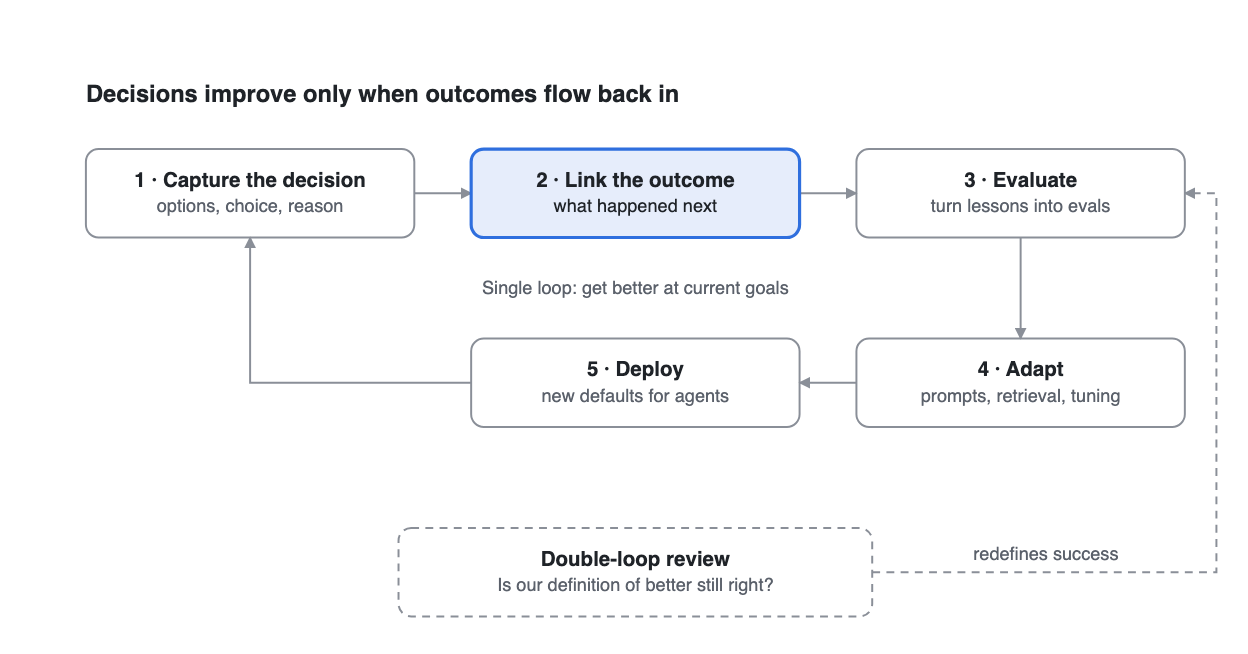
The inner ring is single-loop learning: it makes the organization better at what it already does. The dashed review is double-loop learning: it periodically asks whether the loop's idea of "better" still fits the strategy, and rewrites the evals when it does not.
Each step has a specific job. Capture records the judgment, not just the artifact. Outcome linking is what separates learning from mere approval tracking. Evaluation turns lessons into tests that outlive any model. Adaptation changes prompts, retrieval and, where justified, model weights. Deployment puts the improved defaults back in front of people, whose next decisions start the cycle again.
Outcome linking is necessary but not sufficient. Suppose a product manager prioritizes Feature A over Feature B, and six months later revenue rises. Was A the right call? Revenue may have risen because of a price change, a market shift or a strong sales quarter. The loop observes an outcome; it does not automatically know whether the decision caused it, or whether B would have done better. A loop that confuses correlation with causation can become exceptionally good at reinforcing bad decisions. Where stakes justify it, the loop needs some way to compare against alternatives: holdout groups, staged rollouts, or at minimum a recorded note of the other factors in play.
Old idea, new machinery
Organizational learning is not new. What is new is that machines can now carry part of it.
Double-loop learning. In 1977 Chris Argyris described two kinds of organizational learning in Harvard Business Review (summary). Single-loop learning corrects errors within existing rules, like a thermostat holding 68 degrees. Double-loop learning questions the rules themselves: why 68? Argyris and Schön observed that most organizations are good at the first and struggle with the second (Thinkers50). That distinction will matter later, because AI loops are naturally single-loop.
Continuous improvement. Lean manufacturing made small, repeated corrections a management system rather than an individual habit. The insight was that a modest improvement rate, compounded across thousands of people and years, beats occasional brilliance.
Data flywheels. Tesla gave the idea its machine form. Andrej Karpathy described the fleet as a distributed data-gathering system, with the team's effort shifting from writing algorithms to curating datasets (Electrek). Edge cases found in the field were labeled, used to retrain, and pushed back out to the fleet. The loop, not any single model version, was the asset.
What AI changes. Earlier loops learned from physical signals or from slow, manual reviews. Knowledge work rarely produced machine-readable feedback. Now it does. When employees work through AI agents, the alternatives considered, the option chosen, the correction made and the outcome observed can all be recorded. For the first time, the judgment of knowledge workers can flow through a data-engine-style loop, turning organizational learning from an informal management practice into a continuously operating system.
Model, data and loop: what each contributes
The three assets are not rivals. Each contributes something different, and each can be a durable advantage in the right circumstances. The loop's distinct role is to make the other two more valuable over time, if it is well designed.
| Asset | What it contributes | When it is a durable advantage | When it is fragile |
|---|---|---|---|
| Foundation model | Capability | For frontier labs, whose business is the model | For enterprises relying on one provider's model, since comparable capability is increasingly available elsewhere |
| Proprietary data | Context | Hard-to-reproduce sets: longitudinal clinical records, specialized industrial measurements, unique transaction histories | Data that can be bought, licensed or approximated, or that goes stale as markets move |
| Learning loop | Rate of improvement | When it links decisions to outcomes, is curated, and questions its own goals | When it learns approval instead of outcomes, or trains on its own past recommendations |
The model row needs care. For enterprises consuming foundation models, capability is increasingly available from multiple providers. Performance gaps remain, but they shift quickly; Epoch AI estimates open-weight models have trailed the closed frontier by a few months on average, though the gap varies by benchmark and capability (Epoch AI). A competitive advantage built solely on access to one model may therefore be temporary. That does not mean models change constantly in practice: many enterprise systems keep a model for years for reasons of validation, cost, reliability or regulation.
The loop is different in kind. Its value comes from a history of decisions, outcomes and corrections. A competitor can license the same model tomorrow, and in some markets can buy similar data. It cannot license your record of what you tried, what happened and what you changed as a result. But the loop does not improve on its own. It improves only as well as it is designed, as the next section shows.
How loops fail
A learning loop amplifies whatever it learns, including mistakes. And the more effectively an AI system learns an organization's historical judgment, the more effectively it may reproduce the organization's historical limitations. Six failure modes deserve as much design attention as the loop itself.
- It learns approval, not outcomes. If the loop records only what people accepted, it optimizes toward what looks good in the moment. An accepted suggestion is not the same as a good decision.
- It mistakes correlation for causation. Even with outcomes attached, a loop can credit a decision for results it did not cause, and then recommend more of the same.
- It freezes the culture. An AI loop is naturally single-loop in Argyris's sense: it gets better at doing what the organization already does, without asking whether those rules still make sense. Organizations want AI to encode best practice, but breakthrough decisions often come from challenging it.
- It learns from itself. As people increasingly act on AI recommendations, the loop starts learning from decisions shaped by its own earlier versions. An AI recommends Feature A; a manager accepts; the acceptance is recorded as evidence A was right; the next version recommends similar choices more strongly. The system appears to learn organizational judgment while actually learning its own past advice. This feedback contamination also homogenizes judgment: dissent gets quieter, and the minority view that would have caught a strategic error is the signal the loop learns to discount.
- It learns from the wrong teachers. Loops weight the decisions they see most often. Those may come from the most active users, not the best ones. Without curation, volume beats wisdom.
- It becomes surveillance. If employees believe every disagreement, correction or rejected recommendation will be used to score them, they will optimize for appearing correct rather than exploring alternatives. They will hedge, perform for the record, or withhold the candid reasoning the loop most needs, destroying the very signal it exists to capture.
The common thread is that a loop is only as good as its definition of "better," and that definition is a management choice that has to be revisited. A good organizational learning loop improves decisions. A great one also learns when to question how decisions are made.
Building the loop: what leaders should do now
Most enterprises already generate the raw material for a learning loop. Few have connected it. Eight moves turn decision exhaust into a compounding asset.
- Pick decisions worth learning. Start with a few high-frequency, high-value calls with measurable outcomes: pricing exceptions, incident triage, code review, credit overrides. Do not try to capture everything.
- Record the decision, not just the result. Capture the options considered, the one chosen and the stated reason. Most systems keep only the final artifact and lose the judgment.
- Close the outcome gap, and test for causation. Link each decision to what happened later, note the other factors in play, and use holdouts or staged rollouts where the stakes justify them.
- Tag AI-influenced decisions. Record whether a decision followed, modified or overrode an AI recommendation, so the loop does not treat its own past advice as independent evidence.
- Make evals the executable expression of institutional memory. Evals turn lessons into standards every new model, prompt or agent must pass. They work alongside decision and outcome history, which preserve the context evals leave out (see the table below).
- Capture decisions to improve the system, not to score the people making them. Aggregate and anonymize where possible, and say so plainly to employees. Candid signal depends on it.
- Schedule double-loop reviews. Periodically ask whether the loop's definition of "good" still fits the strategy. Record overrides and dissent as signal, not noise.
- Own the loop's infrastructure. Keep decisions, outcomes, evals and adaptations in a governed, model-independent store. This is where the first essay's protection argument and this essay's growth argument meet: the asset you build is the asset you must guard.
| Component | What it preserves |
|---|---|
| Decision history | What was considered, chosen, and why |
| Outcome history | What happened after the decision |
| Evaluation suite | What future systems must demonstrate |
Conclusion
For most of business history, organizational learning lived in people's heads and left when they did. AI changes that. Judgment can now be recorded, tested against outcomes and fed back into the tools everyone uses.
That makes the central strategic question less about which model to buy and more about which loop to build. Models will keep improving and data will keep accumulating, but neither tells you whether the organization is getting better at deciding. The loop does, if it learns from outcomes rather than approval and questions its own assumptions.
The two essays fit together. The first was about protecting accumulated judgment. This one is about increasing the rate at which judgment improves. An organization with ten years of decision history may lead today, but a rival with a better loop can overtake it. The durable advantage is not only what an organization knows, but how quickly it turns experience into better decisions. The next competitive moat may be organizational learning velocity.
The winners will not simply be the organizations with the smartest people or the most powerful AI. They will be the ones that learn fastest from their own decisions, and keep that learning for themselves.
Sources
— Gaurav
Responses