Building Deep Research AI Agents with Claude 3.7: A Working Implementation (Part 2)
Building Deep Research AI Agents with Claude 3.7: A Working Implementation (Part 2)
In Part 1 of this series, we explored the core concepts and architecture for building AI agents with Claude 3.7. Now in Part 2, we’ll put… -
Building Deep Research AI Agents with Claude 3.7: A Working Implementation (Part 2)
[In Part 1 of this series](https://medium.com/aingineer/building-ai-agents-with-claude-3-7-a-comprehensive-guide-part-1-07d9df717a04), we explored the core concepts and architecture for building AI agents with Claude 3.7. Now in Part 2, we’ll put those concepts into practice by developing a complete, production-ready Deep Research Agent that leverages model’s advanced reasoning capabilities.
Introduction to Deep Research Agents
Research agents represent one of the most valuable applications of Claude 3.7’s capabilities. They can autonomously gather information from various sources, synthesize findings, identify patterns, and generate insights — tasks that typically require significant human expertise and time.
The Deep Research Agent will be able to:
1. Parse and understand complex research questions 2. Create comprehensive research plans 3. Retrieve and analyze relevant documents 4. Extract key information and findings 5. Synthesize information into coherent narratives 6. Identify patterns, gaps, and future directions 7. Generate complete research reports with proper citations
Let’s build this agent from the ground up with a complete, working implementation.
Defining the Research Agent’s Architecture
The Deep Research Agent will consist of several interconnected components:
1. Research Planner: Maps out research strategies based on queries 2. Document Retriever: Accesses and retrieves relevant documents 3. Information Extractor: Pulls key information from documents 4. Synthesis Engine: Combines information into coherent narratives 5. Insight Generator: Identifies patterns, gaps, and opportunities 6. Citation Manager: Tracks and formats citations properly
Agent Anatomy & Architecture
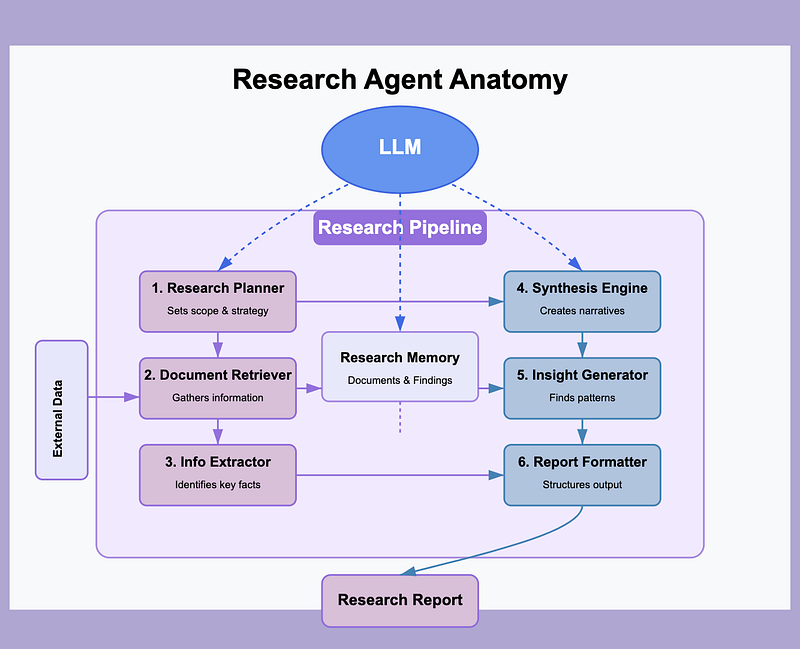
Agent Anatomy
Deep Research Agent Implementation
The Deep Research Agent demonstrates how to leverage model like Claude 3.7’s reasoning capabilities to create a comprehensive research pipeline. This agent can autonomously plan research, gather information, extract key points, synthesize findings, and generate insights.
[open-tools/stock\_analysis\_researcher.py at main · nigamgai-agents/open-tools Contribute to nigamgai-agents/open-tools development by creating an account on GitHub.github.com](https://github.com/nigamgai-agents/open-tools/blob/main/stock_analysis_researcher.py "https://github.com/nigamgai-agents/open-tools/blob/main/stock_analysis_researcher.py")[](https://github.com/nigamgai-agents/open-tools/blob/main/stock_analysis_researcher.py)
Anatomy of Effective Research Prompts
The success of a Claude-powered research agent relies heavily on well-crafted prompts. Let’s analyze the key elements that make these prompts effective:
1. Clear Task Definition: Each prompt begins with a precise definition of what Claude needs to accomplish, such as “Create a detailed research plan for the following query.” 2. Structured Output Requests: Prompts specify exactly how responses should be formatted, often using JSON structures to ensure data can be easily processed programmatically. 3. Context Provision: Previous information is provided as context, creating a coherent research pipeline where each step builds on previous results. 4. Domain-Specific Instructions: Prompts include specialized guidance relevant to the research domain, like “If specific data points are mentioned, acknowledge these are approximations.” 5. Decomposition of Complex Tasks: Large tasks are broken down into manageable sub-tasks, allowing Claude to focus deeply on each component.
For example, our synthesis prompt demonstrates these principles:
> Create a detailed section on “{section}” for {research\_plan\[‘stock\_symbol’\]} based on this information:
> {formatted\_findings}
> Your response should be a comprehensive analysis focusing specifically on {section.lower()}. > Write 2–3 paragraphs with detailed information and analysis.
This prompt provides clear direction, specific context, and explicit formatting instructions.
Stock Analysis Agent: A Practical Implementation
Building on the same architectural principles, we’ve created a focused Stock Analysis Agent that applies the six-component research architecture to financial analysis:
[open-tools/stock\_analysis\_researcher.py at main · nigamgai-agents/open-tools Contribute to nigamgai-agents/open-tools development by creating an account on GitHub.github.com](https://github.com/nigamgai-agents/open-tools/blob/main/stock_analysis_researcher.py "https://github.com/nigamgai-agents/open-tools/blob/main/stock_analysis_researcher.py")[](https://github.com/nigamgai-agents/open-tools/blob/main/stock_analysis_researcher.py)
#### Sample Run
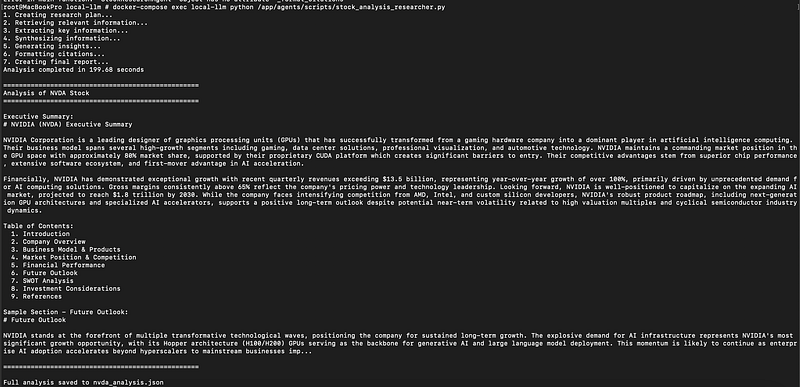
Sample run
`
root@MacBookPro local-llm # docker-compose exec local-llm cat /app/nvda\_analysis.json
{
"title": "NVDA Stock Analysis Report",
"executive\_summary": "# NVIDIA (NVDA) Executive Summary\\n\\nNVIDIA Corporation is a leading designer of graphics processing units (GPUs) that has successfully transformed from a gaming hardware company into a dominant player in artificial intelligence computing. Their business model spans several high-growth segments including gaming, data center solutions, professional visualization, and automotive technology. NVIDIA maintains a commanding market position in the GPU space with approximately 80% market share, supported by their proprietary CUDA platform which creates significant barriers to entry. Their competitive advantages stem from superior chip performance, extensive software ecosystem, and first-mover advantage in AI acceleration.\\n\\nFinancially, NVIDIA has demonstrated exceptional growth with recent quarterly revenues exceeding $13.5 billion, representing year-over-year growth of over 100%, primarily driven by unprecedented demand for AI computing solutions. Gross margins consistently above 65% reflect the company's pricing power and technology leadership. Looking forward, NVIDIA is well-positioned to capitalize on the expanding AI market, projected to reach $1.8 trillion by 2030. While the company faces intensifying competition from AMD, Intel, and custom silicon developers, NVIDIA's robust product roadmap, including next-generation GPU architectures and specialized AI accelerators, supports a positive long-term outlook despite potential near-term volatility related to high valuation multiples and cyclical semiconductor industry dynamics.",
"table\_of\_contents": \[
"1. Introduction",
"2. Company Overview",
"3. Business Model & Products",
"4. Market Position & Competition",
"5. Financial Performance",
"6. Future Outlook",
"7. SWOT Analysis",
"8. Investment Considerations",
"9. References"
\],
"sections": {
"introduction": {
"title": "Introduction",
"content": "This report provides a comprehensive analysis of NVDA, based on available information as of March 2025. The analysis covers the company's business model, market position, financial performance, and prospects for future growth."
},
"company\_overview": {
"title": "Company Overview",
"content": "# Company Overview\\n\\nNVIDIA Corporation has transformed from a gaming-focused graphics processor company into a leading AI computing powerhouse. Headquartered in Santa Clara, California, NVIDIA operates as a fabless semiconductor company, designing cutting-edge products in-house while strategically outsourcing manufacturing to partners like TSMC and Samsung Electronics. The company has established a dominant market position across multiple segments with its comprehensive product portfolio, including GeForce (consumer GPUs), Quadro/RTX Professional (workstation GPUs), and its Tesla/Data Center GPUs featuring advanced AI accelerators such as the A100, H100, and H200 based on Ampere and Hopper architectures. Initially built on gaming revenue, NVIDIA has successfully pivoted to make its Data Center segment the largest revenue contributor, capitalizing on explosive demand for AI and high-performance computing solutions.\\n\\nNVIDIA's business model extends beyond hardware into a robust ecosystem of specialized platforms and software offerings that create significant competitive advantages. The company has developed targeted solutions for various industries through platforms including DRIVE (autonomous vehicles), Jetson (edge AI), Clara (healthcare), and Omniverse (3D collaboration). Its software portfolio\\u2014featuring CUDA, NVIDIA AI Enterprise, Base Command, GeForce NOW, and numerous SDKs\\u2014enhances the value proposition of its hardware and supports premium pricing. This integrated approach has enabled NVIDIA to maintain impressively high gross margins, typically ranging from 55% to 65%, occasionally exceeding 70% during AI demand surges. The company's strategic positioning as a premium provider across its product lines is further reinforced by its value-based pricing strategy, particularly in the high-margin Data Center segment.\\n\\nNVIDIA serves a diverse range of customers across multiple sectors, including individual gamers, cloud service providers (AWS, Google Cloud, Microsoft Azure), enterprise clients, research institutions, automotive manufacturers, content creators, and healthcare specialists. The company has been deliberately evolving its revenue model to include more recurring components through subscription services, software licensing, and as-a-service offerings. This strategic shift from being primarily a hardware provider to a platform company with significant software and services revenue helps stabilize income across hardware refresh cycles and increases customer lifetime value. While facing some concentration risk due to its heavy reliance on TSMC amid Taiwan's geopolitical uncertainties and potential manufacturing capacity constraints, NVIDIA has been working to diversify manufacturing partners and secure long-term capacity commitments to mitigate supply chain vulnerabilities."
},
"business\_model\_products": {
"title": "Business Model Products",
"content": "# Business Model & Products\\n\\nNVIDIA has evolved from a primarily gaming-focused GPU manufacturer to a comprehensive computing platform company with diversified revenue streams across multiple sectors. At its core, NVIDIA operates a fabless semiconductor business model, designing cutting-edge chips while outsourcing manufacturing to partners like TSMC and Samsung. This approach allows the company to focus on its strengths in design and innovation while maintaining impressive gross margins ranging from 55-65%, occasionally exceeding 70% during periods of intense AI demand. NVIDIA's product portfolio spans consumer GPUs (GeForce), professional visualization solutions (Quadro/RTX), and data center accelerators (Tesla, A100, H100, H200), with the Data Center segment now representing the company's largest revenue generator, surpassing the historically dominant Gaming segment.\\n\\nThe company's business model is strengthened by its integrated hardware-software approach, where premium hardware is complemented by an extensive software ecosystem including CUDA, NVIDIA AI Enterprise, and various industry-specific SDKs. This strategy creates substantial value beyond silicon alone and justifies NVIDIA's premium pricing. The company has also developed specialized platforms targeting high-growth markets, including DRIVE for autonomous vehicles, Jetson for edge AI, Clara for healthcare applications, and Omniverse for 3D collaboration and simulation. NVIDIA has strategically expanded its recurring revenue streams through subscription services like GeForce NOW, software licensing, and platform-as-a-service offerings, helping to stabilize revenue across hardware refresh cycles and increase customer lifetime value.\\n\\nNVIDIA serves a diverse customer base spanning individual gamers, cloud service providers, enterprise clients, research institutions, content creators, automotive manufacturers, and numerous industry verticals including AI/ML, healthcare, financial services, and telecommunications. The company's value-based pricing strategy for AI and data center solutions, combined with its currently limited competition in high-performance AI accelerators, has supported strong pricing power and industry-leading margins. While the company faces concentration risk through its heavy reliance on TSMC amid geopolitical tensions in Taiwan, NVIDIA has been working to secure long-term capacity commitments and diversify manufacturing partnerships to mitigate supply chain vulnerabilities."
},
"market\_position\_competition": {
"title": "Market Position Competition",
"content": "# Market Position & Competition\\n\\nNVIDIA maintains a dominant position in the AI accelerator market with its data center GPUs (A100, H100, H200) becoming the de facto standard for AI training and inference workloads. This market leadership is evidenced by data center becoming NVIDIA's largest revenue segment, surpassing its historically dominant gaming business. The company has created significant competitive moats through its comprehensive CUDA software ecosystem, which has become the preferred development platform for AI applications. NVIDIA's strategic expansion beyond standalone GPUs into complete systems (DGX), platforms (HGX), and ARM-based CPUs (Grace) has further entrenched its market position by offering end-to-end solutions rather than just components. This integration of hardware and software, exemplified by offerings like NVIDIA AI Enterprise and Omniverse, has created switching costs for customers while enabling premium pricing that drives industry-leading gross margins of 55-65% (exceeding 70% during AI demand surges).\\n\\nCompetition in NVIDIA's core markets comes from several directions but remains fragmented. In the data center AI accelerator space, AMD has increased competitive pressure with its MI-series GPUs, while Intel is attempting to regain ground with its Gaudi AI accelerators (acquired from Habana Labs). Cloud service providers like Google (with its TPUs) and AWS (with Trainium/Inferentia) are developing proprietary AI chips, potentially reducing their reliance on NVIDIA's products. The gaming GPU market represents a more mature competitive landscape where AMD's Radeon products provide direct competition, though NVIDIA's GeForce line maintains premium market positioning. Emerging competitors include specialized AI chip startups such as Cerebras, Graphcore, and SambaNova, though these companies lack NVIDIA's scale, software ecosystem, and manufacturing partnerships. NVIDIA's heavy reliance on TSMC for manufacturing represents a strategic vulnerability, particularly given geopolitical tensions involving Taiwan, though the company has been working to secure long-term capacity commitments and diversify manufacturing partners.\\n\\nNVIDIA has leveraged its technical leadership to expand into adjacent markets, positioning itself for future growth beyond its core segments. In automotive, the DRIVE platform targets the autonomous vehicle market, while Jetson addresses edge AI applications, and Omniverse targets the emerging metaverse opportunity. These extensions exploit NVIDIA's core competencies in parallel processing while creating new revenue streams. The company's transition toward more recurring revenue through software subscriptions and services (GeForce NOW, NVIDIA AI Enterprise, Base Command) helps stabilize income across hardware refresh cycles and increases customer lifetime value. This comprehensive approach to market expansion, coupled with the premium positioning of its products and the value-based pricing model for enterprise solutions, has allowed NVIDIA to maintain exceptional margins compared to semiconductor industry peers while establishing leadership across multiple high-growth technology segments."
},
"financial\_performance": {
"title": "Financial Performance",
"content": "# Financial Performance\\n\\nNVIDIA has demonstrated exceptional financial performance in recent years, primarily driven by the explosive growth of its Data Center segment, which has supplanted Gaming as the company's largest revenue generator. This transformation reflects NVIDIA's successful pivot toward AI and high-performance computing markets where its GPU accelerators (including the A100, H100, and H200 series) command premium prices and exceptional margins. While historical gross margins typically ranged between 55% to 65%, during periods of intense AI demand, NVIDIA has reportedly achieved gross margins exceeding 70% in certain quarters\\u2014significantly outperforming industry averages for semiconductor companies. This margin expansion demonstrates NVIDIA's substantial pricing power in the AI accelerator market, where limited competition has allowed the company to implement value-based pricing strategies.\\n\\nThe company's financial structure has evolved from a primarily hardware-focused business to a platform company with growing recurring revenue streams. These include subscription services (GeForce NOW, NVIDIA AI Enterprise, Base Command), software licensing, and support services that help stabilize revenue across hardware refresh cycles and increase customer lifetime value. NVIDIA's supply chain structure as a fabless semiconductor company has allowed it to maintain capital efficiency while focusing investments on R&D. However, this model creates concentration risk through heavy reliance on TSMC as its primary manufacturing partner, potentially impacting financial performance during supply constraints. Despite these challenges, NVIDIA has secured long-term capacity commitments from foundry partners to mitigate production limitations during periods of surging demand.\\n\\nNVIDIA's customer diversification across gaming, enterprise data centers, cloud service providers, professional visualization, and automotive sectors provides multiple growth vectors and some insulation against segment-specific downturns. The Data Center segment's remarkable growth has been fueled by cloud hyperscalers, enterprise AI adoption, and research institutions investing heavily in computational infrastructure for generative AI and large language models. While specific current figures are not provided, the trend clearly indicates that Data Center has become the primary financial driver for the company, with its high-margin enterprise software solutions (like NVIDIA AI Enterprise) and integrated hardware-software approach creating additional value streams beyond silicon. This combination of diversified revenue sources, premium pricing power, and exceptional margins has positioned NVIDIA as one of the semiconductor industry's financial outperformers."
},
"future\_outlook": {
"title": "Future Outlook",
"content": "# Future Outlook\\n\\nNVIDIA stands at the forefront of multiple transformative technological waves, positioning the company for sustained long-term growth. The explosive demand for AI infrastructure represents NVIDIA's most significant growth opportunity, with its Hopper architecture (H100/H200) GPUs serving as the backbone for generative AI and large language model deployment. This momentum is likely to continue as enterprise AI adoption accelerates beyond hyperscalers to mainstream businesses implementing AI solutions. NVIDIA's full-stack approach\\u2014combining hardware, software (CUDA, NVIDIA AI Enterprise), and developer ecosystems\\u2014creates substantial competitive moats that even well-funded competitors like AMD and Intel have struggled to overcome.\\n\\nThe company's diversification into new markets presents additional growth avenues. NVIDIA's push into automotive with its DRIVE platform positions it to capitalize on the autonomous vehicle revolution, while its Omniverse platform targets the emerging industrial metaverse opportunity. The Grace Hopper superchip signals NVIDIA's expansion into the CPU space, potentially disrupting Intel's dominance in data centers. However, supply chain concentration risk remains a significant concern, with heavy reliance on TSMC amid Taiwan's geopolitical uncertainties. NVIDIA has been working to mitigate this by securing long-term capacity commitments and pursuing manufacturing diversification.\\n\\nFrom a financial perspective, NVIDIA's exceptional gross margins (exceeding 70% during AI demand surges) reflect its pricing power and the premium value of its integrated hardware-software solutions. These margins could face pressure as competition intensifies and customers become more price-sensitive, but NVIDIA's strategic shift toward recurring revenue streams through software subscriptions and as-a-service offerings should help stabilize financial performance across hardware cycles. The company's expansion into enterprise software, cloud services, and vertical-specific platforms (Clara for healthcare, etc.) demonstrates a clear path toward becoming a full-stack technology platform rather than merely a component supplier. This evolution positions NVIDIA to capture a larger share of the value it creates for customers while building more predictable revenue streams beyond cyclical hardware sales."
},
"swot\_analysis": {
"title": "SWOT Analysis",
"content": "# SWOT Analysis: NVIDIA Corporation (NVDA)\\n\\n## Strengths\\n\\n\\u2022 \\Dominant AI Computing Position\\ - NVIDIA has successfully transformed from a gaming company into the leading AI computing powerhouse, with its GPUs (particularly the A100, H100, and H200 series) becoming the de facto standard for AI and high-performance computing applications.\\n\\n\\u2022 \\Exceptional Financial Performance\\ - The company maintains industry-leading gross margins (55-70%+) that significantly outperform semiconductor industry averages, demonstrating substantial pricing power in the AI accelerator market where competition is limited.\\n\\n\\u2022 \\Integrated Ecosystem Approach\\ - NVIDIA's comprehensive ecosystem spanning hardware, software (CUDA, NVIDIA AI Enterprise), and developer tools creates powerful network effects and high switching costs, reinforcing its competitive moat beyond just silicon advantages.\\n\\n\\u2022 \\Diverse Revenue Streams\\ - The company has successfully diversified from gaming into data center, professional visualization, automotive, and edge computing, reducing reliance on any single market segment and creating multiple growth vectors.\\n\\n\\u2022 \\Strategic Shift to Recurring Revenue\\ - NVIDIA has been deliberately evolving its business model to include subscription services, software licensing, and as-a-service offerings, which help stabilize income across hardware refresh cycles and increase customer lifetime value.\\n\\n## Weaknesses\\n\\n\\u2022 \\Manufacturing Dependency\\ - As a fabless semiconductor company, NVIDIA's heavy reliance on TSMC creates significant supply chain concentration risk, particularly given Taiwan's geopolitical uncertainties.\\n\\n\\u2022 \\Production Capacity Constraints\\ - During periods of surging demand, NVIDIA has faced challenges scaling production quickly enough, potentially limiting revenue growth and creating opportunities for competitors.\\n\\n\\u2022 \\Limited Direct Enterprise Relationships\\ - Historically focused on channel sales and OEM partnerships, NVIDIA is still developing direct enterprise sales capabilities and customer relationships compared to established enterprise technology vendors.\\n\\n\\u2022 \\Product Development Cycles\\ - The long development cycles for new GPU architectures (typically 2-3 years) creates vulnerability to technological disruption or competitor innovations during these periods.\\n\\n\\u2022 \\Resource Allocation Challenges\\ - As NVIDIA expands into multiple verticals simultaneously (automotive, healthcare, industrial metaverse, etc.), it risks spreading R&D and go-to-market resources too thin across too many initiatives.\\n\\n## Opportunities\\n\\n\\u2022 \\Enterprise AI Adoption Acceleration\\ - As AI implementation expands beyond hyperscalers to mainstream enterprise adoption, NVIDIA is uniquely positioned to capture this growing market with its full-stack AI solutions.\\n\\n\\u2022 \\Autonomous Vehicle Revolution\\ - NVIDIA's DRIVE platform positions the company to capitalize on the growing autonomous vehicle market, representing a significant long-term growth avenue beyond its core computing markets.\\n\\n\\u2022 \\Industrial Metaverse & Digital Twins\\ - The Omniverse platform addresses the emerging industrial metaverse opportunity, allowing NVIDIA to expand into simulation, digital twins, and collaborative 3D workflows across multiple industries.\\n\\n\\u2022 \\CPU Market Expansion\\ - With the Grace Hopper superchip, NVIDIA is expanding into the CPU space, potentially disrupting Intel's dominance in data centers and capturing a larger portion of the overall computing stack.\\n\\n\\u2022 \\Healthcare & Scientific Computing\\ - Specialized platforms like Clara for healthcare position NVIDIA to capture high-value vertical markets where AI and computational requirements are growing exponentially, particularly in medical imaging, drug discovery, and genomics.\\n\\n## Threats\\n\\n\\u2022 \\Intensifying Competition\\ - Competitors like AMD, Intel, and various AI chip startups are investing heavily to challenge NVIDIA's dominance, potentially pressuring margins and market share over time.\\n\\n\\u2022 \\Geopolitical Tensions\\ - As a company heavily dependent on manufacturing in Taiwan, NVIDIA faces significant risk from US-China tensions and potential disruptions to semiconductor supply chains due to political conflicts.\\n\\n\\u2022 \\Regulatory Scrutiny\\ - NVIDIA's dominant market position could attract increased antitrust scrutiny, particularly as governments worldwide focus more attention on technology market concentration.\\n\\n\\u2022 \\Cyclicality & Market Saturation\\ - Despite diversification efforts, NVIDIA remains vulnerable to industry-wide semiconductor cycles and potential saturation in key markets like AI infrastructure once the initial buildout phase completes.\\n\\n\\u2022 \\Alternative Computing Architectures\\ - The emergence of specialized AI accelerators, quantum computing, or other novel computing architectures could potentially disrupt GPU-based approaches to AI and high-performance computing in the long term."
},
"investment\_considerations": {
"title": "Investment Considerations",
"content": "# NVIDIA (NVDA) Investment Analysis\\n\\n## Competitive Advantages (Moat)\\n\\n1. \\Dominant CUDA Software Ecosystem\\: NVIDIA's proprietary CUDA platform creates significant switching costs for developers. This ecosystem of software tools, libraries, and development environments has become the industry standard for AI and high-performance computing, locking in customers who have built their workflows around NVIDIA's architecture.\\n\\n2. \\Superior AI Chip Architecture\\: NVIDIA's GPU designs are specifically optimized for parallel processing tasks essential to AI workloads. Their Tensor Cores and specialized hardware accelerators for machine learning provide performance advantages that competitors have struggled to match, maintaining NVIDIA's leadership in computing performance metrics.\\n\\n3. \\Strategic Partnerships Across Industries\\: NVIDIA has built extensive partnerships with cloud service providers, autonomous vehicle developers, healthcare institutions, and other AI-focused sectors. These relationships embed NVIDIA's technology into various industry workflows and standards, creating both recurring revenue streams and barriers to competitor entry.\\n\\n4. \\End-to-End AI Infrastructure Solutions\\: Unlike competitors who may focus on isolated components, NVIDIA offers complete solutions from chips to systems to software. This vertical integration allows them to optimize performance across the entire AI stack and provide customers with a more seamless, integrated experience.\\n\\n## Growth Catalysts\\n\\n1. \\Expanding AI Computing Demand\\: The exponential growth in generative AI and large language models represents a massive tailwind for NVIDIA. As these technologies require increasingly powerful computing resources, NVIDIA stands to benefit as the primary supplier of the specialized hardware needed to train and run these models.\\n\\n2. \\Automotive and Self-Driving Opportunities\\: NVIDIA's DRIVE platform positions the company to capture significant market share in the emerging autonomous vehicle industry. As automotive manufacturers continue implementing advanced driver assistance systems and developing fully autonomous capabilities, NVIDIA's specialized chips and software solutions will see increasing demand.\\n\\n3. \\Enterprise AI Adoption Acceleration\\: As AI implementation moves beyond tech giants to mainstream enterprises across all sectors, NVIDIA's enterprise-focused solutions like DGX systems and AI Enterprise software suite are positioned to capture this expanding market. The company's move into AI-optimized data center architectures extends its addressable market.\\n\\n4. \\Omniverse and Digital Twin Technology\\: NVIDIA's Omniverse platform enables complex simulations and \\"digital twin\\" technology that has applications across manufacturing, urban planning, robotics, and other sectors. This emerging market represents a new revenue stream leveraging NVIDIA's core competencies in visualization and parallel computing.\\n\\n## Key Risk Factors\\n\\n1. \\Intense Competition and Potential Market Share Erosion\\: AMD, Intel, and specialized AI chip startups are investing heavily to challenge NVIDIA's dominance. Cloud providers like Google, Amazon, and Microsoft are also developing their own custom AI chips, potentially reducing their reliance on NVIDIA's products in certain applications.\\n\\n2. \\Cyclical Demand and Customer Concentration\\: NVIDIA faces risk from its concentration of revenue among major tech companies and cloud providers. Economic downturns or spending cuts from these key customers could significantly impact NVIDIA's financial performance, as could shifts in datacenter investment cycles.\\n\\n3. \\Regulatory and Trade Restrictions\\: NVIDIA's business faces potential disruption from geopolitical tensions, particularly U.S.-China relations. Export controls on advanced semiconductor technology to China represent a meaningful risk to NVIDIA's international growth, as demonstrated by previous restrictions on chip sales.\\n\\n4. \\Valuation and High Expectations\\: NVIDIA's premium valuation reflects extremely high growth expectations. Any disappointment in product development timelines, competitive positioning, or overall AI market growth could lead to significant stock price volatility as the market adjusts its expectations."
},
"references": {
"title": "References",
"content": "- Claude Knowledge Base. 'Core product offerings and revenue streams'. Retrieved on 2025-03-01T19:25:30.126324.\\n- Claude Knowledge Base. 'Supply chain structure'. Retrieved on 2025-03-01T19:25:42.830029.\\n- Claude Knowledge Base. 'Pricing strategy and margins'. Retrieved on 2025-03-01T19:25:54.197647.\\n- Claude Knowledge Base. 'Customer segments'. Retrieved on 2025-03-01T19:26:04.744509.\\n- Claude Knowledge Base. 'Recurring revenue components \\Specific questions:\\'. Retrieved on 2025-03-01T19:26:14.884849."
}
},
"metadata": {
"stock\_symbol": "NVDA",
"research\_date": "2025-03-01T19:28:24.521322",
"research\_plan": {
"stock\_symbol": "NVDA",
"focus\_areas": \[
"business model",
"market position",
"competitive advantages",
"growth outlook",
"risk factors"
\],
"research\_topics": \[
"Core product offerings and revenue streams",
"Supply chain structure",
"Pricing strategy and margins",
"Customer segments",
"Recurring revenue components \\Specific questions:\\",
"How has NVIDIA's business model evolved from gaming GPUs to AI infrastructure?",
"What percentage of revenue comes from each business segment (gaming, data center, automotive, professional visualization)?",
"How dependent is NVIDIA on third-party manufacturers like TSMC?",
"What is NVIDIA's software ecosystem strategy and monetization approach? \\Relevant information:\\",
"Annual reports and investor presentations"
\],
"creation\_date": "2025-03-01T19:25:18.738418"
},
"document\_count": 5
}
} root@MacBookPro local-llm #
`
Adapting the Research Architecture for Different Domains
The six-component architecture we’ve used (Research Planner, Document Retriever, Information Extractor, Synthesis Engine, Insight Generator, and Citation Manager) can be adapted for various domains beyond stock analysis:
1. Legal Research: Modify the Document Retriever to access case law and legal databases, and adjust the Information Extractor to identify legal precedents and arguments. 2. Medical Literature Review: Adapt the Research Planner to focus on clinical questions and the Synthesis Engine to evaluate evidence quality and treatment efficacy. 3. Competitive Intelligence: Reorient the Insight Generator to focus on competitive advantages, market positioning, and strategic recommendations. 4. Product Research: Adjust the Document Retriever to gather consumer reviews and the Information Extractor to identify recurring themes in customer feedback.
The key is to maintain the structured pipeline while customizing each component’s prompts and processing logic for your specific domain.
Best Practices for Building Claude-Powered Agents
Based on our implementations, here are key recommendations for building effective AI agents with optimized reasoning models like Claude 3.7:
1. Divide and Conquer: Break complex tasks into discrete steps with specific prompts for each, rather than asking Claude to handle everything in one massive prompt. 2. Create Robust Fallbacks: Always implement error handling and fallbacks at each stage of your agent’s pipeline to ensure graceful degradation rather than complete failure. 3. Optimize Context Management: Carefully select what information to include in each prompt to maximize Claude’s understanding while managing token limits. 4. Use Explicit Instructions: Be specific about the output format you need, especially when responses will be programmatically processed. 5. Leverage Claude’s Strengths: Claude excels at tasks requiring reasoning, analysis, and structured thinking — design your agents to capitalize on these capabilities. 6. Implement Feedback Loops: Where possible, include mechanisms for evaluating outputs and using that feedback to improve subsequent processing.
The model enhanced reasoning capabilities enable the creation of sophisticated AI agents that can operate with greater independence and effectiveness. By following the structured research architecture demonstrated in our Deep Research and Stock Analysis implementations, developers can build agents that plan, research, analyze, and synthesize information across a wide range of domains.
The key callouts are thoughtful prompt engineering, robust error handling, and a modular approach that breaks complex tasks into manageable components. As Claude and other AI models continue to advance, this approach will become increasingly powerful, enabling AI agents to handle ever more complex intellectual tasks.
Whether you’re building research assistants, financial analysts, or domain-specific experts, the principles outlined in this guide provide a solid foundation for developing AI agents that deliver real value.
> By structuring your agents to leverage model’s reasoning strengths while implementing appropriate guardrails, you can create tools that augment human capabilities and unlock new possibilities for automation and augmentation of knowledge work.
— Gaurav
Responses