OKRs — The Framework for Prioritization
OKRs — The Framework for Prioritization
The Cycle: Learn, Reflect, and Prioritize with OKRs OKRs offer a methodical approach to navigating challenges in business environments … -
OKRs — The Framework for Prioritization
> DISCLAIMER: This article might not be relevant if you have already excelled in OKR adoption and achieved significant milestones. However, your curiosity is appreciated if you decide to invest a few.
In my previous article, [Aligning Engineering Roadmaps with Business Objectives: A Guide Using OKRs](https://medium.com/@gauravnigam/aligning-engineering-roadmaps-with-business-objectives-a-guide-using-okrs-03e979bcfc89), I touched upon the significance of OKRs but didn’t delve deeply into their critical role as a prioritization framework. Recent discussions and reflections have prompted me to revisit this essential topic, emphasizing how pivotal OKRs are for strategic decision-making and prioritization.
In the dynamic realm of engineering leadership, three core challenges consistently surface — time, scope, and budget: - Time: The Most Expensive Asset OKRs demand significant alignment and transparency, often competing with day-to-day productivity. Ideally, unlimited time and commitment would enable flawless execution. However, most organizations face time constraints that lead to suboptimal outcomes. - Scope: Navigating Overwhelming Priorities The deluge of tasks and objectives can lead to burnout and inefficiency. Departments distant from direct business decision-making may struggle with OKR adoption, feeling they must comply rather than engage. - Budget: The Eternal Struggle Requests for “more headcount” or “increased operational capacity” often hit the wall of financial constraints, challenging leaders to do more with less.
The Reality of Prioritization
> Effective prioritization is more than a theoretical ideal; it involves tangible practices like voting, scoring, and rigorous impact assessments. Time constraints, overwhelming project scopes, and tight budgets often derail strategic initiatives. How can OKRs help? By aligning departmental objectives with corporate strategy, OKRs cut through the noise, ensuring that every team understands and works towards the same overarching goals.
OKRs are lauded for improving alignment, accountability, and transparency by setting measurable goals. Yet, these strengths also introduce complexities in implementation: - Alignment Issues: Aligning multifaceted teams with varying priorities can prove challenging. - Accountability Demands: Establishing a culture where individuals consistently meet their key results requires significant cultural shifts. - Transparency Hurdles: While fostering openness, transparency can also spotlight underperformance, leading to discomfort and resistance
In my earlier post, [Navigating Milestones in the OKR Journey: Insights from Engineering Leadership](https://medium.com/@gauravnigam/navigating-milestones-in-the-okr-journey-insights-from-engineering-leadership-b2a9e02fa5fa), I discussed these challenges. Having conducted over 50 OKR sessions, I’ve seen firsthand how pivotal they are for bridging gaps between strategy and execution: - During one quarterly planning session, debates over feature prioritization revealed that without clear success metrics, strategic alignment is compromised. Instead of just delivering “X feature by Y date,” discussions must pivot to outcomes that genuinely matter to customers. - Consider the integration of generative AI; the emphasis shouldn’t be solely on technical implementation but on how the technology enhances customer experience and addresses real problems.
Solution — Prioritization at Every Level
Instead of being reactive, using OKRs proactively at every organizational level can transform strategic challenges into aligned, accountable, and transparent action. This systematic approach ensures that resources are directed towards the most impactful projects, enhancing overall business agility. Prioritization itself inherently drives alignment, accountability, and transparency.
OKRs minimize unnecessary discussions and streamline processes, making them invaluable for engineering leaders: - Time Management: Prioritizing based on OKRs helps focus on what’s essential, preventing critical tasks from being lost in the shuffle. - Scope Control: OKRs facilitate tackling one problem at a time, aligning efforts across the organization. - Budget Efficiency: Aligning spending with strategic OKRs ensures that investments are made where they can generate the most significant impact.
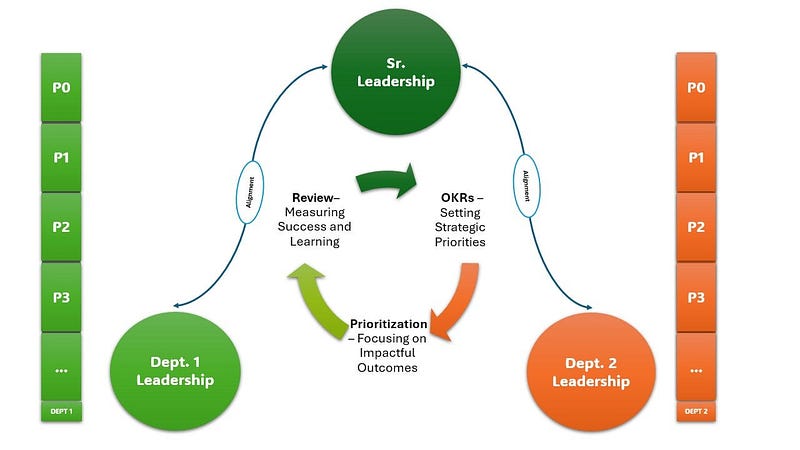
The Cycle: Learn, Reflect, and Prioritize with OKRs
OKRs offer a methodical approach to navigating challenges in business environments, enhancing strategic execution through continuous improvement and alignment. The cycle includes:
1\. Setting Strategic Priorities: - Identify Key Objectives: Define critical objectives that drive maximum organizational value. - Establish Key Results: Set measurable goals for each objective to facilitate progress tracking and effective management.
2\. Focusing on Impactful Outcomes: - Allocate Resources Strategically: Direct resources to align with the priorities defined by the OKRs. - Assess and Adjust Priorities: Continuously review and realign priorities to ensure alignment with strategic goals. Adjust the priority list as needed to concentrate efforts on the most impactful outcomes.
3\. Measuring Success and Learning: - Evaluate OKRs: Assess the achievement of each objective and its impact on organizational goals. - Refine Strategies: Draw lessons from both successes and challenges to refine strategies. - Guide Future Cycles: Apply insights gained to make informed adjustments in subsequent OKR cycles, promoting a culture of agility and continuous improvement.
By effectively prioritizing objectives and key results, we foster alignment, accountability, and transparency, ensuring that our efforts are strategically directed toward unified success. These practices have become indispensable as we navigate the complexities of modern business landscapes.
Over the past decade, I have meticulously compiled notes and iterated on these cycles, both as an organizer and a participant. My recent interactions with engineering leaders have confirmed a strong appetite for collaboration and shared learning in this area. With great excitement, I am pleased to announce the launch of my weekly newsletter on Substack. Here, I will share insights on engineering OKRs, best practices, and various strategies to leverage these proven methods for optimal outcomes.
[Subscribe](https://open.substack.com/pub/gauravnigam/p/okrs-the-framework-for-prioritization?r=2v9yhh&utm_campaign=post&utm_medium=web&showWelcomeOnShare=true) to join the vibrant community and transform our organizational strategies and effective prioritization today.
— Gaurav
Responses