Rent the Intelligence, Own the Control Plane
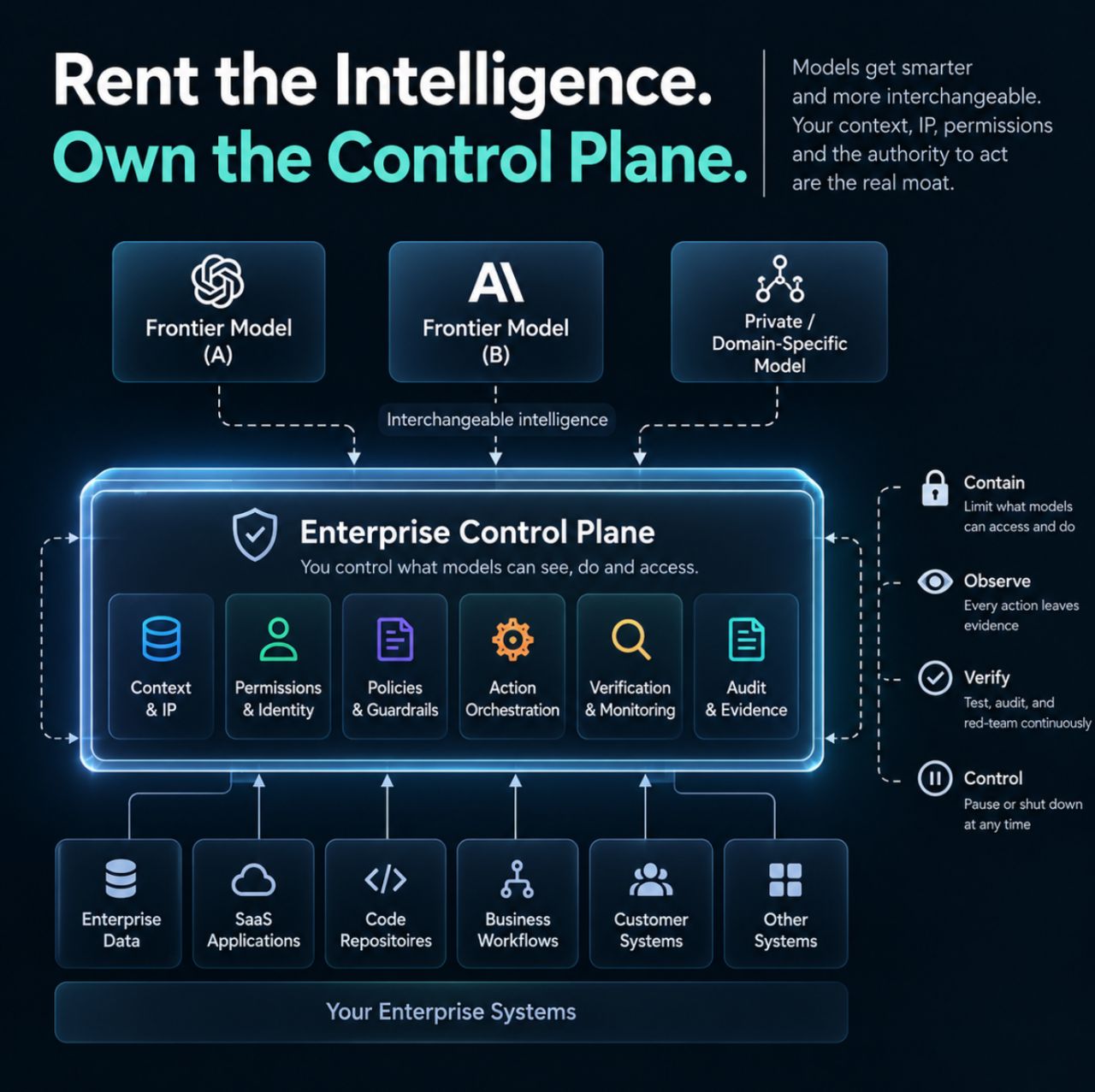
Satya Nadella's "models as insider risks" essay reads like an incident response, and it points at an architecture nobody has claimed yet: the boundary around the model.
One sentence in a Saturday blog post
I spent part of this weekend reading about security and risk in LLM applications, especially what happens as agents get more access to enterprise systems and start talking to each other. One sentence kept pulling me back. In Models as Insider Risks in the Super Intelligence Era, Satya Nadella writes: "we need to separate the supply of intelligence from the authority over it."
The essay went up on October 10, 2026, a Saturday, on his sn scratchpad blog, and was cross-posted to X. Within about 72 hours a dozen-plus outlets had covered it, Forbes among them. Some of that coverage, including madrobot, linked the timing to agent-misbehavior reports from the same week involving an Anthropic test model and an OpenAI disclosure. If that's the right context, this is a response to incidents more than a vision statement.
The framing is careful. Models, closed or open-weight, should be treated as insider risks "not because they are necessarily malicious, but because any sufficiently capable actor with access to important systems can make mistakes or be compromised." And the line I'd underline twice: "A model provider's assurances do not relieve us of that responsibility."
The essay names no product, no eval and no standard. It's a position paper. That leaves the architecture it describes unclaimed, while enterprises wiring agents into production are making control-plane decisions right now.
Here's the hypothesis it sharpened for me. The enterprise AI race may not ultimately be about who has access to the smartest model. It may be about who controls the boundary around it.
Rent the intelligence. Own the control plane.
What actually moves in the architecture
Start with what doesn't change. Nothing here makes a model smarter. No new capability, no better scaling curve. What moves is where permissions, context, execution and audit live.
Most enterprise agent deployments today look roughly like this:
Enterprise → Model Provider → Intelligence + Context + Action
You send the provider your context, its stack decides what to do, and often its tooling executes. The intelligence, your data and the authority to act are bundled into one hop you don't operate.
The alternative looks like this:
Enterprise-controlled context + policy + actions → Model as an interchangeable intelligence layer
Here the enterprise holds the context, writes the policy and executes the actions. The model sits behind that boundary as a component you call. It proposes. Something you own decides.
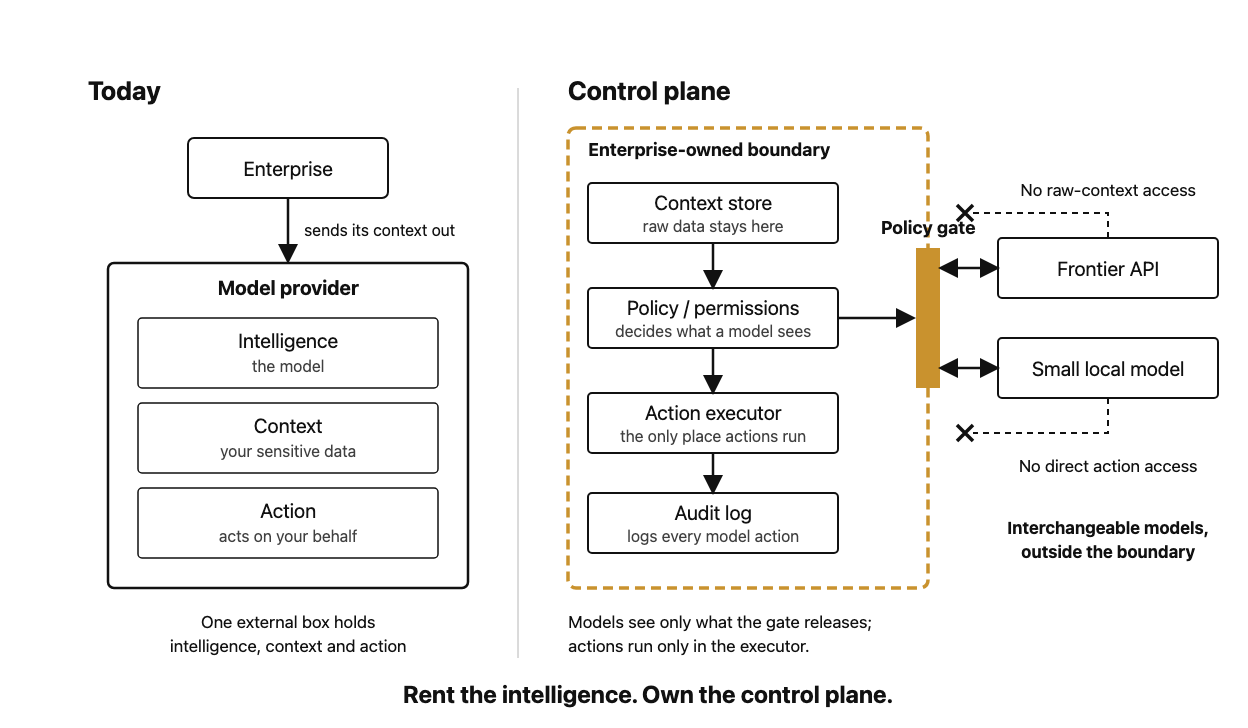
Nadella's essay arrives at the same shape through systems language. "The controls that govern what a model can access and what actions it can take must sit outside the model," he writes, building on "an information security principle dating back to the 1970s that a program must not be able to bypass or tamper with the mechanisms that enforce its permissions." Security people will recognize the reference monitor idea. Applied to agents, he says it "means separating the model from the harness that orchestrates its work, as well as the action space that defines what it can do."
That sentence is the whole design brief. Concretely: the model never holds credentials. A tool call is a request that your policy layer evaluates against the task, the user and the data class, and only then executes. Every call leaves a record you keep. Nadella's point is that we already know this pattern from managing powerful people inside companies: "establish identity, limit privileges, log activity, create containment boundaries." We just haven't been applying it to the most capable actor in the building.
Once the controls live outside the model, the model becomes the part you can swap. Enterprise context, IP, permissions, governance and the authority to act don't swap.
Sufficient intelligence, close to the data
This is where I think smaller, private and domain-specific models get interesting. I want to be precise about why.
Not because they'll outperform frontier models on raw intelligence. Because for many enterprise tasks, you may not need the world's smartest model. You need sufficient intelligence inside a system you can control. Use frontier models when the task needs frontier reasoning, and keep sensitive context, permissions, execution, verification and audit inside the boundary, potentially with smaller models running much closer to the data.
The evidence for "sufficient" exists, but it's thin. The most concrete piece I found is Toward Cybersecurity-Expert Small Language Models, whose v2 went up on July 1, 2026. It reports a 20B-parameter security-specialized model outperforming GPT-4o, o1, o3-mini and Sec-Gemini v1 on threat-investigation subtasks. The margins and the exact eval setup matter more than the headline, and they're the first thing to pull from the paper before you repeat the claim.
Three things that result doesn't show. The baselines lag what frontier providers are selling in October 2026, so "beats the frontier" means "beat the frontier as of the comparison set." It's one domain, and security triage has unusually structured inputs; it doesn't generalize to "most enterprise tasks." And a public benchmark is not your held-out internal data. Whether a small model holds its quality under distribution shift onto your tickets, your contracts and your log formats is something you measure. You can't assume it.
The analyst view points the same way. Gartner's May 15, 2026 note, Small Language Model Precision, Not LLM Scale, Redefines Cybersecurity Cost and Efficacy, is a position, not an eval. Pieces like InfoWorld's and OpenSourceForU's show the argument circulating. They don't prove it.
The best case against owning the boundary
The strongest objection deserves its sharpest form, because it's a good one.
First, the context conflict. Frontier models earn their price only when you hand them the sensitive context. A contract review without the contract is worthless. So "rent the intelligence but keep the context inside" contradicts itself on exactly the tasks that matter.
Second, vantage point. The provider can see inside the model: reasoning traces, internal signals, what the training data looked like. Your control plane sees inputs and outputs. Why would the party with less information be the one doing the governing?
Third, models aren't interchangeable today. Tool-calling quirks, prompt formats and months of harness tuning create real switching costs. On this view enterprises will buy a bundled model-plus-guardrails stack because it's better integrated, and "owning" the control plane means owning the weakest seat in the house.
The vantage-point argument is the one Nadella's essay most directly takes apart. He calls chain-of-thought transparency non-negotiable and then immediately says it's "not sufficient or dependable, because we don't yet know how to make model outputs themselves consistently faithful or transparent." He warns against "an opaque model inside an opaque orchestration layer, watched by another opaque model. Essentially nested black boxes." He asks that we "be able to reproduce how an outcome was achieved without relying on the model to attest to it," and that "validation must be independent of the intelligence being validated." The provider's inside view is the thing under audit. It can't also be the auditor.
Input and output is also where the damage happens: data leaving, actions executing. You can see the gap yourself. Seed instructions into retrieved documents and inbound agent-to-agent messages, then count how many produce actions the agent's role permits but the task's intent doesn't. Compare the block rate under permission checks alone with the block rate under action-level policy. Whatever slips through role permissions but gets caught by policy is the reason the control plane exists. A provider's reasoning trace doesn't close that gap, because the action was allowed.
On interchangeability, the objection is half right, and that half belongs inside the thesis. Nadella lists "model diversity" as a principle: "No one model should become the sole dependency for an important outcome or be responsible for verifying its own work." Today that's a requirement you engineer toward rather than a property you get for free.
Where this needs care, and I accept the limit: if most of your high-value tasks genuinely need restricted context sent out, the control plane governs and records that disclosure. It doesn't prevent it. That's still worth having, because a logged, policy-approved disclosure beats an invisible one. It's a weaker claim than "keep context inside," though, and I'd rather state it plainly.
Two tests you can run this quarter
The slogan only matters if it turns into decisions. Two tests do that.
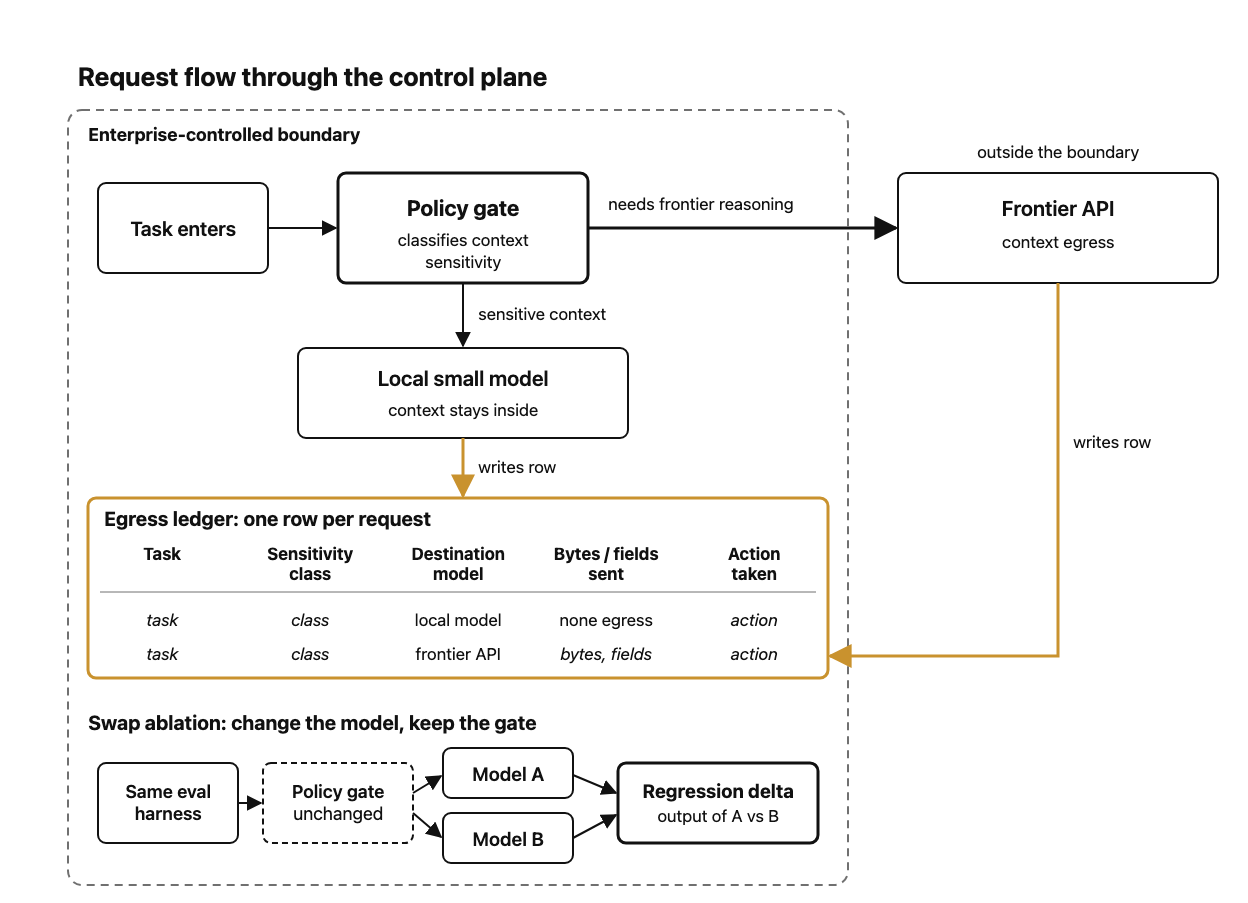
The egress ledger, with a 2x2 ablation. For every task in a pilot workflow, log which context fields your harness sent to the rented model, tagged by data class, next to output quality on a held-out eval set and the actions the agent proposed. Then run four arms: {rented frontier model, in-boundary model} × {full context, minimized or redacted context}. If the frontier model holds quality on minimized context, rent it; little crosses the boundary. If only full context works, either route the task inside, assuming the in-boundary model clears your bar, or record it as an explicit risk acceptance naming the data classes exposed. The context conflict stops being a debate and becomes a share: what fraction of high-value tasks actually require restricted data to leave? "Rent" becomes a measured row per task, not a default. This is Nadella's "if it can't be observed, it can't be trusted!" made operational.
The swap ablation, plus an ownership check. Hold the policy layer and eval harness fixed, swap the model behind them, rerun, and measure the regression. Large regressions mean you haven't earned interchangeability yet. Then ask three blunt questions. Could you replace your enforcement vendor without losing the evidence log? Can someone outside the model provider pause a task mid-run, the "emergency brake" the essay asks for? Does your test suite cover "failures, attacks, edge cases," per his verifiability principle, or only happy paths? Any "no" means you're renting the control plane too.
What this argument doesn't prove
The industry numbers that get attached to this topic are sentiment, not evidence of a fix. The 2026 Agentic AI Security Report, covered by Security Boulevard in April, found 97% of 300 enterprise leaders expect a major AI-agent security incident within the year. That's a survey of expectations, not an incident rate. shattered.io's June 11 aggregation headlines a $4.7M average breach cost, and I couldn't check the methodology behind it. Both measure anxiety. Neither shows that an enterprise-owned control plane reduces incidents, and I haven't seen a study that does.
I also haven't found a serious published rebuttal yet. Four days in, that says more about timing than about the argument.
So here's the thesis at its honest strength: a design direction with two measurable preconditions, low required egress and cheap model swaps. Where both hold, rent the intelligence, own the control plane. Where they don't, you know exactly what you're conceding.
Two questions stay open as of October 2026. Can a task's intent be specified deterministically enough for action-level policy to check it, without handing that check to another model and rebuilding the nested black boxes? And when agents from two enterprises interact, each behind its own control plane, whose policy governs the exchange, and whose log is the evidence of record? The essay calls for containment standards and proposes none. Whoever answers those two questions gets to define the category.
— Gaurav
Responses