A Complete Guide to Implementing Streaming RAG
A Complete Guide to Implementing Streaming RAG
As enterprises embrace real-time data flows — such as live sensor readings, continuous social media feeds, or ongoing financial… -
A Complete Guide to Implementing Streaming RAG
As enterprises embrace real-time data flows — such as live sensor readings, continuous social media feeds, or ongoing financial transactions — the need arises for AI systems that can quickly adapt to incoming information. Streaming Retrieval-Augmented Generation (Streaming RAG) extends the traditional RAG paradigm to support continuous data ingestion, on-the-fly updates, and low-latency reasoning over evolving data streams.
This guide outlines architectural patterns, technology stacks, performance considerations, and operational best practices. It aims to help architects, engineering leads, and senior engineers build scalable, responsive, and high-availability systems that incorporate real-time data into their retrieval, reasoning, and generation pipelines.
Core Concepts of Streaming RAG
Unlike static or batch-processed RAG setups, Streaming RAG deals with data that arrives continuously. Instead of relying on periodic batch updates or static indexes, it integrates with streaming platforms and incremental indexing strategies: - Continuous Retrieval: Automatically update retrieval indexes as new data arrives, maintaining a near-real-time view of the data domain. - Incremental Reasoning: Adapt reasoning modules to handle partially updated context, reacting to new events or signals as they occur. - Dynamic Generation: Produce responses that reflect the latest available information, ensuring answers remain timely and relevant.
For example, a streaming market intelligence system could continuously ingest stock price updates and news feeds. A Streaming RAG would retrieve the latest financial articles, reason over current market trends, and generate insights that reflect up-to-the-minute market conditions.
Architectural Patterns & Data Flow
Reference Architecture:
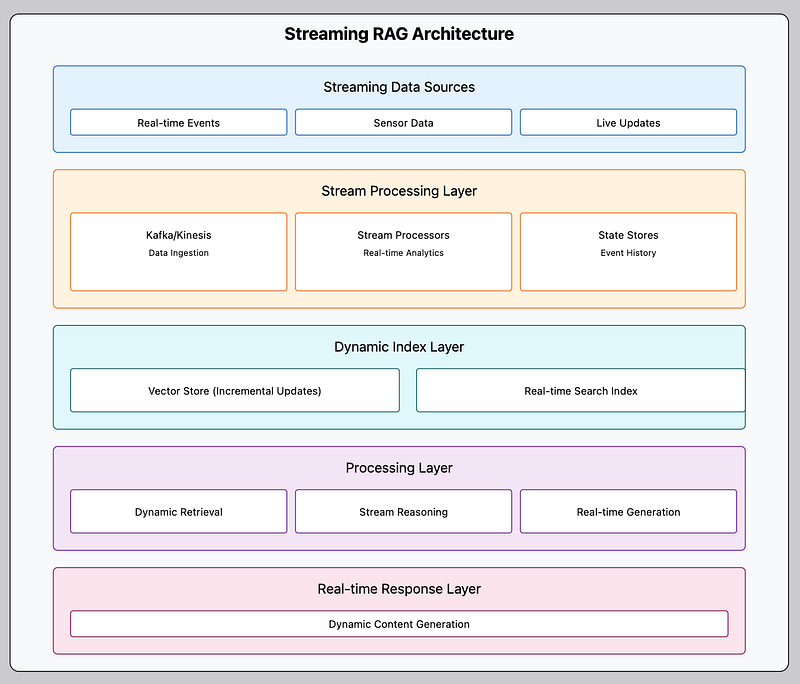
Streaming RAG
#### Data Flow:
1. Incoming Query: A user requests information that depends on real-time data. 2. Continuous Updates: Data flows in from streaming sources (e.g., Apache Kafka, Kinesis), updating retrieval indexes and context stores incrementally. 3. Dynamic Retrieval: The Retrieval Module fetches the latest relevant documents or embeddings from an incrementally updated index. 4. Adaptive Reasoning: The Reasoning Module processes the dynamically changing context, reconciling older and newer information. 5. On-Demand Generation: The Generation Module produces responses that reflect the most up-to-date state of the world. 6. Response Delivery: The final answer, informed by continuous data streams, is returned to the user.
Streaming Ingestion & Indexing
Key Technologies: - Message Queues/Streams: Apache Kafka, Amazon Kinesis, or Google Pub/Sub for ingesting data in near real time. - Incremental Indexing: Update vector databases (e.g., Pinecone, Weaviate) or search engines (e.g., Elasticsearch) as new documents arrive. - Change Data Capture (CDC): Track changes in upstream databases and propagate them to retrieval indexes.
Example Implementation:
`
class StreamingIngestionPipeline:
def \_\_init\_\_(self, stream\_config: Dict):
self.consumer = KafkaConsumer(\\stream\_config)
async def run(self, index\_updater):
\# Continuously read messages from Kafka
async for message in self.consumer:
doc = self.\_parse\_message(message)
await index\_updater.update\_index(doc)
`
Retrieval Module for Streaming Data
The Retrieval Module must handle dynamic indexes: - Incremental Updates: Insert, update, or delete documents as they stream in. - Real-Time Relevance: Continuously re-rank or re-score documents to ensure queries return the freshest, most relevant data. - Low Latency: Use in-memory caches or approximate nearest neighbor (ANN) solutions for ultra-fast lookups.
`
class StreamingRetrievalModule:
def \_\_init\_\_(self, vector\_store):
self.vector\_store = vector\_store
async def retrieve(self, query: str, top\_k: int = 5) -> List\[Dict\]:
query\_embedding = self.\_embed(query)
results = await self.vector\_store.similarity\_search(query\_embedding, top\_k)
return results
`
Reasoning with Continuously Updated Context
The Reasoning Module adapts to a changing knowledge landscape: - Context Windows: Manage a sliding window of recent data points. - Conflict Resolution: If newer data contradicts older insights, favor recent or more authoritative sources. - Streaming Reasoning Models: Consider fine-tuning language models to handle evolving context, or maintain memory modules that continuously refresh their content.
`
class StreamingReasoningModule:
async def process\_context(self, retrieved\_docs: List\[Dict\], current\_state: Dict) -> Dict:
\# Combine new docs with current state
updated\_context = self.\_merge\_current\_state(current\_state, retrieved\_docs)
\# Apply domain logic to interpret changing signals insights = self.\_derive\_insights(updated\_context)
return {"insights": insights, "state": updated\_context}
`
Generation Module: Always Current Responses
The Generation Module produces responses that reflect the most recent data: - Prompt Templates: Incorporate timestamps or version info to clarify recency. - Temporal Awareness: The LLM can reference “just now” or “as of the latest event” to indicate freshness. - Post-Processing: Validate that the generated response is consistent with the latest updates. If the data changed mid-generation, consider re-running generation steps.
`
class StreamingGenerationModule:
async def generate(self, reasoning\_output: Dict) -> str:
prompt = self.\_build\_prompt(reasoning\_output\["insights"\])
response = await self.llm.generate(prompt, parameters={"max\_length": 1500})
return response
`
Performance and Scalability
Throughput & Latency: - Scale ingestion pipelines by adding more Kafka partitions or Kinesis shards. - Use horizontal scaling for vector stores or search indexes to handle increasing data volumes.
Caching & Precomputation: - Cache frequently accessed query embeddings or partial reasoning results. - Precompute embeddings for incoming documents asynchronously to reduce query-time overhead.
Load Balancing: - Deploy multiple retrieval nodes and reasoning modules behind a load balancer. - Consider event-driven architectures for elasticity (e.g., auto-scaling pods with Kubernetes).
Monitoring, Observability, and Maintenance
Metrics: - Ingestion Rate: Track the volume of incoming documents per second. - Index Latency: Measure how quickly new documents become searchable after ingestion. - Freshness Metrics: Assess how recently retrieved documents have been updated.
Logging & Tracing: - Log all ingestion events, including timestamps and document IDs. - Trace queries from ingestion through retrieval and reasoning to identify bottlenecks.
Automated Maintenance: - Periodically prune outdated data or apply retention policies. - Re-index or compaction tasks can run during low-traffic periods to maintain index health.
Security and Compliance
Data Integrity: - Validate incoming data streams to prevent injection of malicious content. - Consider cryptographic signatures or checksums for data authenticity.
Access Controls: - Enforce RBAC/ABAC to limit who can produce or consume streams. - Restrict queries from unauthorized users who might access sensitive, real-time data.
Compliance: - If dealing with regulated data (e.g., financial or healthcare), ensure streaming pipelines respect data privacy laws. - Implement data minimization strategies to avoid storing unnecessary data over time.
Common Challenges and Solutions
Late-Arriving Data: Challenge: Some relevant information arrives after the initial query. Solution: Consider partial updates or delayed finalization of answers, or allow clients to re-query after a brief interval.
Data Drift: Challenge: Continuous streams may change the domain dynamics quickly. Solution: Regularly retrain embeddings or fine-tune reasoning models to handle evolving vocabularies and topics.
Spikes in Data Volume: Challenge: Sudden surges can overwhelm ingestion or retrieval layers. Solution: Implement rate-limiting, backpressure mechanisms, and auto-scaling policies.
Lifecycle Management & MLOps Integration
Model Versioning & Registries: Track changes in embeddings or LLM fine-tuning as data patterns evolve.
CI/CD Pipelines: Automate deployment of updated model checkpoints or indexing logic as streaming conditions change.
Continuous Data & Pipeline Management: Integrate DataOps practices to monitor data quality. Set alerts for unusual ingestion rates, outdated schemas, or embeddings needing refresh.
Example Use Cases
Financial Market Analytics: - Continuously ingest stock ticks and news headlines. - Provide near-real-time summaries of market sentiment and price movements.
E-commerce Personalization: - Stream user activity, product updates, and inventory changes. - Generate dynamic recommendations that reflect current availability and popularity.
IoT Monitoring & Alerts: - Process sensor data from industrial equipment. - Reason about device states and generate on-the-fly maintenance suggestions. -
Conclusion
Streaming RAG complements RAG architectures by incorporating continuous data ingestion and near-real-time updates. By adopting the architectural patterns, incremental indexing strategies, performance optimizations, and compliance measures discussed in this guide, engineering teams can build systems that remain perpetually fresh, accurate, and responsive. Streaming RAG unlocks dynamic, time-sensitive use cases and enables enterprises to capitalize on the full potential of their continuously evolving data ecosystems.
> For additional details on other type of RAGs, navigate to — [A Complete Guide to Retrieval-Augmented Generation (RAG): 16 Different Types, Their Implementation, and Use Cases](https://medium.com/aingineer/a-complete-guide-to-retrieval-augmented-generation-rag-16-different-types-their-implementation-10d48248517b)
— Gaurav
Responses