A Comprehensive Guide to Implementing Modular RAG for Scalable AI Systems
A Comprehensive Guide to Implementing Modular RAG for Scalable AI Systems
An In-Depth Guide for Engineering Teams -
A Comprehensive Guide to Implementing Modular RAG for Scalable AI Systems
An In-Depth Guide for Engineering Teams
In the rapidly evolving landscape of AI, Modular RAG (Retrieval-Augmented Generation) has emerged as a transformative approach to building robust, scalable, and adaptable AI systems. By decoupling retrieval, reasoning, and generation into independent modules, Modular RAG empowers engineering leaders, architects, and senior engineers to design systems that are not only efficient but also flexible enough to meet the dynamic demands of modern enterprises.
This guide aims to provide an in-depth exploration of Modular RAG, from its foundational principles to practical implementation strategies, tailored for professionals with a keen interest in scaling enterprise AI systems.
#### What is Modular RAG?
Modular RAG is an architectural paradigm that separates the core components of Retrieval-Augmented Generation into three independent modules:
1. Retrieval: Fetches relevant data from large, unstructured datasets. 2. Reasoning: Processes and contextualizes retrieved information for deeper understanding. 3. Generation: Produces coherent and contextually relevant outputs.
The modular approach offers several advantages over traditional monolithic systems: - Flexibility: Each component can be optimized or replaced independently. - Scalability: Simplifies horizontal and vertical scaling to handle increased workloads. - Customizability: Facilitates domain-specific optimizations for enhanced performance.
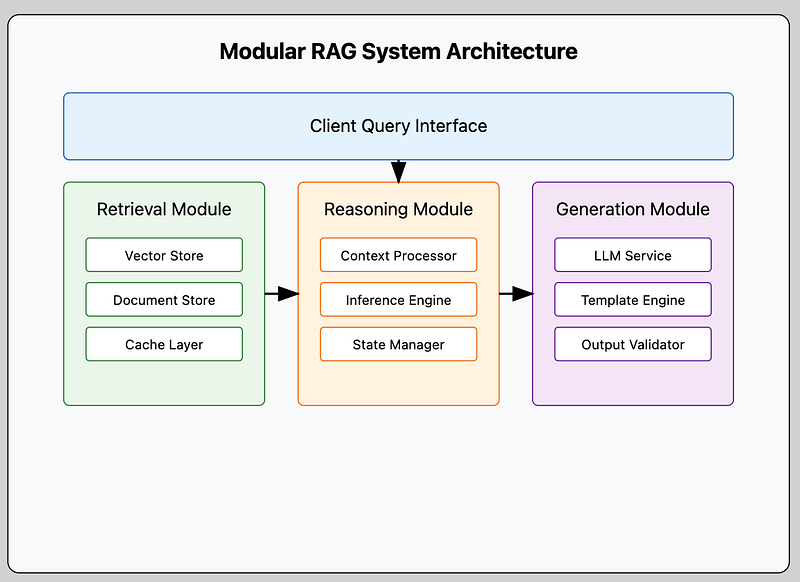
System architecture
#### Benefits of Modular RAG for Enterprise AI
Enterprises are increasingly adopting Modular RAG due to its alignment with key business and technical objectives:
1. Agility in Development: The decoupled architecture supports iterative development and experimentation without disrupting other components. 2. Collaboration Across Teams: Teams can focus on specific modules, accelerating development cycles. 3. Simplified Maintenance: Modular design makes troubleshooting, debugging, and upgrades more straightforward. 4. Seamless Integration: New capabilities or third-party tools can be integrated without rearchitecting the entire system.
#### Core Principles of Modular RAG
1\. Component Independence
Each module should have clear interfaces and operate autonomously. For instance, retrieval mechanisms can be powered by vector search engines like Elasticsearch, while the reasoning module may use transformer-based models for contextual understanding.
2\. Interoperability
Modules must communicate seamlessly using standard protocols or APIs, ensuring compatibility across diverse tech stacks.
3\. Scalability
Design with scalability in mind by leveraging cloud-native services, containerization, and load balancers.
4\. Customizability
Implement mechanisms to fine-tune modules for domain-specific requirements, such as using custom embeddings for retrieval or training bespoke generation models. -
#### Step-by-Step Guide to Implementing Modular RAG
Step 1: Define Use Cases and Objectives
Start by identifying the specific goals of your system. Is it customer support, knowledge management, or content generation? This will influence module design and optimization priorities.
Step 2: Design the Modular Architecture
Develop a high-level architecture that separates retrieval, reasoning, and generation. Here’s an example:
1. Retrieval Layer: Use tools like FAISS, Pinecone, or Weaviate to handle vectorized search efficiently. 2. Reasoning Layer: Incorporate models such as OpenAI’s GPT-4 or fine-tuned transformers for contextual understanding. 3. Generation Layer: Deploy language models fine-tuned for your domain to generate high-quality outputs.
Step 3: Select the Technology Stack
Choose technologies that align with your use case and scalability requirements: - Retrieval: Vector databases, Elasticsearch, Pinecone. - Reasoning: Hugging Face transformers, LangChain, OpenAI APIs. - Generation: GPT models, T5, or domain-specific language models.
Step 4: Build Independent Modules
Develop and test each module independently. Use synthetic datasets or benchmarks for validation.
1. Retrieval: Implement and test search capabilities with a focus on precision and recall. 2. Reasoning: Fine-tune transformers to process and contextualize data effectively. 3. Generation: Train or fine-tune a generative model to meet output quality requirements.
Step 5: Integrate Modules
Connect the modules via well-defined APIs. Ensure smooth data flow and low latency between components.
Step 6: Optimize for Performance
Conduct performance testing and optimize bottlenecks. For example: - Use caching strategies in the retrieval module. - Optimize inference latency in the reasoning and generation modules using quantization or hardware acceleration.
Step 7: Implement Monitoring and Maintenance
Set up monitoring tools to track system performance and health. Metrics might include response time, accuracy, and user satisfaction.
#### Implementation Details
1. Retrieval Module
`
from typing import Dict, List
import faiss
import numpy as np
from redis import Redis
from elasticsearch import Elasticsearch
class RetrievalModule: def \_\_init\_\_(self, config: Dict): self.vector\_store = self.\_init\_vector\_store(config) self.document\_store = self.\_init\_document\_store(config) self.cache = self.\_init\_cache(config)
def \_init\_vector\_store(self, config): \# Initialize FAISS index dimension = config\['embedding\_dim'\] index = faiss.IndexHNSWFlat(dimension, config\['n\_links'\]) return index
def \_init\_document\_store(self, config): \# Initialize Elasticsearch es = Elasticsearch(\[config\['es\_host'\]\]) return es
def \_init\_cache(self, config): \# Initialize Redis cache redis = Redis( host=config\['redis\_host'\], port=config\['redis\_port'\], db=config\['redis\_db'\] ) return redis
async def retrieve(self, query: str, top\_k: int = 5) -> List\[Dict\]: \# Check cache first cache\_key = f"query:{hash(query)}" if cached :\= self.cache.get(cache\_key): return cached
\# Get vector embedding for query query\_vector = self.\_get\_embedding(query)
\# Search vector store D, I = self.vector\_store.search(query\_vector, top\_k)
\# Fetch documents from document store results = \[\] for idx in I\[0\]: doc = self.document\_store.get(id=idx) results.append(doc)
\# Cache results self.cache.setex( cache\_key, timedelta(minutes=30), json.dumps(results) )
return results
`
2\. Reasoning Module
`
from transformers import AutoModelForSequenceClassification, AutoTokenizer
import torch
class ReasoningModule: def \_\_init\_\_(self, config: Dict): self.model = self.\_load\_model(config) self.tokenizer = self.\_load\_tokenizer(config) self.state\_manager = StateManager(config)
def \_load\_model(self, config): model = AutoModelForSequenceClassification.from\_pretrained( config\['model\_name'\], device\_map='auto' ) return model
def process(self, retrieved\_docs: List\[Dict\], query: str) -> Dict: \# Combine retrieved docs with query context = self.\_prepare\_context(retrieved\_docs, query)
\# Get model inference inputs = self.tokenizer( context, return\_tensors='pt', truncation=True, max\_length=512 )
with torch.no\_grad(): outputs = self.model(\\inputs)
\# Process outputs processed\_results = self.\_process\_outputs(outputs)
\# Update state self.state\_manager.update(processed\_results)
return processed\_results
`
3\. Generation Module
`
from transformers import AutoModelForCausalLM, AutoTokenizer
import torch
class GenerationModule: def \_\_init\_\_(self, config: Dict): self.model = self.\_init\_model(config) self.tokenizer = self.\_init\_tokenizer(config) self.validator = OutputValidator(config)
def generate(self, context: Dict, max\_length: int = 512) -> str: \# Prepare prompt template prompt = self.\_prepare\_prompt(context)
\# Generate response inputs = self.tokenizer( prompt, return\_tensors='pt', truncation=True )
outputs = self.model.generate( \\inputs, max\_length=max\_length, num\_beams=4, temperature=0.7, no\_repeat\_ngram\_size=3 )
response = self.tokenizer.decode(outputs\[0\])
\# Validate output validated\_response = self.validator.validate(response)
return validated\_response
`
4\. Monitoring and Observability
`
from prometheus\_client import Counter, Histogram
import logging
class MetricsCollector: def \_\_init\_\_(self): \# Latency metrics self.retrieval\_latency = Histogram( 'retrieval\_latency\_seconds', 'Time spent in retrieval module' ) self.reasoning\_latency = Histogram( 'reasoning\_latency\_seconds', 'Time spent in reasoning module' ) self.generation\_latency = Histogram( 'generation\_latency\_seconds', 'Time spent in generation module' )
\# Error metrics self.retrieval\_errors = Counter( 'retrieval\_errors\_total', 'Total retrieval errors' )
\# Cache metrics
self.cache\_hits = Counter(
'cache\_hits\_total',
'Total cache hits'
)
`
5\. Load Testing and Configuration
`
import locust
class ModularRAGUser(HttpUser): @task def query\_rag(self): payload = { "query": "What is modular RAG?", "max\_length": 512 }
with self.client.post(
"/api/v1/query",
json=payload,
catch\_response=True
) as response:
if response.status\_code == 200:
response.success()
else:
response.failure(
f"Failed with status code: {response.status\_code}"
)
`
6\. Deployment architecture
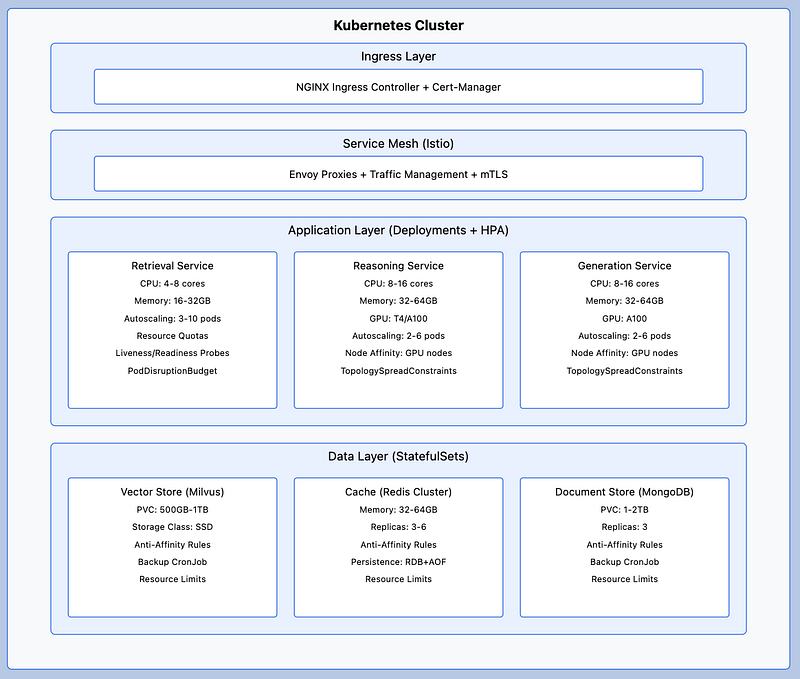
Suggested Deployment architecture
#### Security Considerations
Implementing Modular RAG requires a proactive approach to security, ensuring the protection of sensitive data and safeguarding system integrity. Here are key considerations:
1\. Data Security: - Encrypt data both in transit (e.g., using TLS 1.3) and at rest (e.g., AES-256). - Implement role-based access control (RBAC) to restrict module access and ensure sensitive information is masked before processing.
2\. API Protection: - Use authentication mechanisms like OAuth 2.0 or API tokens to secure communication between modules. - Implement input validation and rate limiting to prevent injection and abuse attacks.
3\. Monitoring and Incident Response: - Set up real-time monitoring for unusual activity, such as abnormal query patterns. - Use tools like Prometheus or Splunk to aggregate and analyze logs for potential threats.
4\. Module-Specific Safeguards: - In retrieval, sanitize inputs to prevent adversarial attacks on vector or document stores. - In generation, validate outputs to avoid sensitive or inappropriate content leakage.
5\. Privacy Compliance: - Ensure the system complies with privacy regulations like GDPR or CCPA by processing only necessary data and maintaining user consent mechanisms.
6\. Secure Deployment: - Use containerization and network segmentation to isolate modules. - Follow zero-trust principles to minimize unauthorized access risks.
#### Common Challenges and Solutions
While Modular RAG offers significant advantages, implementing it effectively requires addressing common challenges. Here’s an expanded look at these challenges and actionable solutions:
1\. Data Silos
Challenge: Data is often scattered across different systems, formats, or departments, leading to inefficiencies in retrieval and reasoning.
Solution: - Implement a unified data lake to consolidate structured and unstructured data, enabling seamless access and processing. - Use federated search mechanisms to query disparate data sources in real-time without duplicating data. - Employ data integration tools (e.g., Apache Kafka, Apache Nifi) to streamline ingestion and synchronization across systems.
2\. Latency Issues
Challenge: High response times can degrade user experience, especially in time-sensitive applications.
Solution: - Use asynchronous processing to decouple tasks and reduce wait times for critical components. - Incorporate caching layers (e.g., Redis, Memcached) to store frequently accessed data and reduce retrieval overhead. - Deploy content delivery networks (CDNs) for faster distribution of large static datasets. - Optimize models using quantization or pruning to reduce inference latency.
3\. Model Drift
Challenge: Over time, models can become less accurate as they are exposed to new or evolving data.
Solution: - Establish regular retraining pipelines with automated triggers based on model performance metrics or data changes. - Use continual learning frameworks to update models incrementally without requiring full retraining. - Monitor drift with tools that compare model predictions against real-world outcomes (e.g., Explainable AI frameworks or custom validation scripts).
4\. Scaling Bottlenecks
Challenge: Increasing system demands can overwhelm individual components, impacting performance and reliability.
Solution: - Use container orchestration platforms like Kubernetes to automate horizontal scaling of modules. - Optimize load balancing with tools like NGINX or Traefik to distribute traffic evenly across modules. - Leverage serverless architectures for generation or reasoning modules to handle sporadic traffic spikes efficiently. - Implement multi-cloud strategies to ensure redundancy and scalability across different geographic regions.
#### Applications of Modular RAG in Enterprises
1. Customer Support Automation: Deliver accurate, context-aware responses to customer queries. 2. Knowledge Management: Extract, summarize, and contextualize information from vast repositories. 3. Content Creation: Generate domain-specific marketing or technical content with high quality. 4. Healthcare and Legal Industries: Provide quick access to domain-specific knowledge, improving decision-making.
#### Best Practices for Modular RAG Implementation
1\. Adopt a Microservices Approach: Deploy each module as an independent service for flexibility and maintainability.
2\. Leverage Cloud-Native Tools: Use services like AWS SageMaker or GCP Vertex AI for scalability and efficiency.
3\. Integrate Feedback Loops: Continuously improve modules by incorporating user feedback and retraining models.
4\. Ensure Data Security: Implement encryption, access controls, and governance frameworks.
Conclusion
Modular RAG’s modularity, scalability, and flexibility make it an ideal choice for enterprises seeking to harness the power of AI while maintaining adaptability and control.
By following the principles and steps outlined in this guide, architects and engineering leaders can build systems that are not only effective today but also ready to scale and evolve for the challenges of tomorrow. Whether you are embarking on your first AI project or scaling an existing system, Modular RAG offers a roadmap to success in the era of intelligent systems.
> For additional details on other type of RAGs, navigate to — [A Complete Guide to Retrieval-Augmented Generation (RAG): 16 Different Types, Their Implementation, and Use Cases](https://medium.com/aingineer/a-complete-guide-to-retrieval-augmented-generation-rag-16-different-types-their-implementation-10d48248517b)
— Gaurav
Responses