A Comprehensive Reference Guide to Building Agentic AI Systems
A Comprehensive Reference Guide to Building Agentic AI Systems
As artificial intelligence (AI) continues to evolve, the focus is shifting from passive models to agentic AI — systems capable of… -
A Comprehensive Reference Guide to Building Agentic AI Systems
As artificial intelligence (AI) continues to evolve, the focus is shifting from passive models to agentic AI — systems capable of autonomous decision-making, planning, and execution. These systems leverage a combination of memory, tools, and sophisticated planning mechanisms to solve complex problems dynamically. For senior engineers and architects venturing into AI agent development, understanding the foundational components of agentic AI is essential.
Why Agentic AI?
Traditional AI models, while powerful, often operate within predefined boundaries, generating outputs reactively based on input prompts. Agentic AI, however, moves beyond this by embedding planning, reflection, and goal-oriented action. This paradigm opens the door to building AI that can: - Break down complex tasks into subgoals. - Adapt and iterate based on feedback loops. - Utilize external tools (e.g., calculators, code interpreters) to enhance functionality. - Retain and apply knowledge through short-term and long-term memory.
Architecture Component of Agentic System
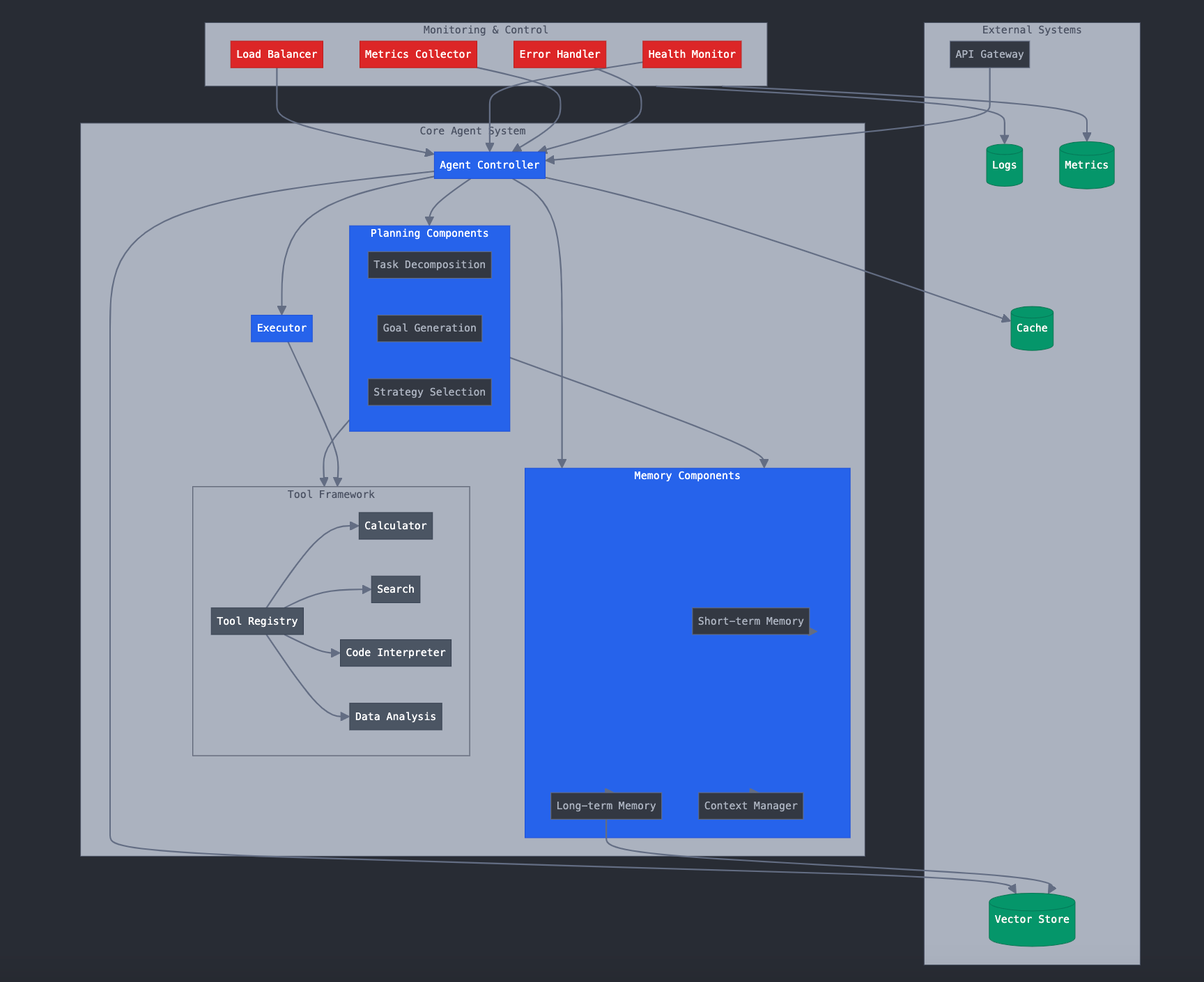
Core Component Architecture
Core Components of Agentic Systems
The architecture of agentic AI revolves around several key components, as illustrated in IBM’s conceptual diagram:
#### 1\. Memory
Memory forms the backbone of agentic AI, enabling systems to recall past interactions and experiences. This memory is categorized into: - Short-term memory: Facilitates immediate context retention. - Long-term memory: Stores persistent knowledge for extended problem-solving capabilities.
Memory not only enhances continuity across sessions but also allows agents to learn and evolve over time.
#### 2\. Tools
Agentic AI leverages external tools to extend its capabilities. Common tools include: - Calculators for numerical tasks. - Code interpreters for executing and debugging scripts. - Search engines to fetch real-time information. - Calendars to manage scheduling tasks.
With tools, agents can perform actions beyond their internal logic, increasing flexibility and accuracy.
#### 3\. Planning
Planning enables agents to outline tasks, set goals, and break problems into manageable steps. Planning in agentic AI often incorporates: - Reflection: Reviewing past decisions to refine approaches. - Self-criticism: Allowing the agent to assess and correct errors. - Chain of thoughts: Building a sequential thought process for complex reasoning. - Subgoal decomposition: Dividing overarching goals into smaller, actionable steps.
#### 4\. Action
Once planning is complete, the agent proceeds to execute tasks, interacting with tools and refining its actions as necessary. The action phase may involve iterative loops, where the agent reviews outcomes and re-engages in planning.
#### Execution Flow
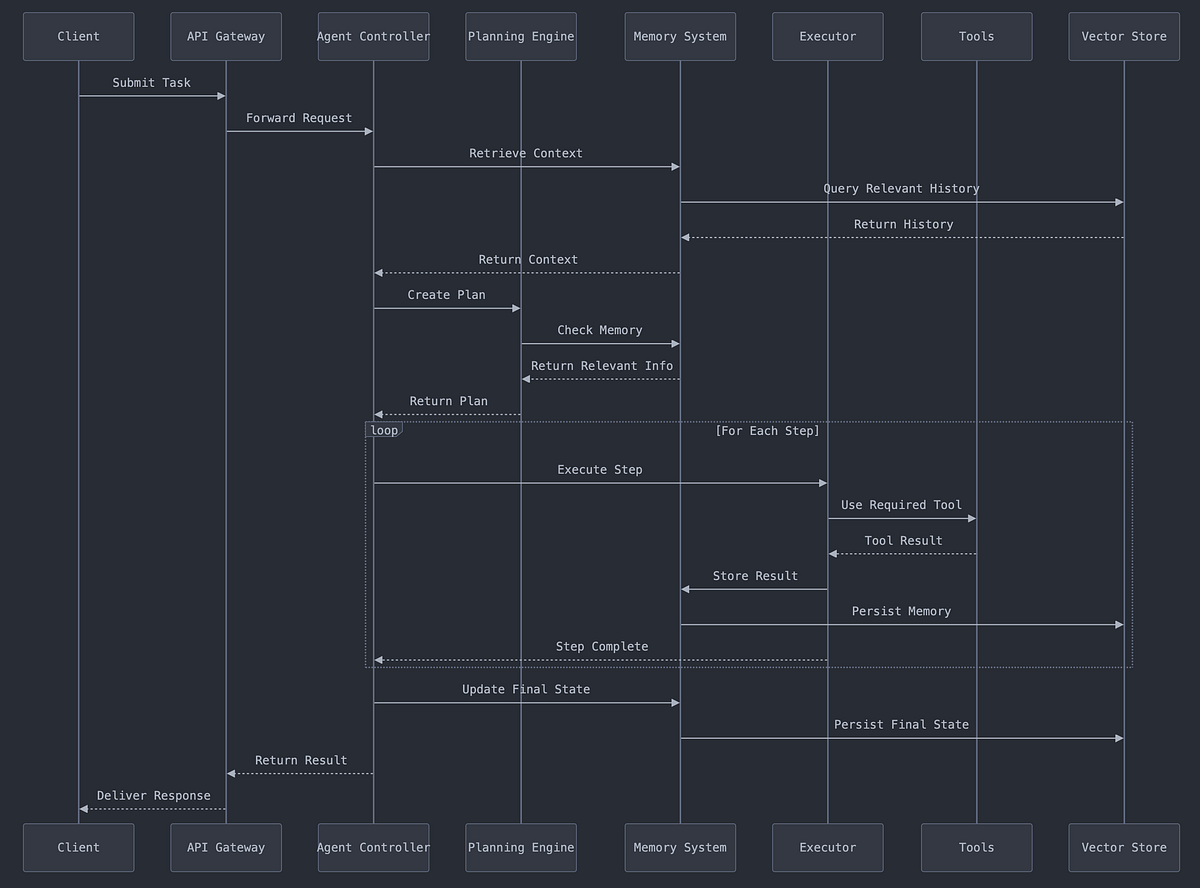
Execution Flow
Promising Architectures for Agentic AI
Several architectures stand out as promising frameworks for building agentic AI:
1. ReAct (Reasoning + Acting) Framework: This framework synergizes reasoning and acting steps, allowing agents to iteratively think and execute actions. It is particularly effective for tasks requiring multi-step problem-solving and tool use. 2. LangGraph (Evolution of LangChain): LangGraph facilitates the development of AI agents by structuring workflows into directed graphs, allowing branching decisions and complex task orchestration. It builds upon LangChain’s foundation but introduces enhanced capabilities for agentic workflows. 3. AutoGPT/AgentGPT Architectures: These architectures focus on recursive task decomposition and automation. AutoGPT agents can autonomously set goals, decompose tasks, and execute them iteratively.
Implementation Details
#### 1\. Memory Systems
Memory in agentic AI requires careful implementation across multiple layers:
#### Short-term Memory (Working Memory)
`
from langchain.memory import ConversationBufferMemory, ConversationBufferWindowMemory
\# For recent context retention
short\_term\_memory = ConversationBufferWindowMemory(
k=5, \# Keep last 5 interactions
return\_messages=True,
memory\_key="chat\_history",
input\_key="input",
output\_key="output"
)
`
#### Long-term Memory (Persistent Storage)
`
from langchain.vectorstores import Chroma
from langchain.embeddings import OpenAIEmbeddings
\# Initialize vector store embeddings = OpenAIEmbeddings() vectorstore = Chroma( collection\_name="agent\_memory", embedding\_function=embeddings, persist\_directory="./memory" )
\# Store and retrieve memories def store\_memory(text: str, metadata: dict): vectorstore.add\_texts( texts=\[text\], metadatas=\[metadata\] )
def retrieve\_relevant\_memories(query: str, k: int = 3):
return vectorstore.similarity\_search(query, k=k)
`
#### Memory Management Best Practices - Implement periodic memory consolidation - Use relevance scoring for memory retrieval - Handle context window limitations - Implement memory cleanup for outdated information
#### 2\. Tool Integration Framework
Tools should be implemented with proper error handling and validation:
`
from typing import Protocol, Dict, Any
from pydantic import BaseModel, Field
class ToolInterface(Protocol): def execute(self, inputs: Dict\[str, Any\]) -> Dict\[str, Any\]: """Execute tool functionality""" pass
class CalculatorTool(BaseModel): name: str = Field(default="calculator") description: str = Field(default="Performs mathematical calculations")
def execute(self, inputs: Dict\[str, Any\]) -> Dict\[str, Any\]: try: expression = inputs.get("expression") if not expression: raise ValueError("No expression provided")
\# Safe eval implementation import ast import operator
operators = { ast.Add: operator.add, ast.Sub: operator.sub, ast.Mult: operator.mul, ast.Div: operator.truediv }
def eval\_expr(node): if isinstance(node, ast.Num): return node.n elif isinstance(node, ast.BinOp): op = operators.get(type(node.op)) if not op: raise ValueError("Unsupported operation") return op(eval\_expr(node.left), eval\_expr(node.right)) else: raise ValueError("Invalid expression")
tree = ast.parse(expression, mode='eval') result = eval\_expr(tree.body)
return {"result": result}
except Exception as e:
return {"error": str(e)}
`
#### 3\. Planning and Execution Framework
Implementing a robust planning system using the ReAct framework:
`
from typing import List, Optional
from pydantic import BaseModel
class Action(BaseModel): tool: str input: Dict\[str, Any\] thought: str
class Plan(BaseModel): goal: str steps: List\[Action\] current\_step: int = 0 status: str = "pending"
class PlanningAgent: def \_\_init\_\_(self, tools: Dict\[str, ToolInterface\], llm): self.tools = tools self.llm = llm self.memory = ConversationBufferMemory()
def create\_plan(self, goal: str) -> Plan: \# Generate plan using LLM prompt = self.\_create\_planning\_prompt(goal) response = self.llm.predict(prompt)
\# Parse response into structured plan actions = self.\_parse\_actions(response) return Plan(goal=goal, steps=actions)
def execute\_plan(self, plan: Plan) -> Dict\[str, Any\]: results = \[\]
for step in plan.steps: try: \# Execute tool tool = self.tools.get(step.tool) if not tool: raise ValueError(f"Tool {step.tool} not found")
result = tool.execute(step.input)
\# Store result in memory self.memory.save\_context( {"input": step.input}, {"output": result} )
results.append(result)
except Exception as e: return { "error": str(e), "step": step.dict(), "results\_so\_far": results }
return {"results": results}
`
Real-world Implementation Considerations
#### 1\. Error Handling and Reliability
Implement comprehensive error handling:
`
class AgentError(Exception):
"""Base exception for agent-related errors"""
pass
class ToolExecutionError(AgentError): """Raised when a tool execution fails""" pass
class PlanningError(AgentError): """Raised when plan creation or execution fails""" pass
def safe\_execute\_tool(tool: ToolInterface, inputs: Dict\[str, Any\]) -> Dict\[str, Any\]:
try:
return tool.execute(inputs)
except Exception as e:
raise ToolExecutionError(f"Tool execution failed: {str(e)}")
`
#### 2\. Performance Optimization
Implement caching and optimization strategies:
`
from functools import lru\_cache
from typing import Optional
import time
class CachedTool: def \_\_init\_\_(self, tool: ToolInterface, cache\_ttl: int = 3600): self.tool = tool self.cache\_ttl = cache\_ttl self.\_cache = {}
@lru\_cache(maxsize=1000) def execute(self, inputs: Dict\[str, Any\]) -> Dict\[str, Any\]: cache\_key = str(inputs) current\_time = time.time()
\# Check cache if cache\_key in self.\_cache: result, timestamp = self.\_cache\[cache\_key\] if current\_time - timestamp < self.cache\_ttl: return result
\# Execute and cache
result = self.tool.execute(inputs)
self.\_cache\[cache\_key\] = (result, current\_time)
return result
`
#### 3\. Scaling Considerations
Implement rate limiting and concurrency control:
`
import asyncio
from typing import List
from async\_timeout import timeout
class ScalableAgent: def \_\_init\_\_(self, max\_concurrent: int = 5, timeout\_seconds: int = 30): self.semaphore = asyncio.Semaphore(max\_concurrent) self.timeout\_seconds = timeout\_seconds
async def execute\_concurrent\_actions(self, actions: List\[Action\]) -> List\[Dict\[str, Any\]\]: async def execute\_with\_timeout(action: Action) -> Dict\[str, Any\]: async with self.semaphore: async with timeout(self.timeout\_seconds): return await self.\_execute\_action(action)
return await asyncio.gather(
\*\[execute\_with\_timeout(action) for action in actions\],
return\_exceptions=True
)
`
#### 4\. Monitoring and Observability
Implement comprehensive logging and monitoring:
`
import logging
from datetime import datetime
from typing import Optional
class AgentMonitor: def \_\_init\_\_(self): self.logger = logging.getLogger("agent\_monitor") self.metrics = {}
def log\_execution( self, action\_type: str, start\_time: datetime, end\_time: datetime, status: str, error: Optional\[Exception\] = None ): duration = (end\_time - start\_time).total\_seconds()
self.logger.info({ "action\_type": action\_type, "duration": duration, "status": status, "error": str(error) if error else None, "timestamp": datetime.utcnow().isoformat() })
\# Update metrics
self.metrics\[action\_type\] = {
"count": self.metrics.get(action\_type, {}).get("count", 0) + 1,
"avg\_duration": (
self.metrics.get(action\_type, {}).get("avg\_duration", 0) \*
self.metrics.get(action\_type, {}).get("count", 0) +
duration
) / (self.metrics.get(action\_type, {}).get("count", 0) + 1)
}
`
Integration Examples
To bring this to life, let’s consider building an AI-driven research assistant using LangGraph, leveraging the ReAct framework.
#### 1\. Building a Research Assistant Agent
`
class ResearchAssistant:
def \_\_init\_\_(self):
self.tools = {
"search": SearchTool(),
"summarize": SummarizationTool(),
"extract": DataExtractionTool()
}
self.planner = PlanningAgent(self.tools, llm)
self.monitor = AgentMonitor()
async def research\_topic(self, topic: str) -> Dict\[str, Any\]: try: \# Create research plan plan = self.planner.create\_plan(f"Research {topic}")
\# Execute plan start\_time = datetime.utcnow() results = await self.planner.execute\_plan(plan) end\_time = datetime.utcnow()
\# Monitor execution self.monitor.log\_execution( action\_type="research", start\_time=start\_time, end\_time=end\_time, status="success" )
return results
except Exception as e:
self.monitor.log\_execution(
action\_type="research",
start\_time=start\_time,
end\_time=datetime.utcnow(),
status="error",
error=e
)
raise
`
Cost and Resource Considerations
#### 1\. Token Usage Optimization
`
class TokenManager:
def \_\_init\_\_(self, max\_tokens: int = 4096):
self.max\_tokens = max\_tokens
self.current\_tokens = 0
def estimate\_tokens(self, text: str) -> int: \# Rough estimation: 4 chars = 1 token return len(text) // 4
def can\_add\_text(self, text: str) -> bool: estimated\_tokens = self.estimate\_tokens(text) return (self.current\_tokens + estimated\_tokens) <= self.max\_tokens
def add\_text(self, text: str) -> bool:
if self.can\_add\_text(text):
self.current\_tokens += self.estimate\_tokens(text)
return True
return False
`
#### 2\. Resource Monitoring
`
class ResourceMonitor:
def \_\_init\_\_(self, cost\_per\_token: float = 0.0001):
self.cost\_per\_token = cost\_per\_token
self.token\_usage = 0
self.api\_calls = 0
def track\_usage(self, tokens\_used: int): self.token\_usage += tokens\_used self.api\_calls += 1
def get\_cost\_estimate(self) -> float: return self.token\_usage \* self.cost\_per\_token
def get\_usage\_report(self) -> Dict\[str, Any\]:
return {
"total\_tokens": self.token\_usage,
"total\_api\_calls": self.api\_calls,
"estimated\_cost": self.get\_cost\_estimate()
}
`
Security Best Practices
#### 1\. Input Validation
`
from pydantic import BaseModel, validator
from typing import List, Optional
class UserInput(BaseModel): query: str max\_tokens: Optional\[int\] = 1000
@validator('query') def validate\_query(cls, v): if len(v.strip()) == 0: raise ValueError("Query cannot be empty") if len(v) > 1000: raise ValueError("Query too long") return v
@validator('max\_tokens')
def validate\_max\_tokens(cls, v):
if v is not None and (v < 1 or v > 4096):
raise ValueError("max\_tokens must be between 1 and 4096")
return v
`
#### 2\. Tool Access Control
`
from enum import Enum
from typing import Set
class ToolPermission(Enum): READ = "read" WRITE = "write" EXECUTE = "execute"
class SecureTool(ToolInterface): def \_\_init\_\_(self, tool: ToolInterface, required\_permissions: Set\[ToolPermission\]): self.tool = tool self.required\_permissions = required\_permissions
def execute(self, inputs: Dict\[str, Any\], user\_permissions: Set\[ToolPermission\]) -> Dict\[str, Any\]:
if not self.required\_permissions.issubset(user\_permissions):
raise PermissionError("Insufficient permissions to execute tool")
return self.tool.execute(inputs)
`
Testing Framework
#### 1\. Unit Testing
`
import pytest
from unittest.mock import Mock, patch
def test\_planning\_agent(): \# Mock dependencies mock\_llm = Mock() mock\_tool = Mock()
\# Setup agent agent = PlanningAgent({"test\_tool": mock\_tool}, mock\_llm)
\# Test plan creation mock\_llm.predict.return\_value = "Test plan response" plan = agent.create\_plan("Test goal")
assert plan.goal == "Test goal" assert len(plan.steps) > 0
\# Test plan execution mock\_tool.execute.return\_value = {"result": "success"} result = agent.execute\_plan(plan)
assert result\["results"\]\[-1\]\["result"\] == "success"
`
#### 2\. Integration Testing
`
@pytest.mark.asyncio
async def test\_research\_assistant():
assistant = ResearchAssistant()
\# Test complete research flow result = await assistant.research\_topic("test topic")
assert "results" in result assert len(result\["results"\]) > 0
\# Test error handling
with pytest.raises(AgentError):
await assistant.research\_topic("")
`
Deployment Considerations
#### 1\. Environment Configuration
`
from pydantic import BaseSettings
class AgentConfig(BaseSettings): max\_concurrent\_actions: int = 5 memory\_ttl: int = 3600 token\_limit: int = 4096 api\_timeout: int = 30 debug\_mode: bool = False vector\_store\_path: str = "./vector\_store" log\_level: str = "INFO"
class Config: env\_prefix = "AGENT\_"
\### 2. Container Configuration
\\\`dockerfile
FROM python:3.9\-slim
\# Set working directory WORKDIR /app
\# Copy requirements COPY requirements.txt .
\# Install dependencies RUN pip install --no-cache-dir -r requirements.txt
\# Copy application code COPY . .
\# Set environment variables ENV AGENT\_MAX\_CONCURRENT\_ACTIONS=5 ENV AGENT\_MEMORY\_TTL=3600 ENV AGENT\_TOKEN\_LIMIT=4096
\# Run the application
CMD \["python", "main.py"\]
`
#### 2\. Kubernetes Deployment
`
apiVersion: apps/v1
kind: Deployment
metadata:
name: ai-agent
namespace: ai-agents
spec:
replicas: 3
selector:
matchLabels:
app: ai-agent
template:
metadata:
labels:
app: ai-agent
spec:
containers:
\- name: ai-agent
image: ai-agent:latest
resources:
requests:
memory: "1Gi"
cpu: "500m"
limits:
memory: "2Gi"
cpu: "1000m"
env:
\- name: AGENT\_MAX\_CONCURRENT\_ACTIONS
value: "5"
\- name: AGENT\_MEMORY\_TTL
value: "3600"
volumeMounts:
\- name: vector-store
mountPath: /app/vector\_store
volumes:
\- name: vector-store
persistentVolumeClaim:
claimName: vector-store-pvc
\---
apiVersion: v1
kind: Service
metadata:
name: ai-agent-service
spec:
selector:
app: ai-agent
ports:
\- port: 80
targetPort: 8080
type: LoadBalancer
`
Performance Tuning
#### 1\. Memory Optimization
`
from typing import Optional, Dict, Any
import gc
import psutil
class MemoryOptimizer: def \_\_init\_\_(self, threshold\_mb: int = 1000): self.threshold\_mb = threshold\_mb self.last\_cleanup = time.time()
def check\_memory\_usage(self) -> Dict\[str, Any\]: process = psutil.Process() memory\_info = process.memory\_info()
return { "rss": memory\_info.rss / 1024 / 1024, \# MB "vms": memory\_info.vms / 1024 / 1024, \# MB "percent": process.memory\_percent() }
async def optimize\_if\_needed(self): memory\_usage = self.check\_memory\_usage()
if memory\_usage\["rss"\] > self.threshold\_mb: await self.perform\_optimization()
async def perform\_optimization(self): \# Clear Python's garbage collector gc.collect()
\# Clear tool caches for tool in self.tools.values(): if hasattr(tool, 'clear\_cache'): tool.clear\_cache()
\# Compact memory if possible
if hasattr(gc, 'collect'):
gc.collect()
`
#### 2\. Load Balancing
`
class LoadBalancer:
def \_\_init\_\_(self, max\_workers: int = 3):
self.workers = \[\]
self.current\_index = 0
self.lock = asyncio.Lock()
for \_ in range(max\_workers): self.workers.append(AgentWorker())
async def get\_next\_worker(self) -> 'AgentWorker': async with self.lock: worker = self.workers\[self.current\_index\] self.current\_index = (self.current\_index + 1) % len(self.workers) return worker
async def process\_request(self, request: Dict\[str, Any\]) -> Dict\[str, Any\]:
worker = await self.get\_next\_worker()
return await worker.process(request)
`
Advanced Features
#### 1\. Multi-Agent Collaboration
`
class AgentTeam:
def \_\_init\_\_(self, agents: Dict\[str, 'Agent'\]):
self.agents = agents
self.coordinator = TeamCoordinator()
async def collaborate(self, task: Dict\[str, Any\]) -> Dict\[str, Any\]: \# Decompose task into subtasks subtasks = self.coordinator.decompose\_task(task)
\# Assign subtasks to agents assignments = self.coordinator.assign\_subtasks(subtasks, self.agents)
\# Execute subtasks in parallel results = await asyncio.gather(\*\[ agent.execute\_task(subtask) for agent, subtask in assignments.items() \])
\# Combine results return self.coordinator.combine\_results(results)
class TeamCoordinator: def decompose\_task(self, task: Dict\[str, Any\]) -> List\[Dict\[str, Any\]\]: \# Implementation of task decomposition logic pass
def assign\_subtasks( self, subtasks: List\[Dict\[str, Any\]\], agents: Dict\[str, 'Agent'\] ) -> Dict\['Agent', Dict\[str, Any\]\]: \# Implementation of task assignment logic pass
def combine\_results(self, results: List\[Dict\[str, Any\]\]) -> Dict\[str, Any\]:
\# Implementation of result combination logic
pass
`
#### 2\. Learning and Adaptation
`
class AdaptiveAgent:
def \_\_init\_\_(self):
self.performance\_history = \[\]
self.strategy\_weights = defaultdict(float)
self.learning\_rate = 0.1
def update\_strategy\_weights(self, strategy: str, performance: float): self.strategy\_weights\[strategy\] = ( (1 - self.learning\_rate) \* self.strategy\_weights\[strategy\] + self.learning\_rate \* performance )
def select\_strategy(self) -> str: if random.random() < 0.1: \# Exploration return random.choice(list(self.strategy\_weights.keys())) else: \# Exploitation return max( self.strategy\_weights.items(), key=lambda x: x\[1\] )\[0\]
async def execute\_with\_adaptation(self, task: Dict\[str, Any\]) -> Dict\[str, Any\]: strategy = self.select\_strategy() start\_time = time.time()
try: result = await self.execute\_strategy(strategy, task) execution\_time = time.time() - start\_time
\# Update strategy weights based on performance performance = self.calculate\_performance(result, execution\_time) self.update\_strategy\_weights(strategy, performance)
return result
except Exception as e:
self.update\_strategy\_weights(strategy, 0.0) \# Penalize failed strategy
raise
`
Maintenance and Monitoring
#### 1\. Health Checks
`
class HealthMonitor:
def \_\_init\_\_(self):
self.last\_check = time.time()
self.health\_metrics = {}
async def check\_health(self) -> Dict\[str, Any\]: current\_time = time.time()
\# Check system resources memory\_usage = psutil.virtual\_memory() cpu\_usage = psutil.cpu\_percent(interval=1)
\# Check component health component\_health = await self.check\_component\_health()
\# Update health metrics self.health\_metrics.update({ "last\_check": current\_time, "uptime": current\_time - self.last\_check, "memory\_usage": memory\_usage.percent, "cpu\_usage": cpu\_usage, "components": component\_health })
return self.health\_metrics
async def check\_component\_health(self) -> Dict\[str, str\]: health = {}
\# Check each component for component in self.components: try: await component.health\_check() health\[component.name\] = "healthy" except Exception as e: health\[component.name\] = f"unhealthy: {str(e)}"
return health
`
#### 2\. Metrics Collection
`
class MetricsCollector:
def \_\_init\_\_(self):
self.metrics = defaultdict(list)
def record\_metric( self, metric\_name: str, value: float, tags: Optional\[Dict\[str, str\]\] = None ): self.metrics\[metric\_name\].append({ "timestamp": time.time(), "value": value, "tags": tags or {} })
def get\_metrics\_summary(self) -> Dict\[str, Any\]: summary = {}
for metric\_name, values in self.metrics.items(): summary\[metric\_name\] = { "count": len(values), "mean": statistics.mean(v\["value"\] for v in values), "max": max(v\["value"\] for v in values), "min": min(v\["value"\] for v in values) }
return summary
`
Iteration and Refinement
Post-execution, the agent reflects on the accuracy of its findings, refines data extraction methods, and improves based on feedback.
Final Thoughts
Agentic AI will transform artificial intelligence, enabling systems that can reason, plan, and act independently. This guide provides a foundation for implementing such systems, but remember that each implementation may require specific adjustments based on use case requirements and constraints.
— Gaurav
Responses